|
VOOZH | about |
|
VOOZH | about |
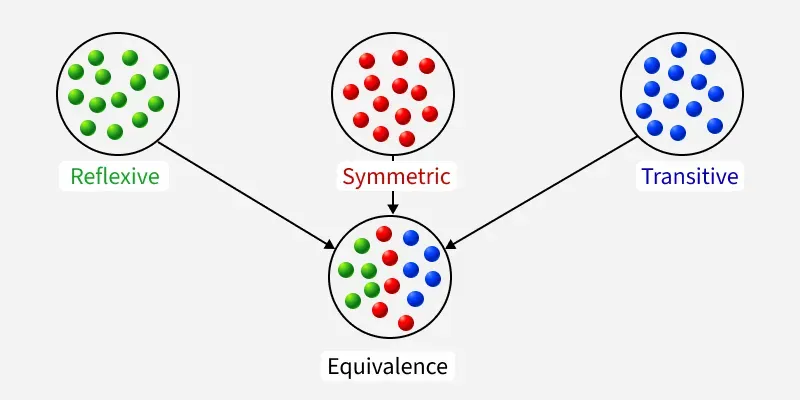
An equivalence Relation is a type of relation that satisfies three fundamental properties: reflexivity, symmetry, and transitivity. These properties ensure that it defines a partition on a set, where elements are grouped into equivalence classes based on their similarity or equality.
The equivalence relation is a relationship on the set which is generally represented by the symbol “∼”. An equivalence relation on a set is a binary relation that satisfies three fundamental properties:
- Reflexivity: ∀ a ∈ S: a ~ a
- Symmetry: ∀ a, b ∈ S: a ~ b ⇒ b ~ a
- Transitivity: ∀ a, b, c ∈ S: (a ~ b) ∧ (b ~ c) ⇒ a ~ c
A relation R on a set A is called a reflexive relation if
(a, a) ∈ R ∀ a ∈ A, i.e. aRa for all a ∈ A, where R is a subset of (A ✕ A), i.e. the cartesian product of set A with itself.
This means if element “a” is present in set A, then a relation “a” to “a” (aRa) should be present in relation R. If any such aRa is not present in R, then R is not a reflexive relation.
A relation R on a set A is called a symmetric relation if and only if
∀ a, b ∈ A, if (a, b) ∈ R then (b, a) ∈ R and vice versa i.e., where R is a subset of (A x A), i.e. the cartesian product of set A with itself.
This means if an ordered pair of elements “a” to “b” (aRb) is present in relation R, then an ordered pair of elements “b” to “a” (bRa) should also be present in relation R. If any such bRa is not present for any aRb in R, then R is not a symmetric relation.
A relation R on a set A is called a transitive relation if and only if
∀ a, b, c ∈ A, if (a, b) ∈ R and (b, c) ∈ R then (a, c) ∈ R, where R is a subset of (A x A), i.e. the cartesian product of set A with itself.
This means if an ordered pair of elements “a” to “b” (aRb) and “b” to “c” (bRc) is present in relation R, then an ordered pair of elements “a” to “c” (aRC) should also be present in the relation R. If any such aRc is not present for any aRb & bRc in R R is not a transitive relation.
A classic example of an equivalence relation is the relation of "equality" on the set of real numbers. Given any two real numbers "a" and "b":
Some other examples include:
Let us assume that R is a relation on the set of ordered pairs of positive integers such that ((a, b), (c, d))∈ R if and only if ad = bc. Is R an equivalence relation?
To prove that R is an equivalence relation, we must show that R is
Let's verify all these relations for any given relation R.
The process of identifying if any given relation is reflexive:
Consider set A = {a, b} and a relation R = {{a, a}, {b, b}}.
For the element a in A:
⇒ The pair {a, a} is present in R.
⇒ Hence aRa is satisfied.For the element b in A:
⇒ The pair {b, b} is present in R.
⇒ Hence bRb is satisfied.
As the condition for 'a', ‘b’ is satisfied, the relation is reflexive.
To verify a symmetric relation, do the following:
Follow the example given below for better understanding.
Consider set A = { 1, 2, 3, 4 } and a relation R = { (1, 2), (1, 3), (2, 1), (3, 4), (3, 1),(4.3) }
For the pair (1, 2) in R:
⇒ The reversed pair (2, 1) is present in the relation.
⇒ This pair satisfies the conditionFor the pair (1, 3) in R:
⇒ The reversed pair (3, 1) is present in the relation.
⇒ This pair satisfies the conditionFor the pair (2, 1) in R:
⇒ The reversed pair (1, 2) is present in the relation.
⇒ This pair satisfies the conditionFor the pair (3, 4) in R:
⇒ The reversed pair (4, 3) is present in the relation.
⇒ This pair satisfy the conditionFor the pair (3, 1) in R:
⇒ The reversed pair (1, 3) is present in the relation
⇒ This pair satisfies the condition
As the set satisfies the condition, the relation is symmetric.
To verify the transitive relation:
Consider set R = {(1, 2), (2, 3), (3, 4), (1, 3), (2, 4), (1, 4)}
For the pairs (1, 2) and (2, 3):
⇒ The relation (1, 3) exists.
⇒ This satisfies the condition.For the pairs (2, 3) and (3, 4):
⇒ The relation (2, 4) exists.
⇒ This satisfies the condition.For the pairs (1, 3) and (3, 4):
⇒ The relation (1, 4) exists.
⇒ This satisfies the condition.All possible pairs satisfy the condition of transitivity.
So, the given relation is transitive.
Hence, the transitive property is proved.
Question 1: Show that the relation R, defined in the set A of all polygons as R = {(P1, P2): P1 and P2 have the same number of sides}, is an equivalence relation on A.
Solution:
Given A = set of all polygons
R = {(P1, P2): P1 and P2 have same number of sides}In order to prove that R is an equivalence relation, we must show that R is reflexive, symmetric and transitive.
- Reflexive: Let P A
Clearly, Number of sides of P = number of sides of P
(P, P) ⋿ R ∀ P ⋿ A
Hence, R is reflexive.
- Symmetric: Let P1, P2 ⋿ A
Let (P1, P2) ⋿ R ⇒ P1 and P2 have same number of sides
⇒ P2 and P1 have same number of sides
⇒ (P2, P1) ⋿ A
Hence R is Symmetric.
- Transitive: Let P1, P2 ⋿ A
Let (P1, P2) ⋿ R and (P2, P3) ⋿ R
⇒ Number of sides of P1 = number of sides of P2 and
⇒ Number of sides of P2 = number of sides of P3
⇒ Number of sides of P1 = number of sides of P3
⇒ (P1, P3) ⋿ R
Hence R is transitive.Thus, R is reflexive, symmetric and transitive and hence R is an equivalence relation on A.
Question 2: Prove that a relation defines an equivalence relation for triangles in geometry.
Solution:
In order to prove that R is an equivalence relation, we must show that R is reflexive, symmetric and transitive.
- Reflexive: Every triangle is similar to itself.
x is similar to x, ∀ x ⋿ R ⇒ xRx, ∀ x ⋿ T
so, R is reflexive on T.
- Symmetric: x is similar to y
⇒ y is similar to x.
⇒ yRx
Hence R is symmetric relation on R.
- Transitive: x is similar to y and y is similar to z
⇒ xRy and yRz
⇒ x is similar to z
⇒xRz.
Hence R is transitive relation on R.Hence R is an equivalence relation on T.
Question 3: Show that the relation R in the set A = {x ⋿ Z : 0 ≤ x ≤ 12} given by R = {(a, b): a = b} is an equivalence relation.
Question 4: Let a relation R be defined on the set Z of integers by x R y <⇒ x = y; x, y ⋿ Z. Show that R is an equivalence relation.
Question 1: Show that the relation R in the set A = {1, 2, 3, 4, 5} given by R = {(a, b): |a-b| is even} is an equivalence Relation.
Question 2: Let f: x→y be a function. Define a relation R in X as R = {(a, b): f(a) = f(b)}. Examine if R is an equivalence relation.