|
VOOZH | about |
|
VOOZH | about |
The concept of limits is fundamental in Calculus and helps describe the behavior of a function near a given point. While limits can be evaluated algebraically, they can also be estimated directly from a graph by observing how the function behaves as x approaches a specific value.
For a function f(x), the limit at x=a is written as:
To estimate this from a graph:
- Observe the value that f(x) approaches as x→a from the left-hand side
- Observe the value that f(x) approaches as x→a from the right-hand side
Key Observations from Graphs
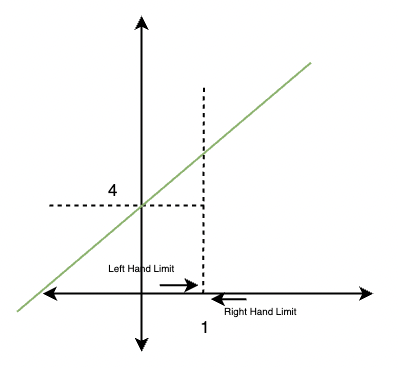
Example : Consider the function f(x) = 3x + 4
To estimate:
From the graph, as x approaches 1 from both sides, the function values approach 7. Thus,
Notice that as we approach from both the left-hand side and right-hand side of x = 1, the function moves toward a single value. This value is called the limit of the function.
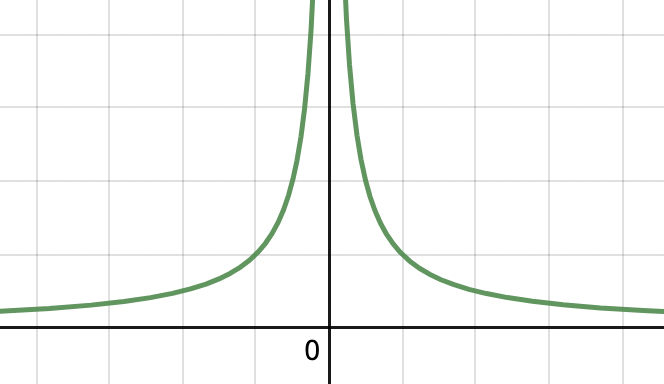
Sometimes there are certain kinds of functions that move towards infinity. In such cases, the value of the limit goes up to infinite.
For example, for function f(x) =
The limit for this function at x → 0,
Notice in the figure that the limit at x = 0 is unbounded and is going up to infinity. Such limits are called unbounded limits.
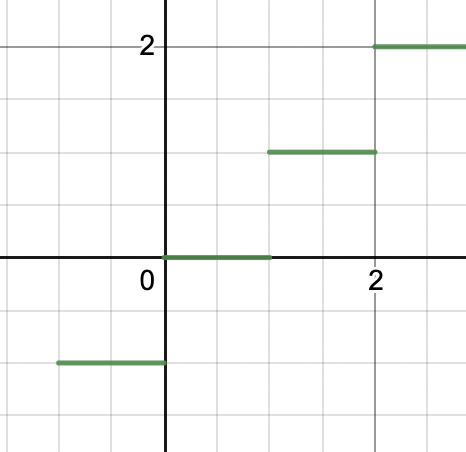
Sometimes functions are not continuous, which means they tell us two different limits while approaching from two different sides.
For example, the greatest integer function is inherently discontinuous, and at these discontinuities, we observe two different values.
f(x) =[x]
At x = 1, there are two values when approached from two different sides. In such cases, mostly we are asked to tell the value from one side. These are called one-sided limits.
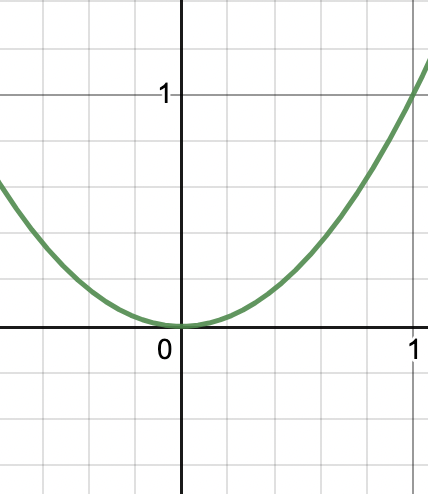
Question 1: Find the
Graph of x2 is an upward parabola which is centered at origin.
Notice that the function starts moving towards taking a value of 1 as one moves towards the value of x = 1.
Thus,
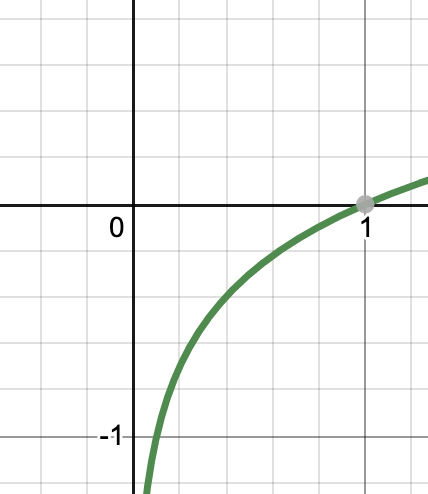
Question 2: Find the
Graph of log(x)is a saturating function. The figure below shows the graph of the given function.
Notice that the function starts moving towards taking a value of as one moves towards the value of x = 0. This is an example of unbounded limit.
Thus,
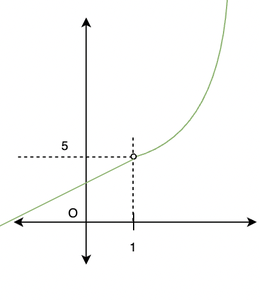
Question 3: Find the limit of the function at x = 1.
In the graph, the white dot at x = 1 indicates that the function is not defined at x = 1. That means, there should be no value of the function at x =1.
Limit allows us to calculate the values the function was approaching had it been defined at x =1.
So, in this case from graph it can be seen that the function is approaching value of 5.
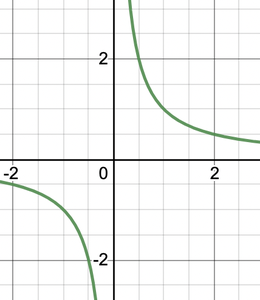
Question 4: Find the value of the limit of the function f(x) = at x = 0.
The figure shows the graph for the given function
The figure makes it clear that there are two limits depending on from which side we are approaching the function.
Left Hand Side Limit:
While approaching zero from the negative side of the origin takes the function to negative infinity.
Right Hand Side Limit:
While approaching zero from the positive side of the origin takes the function to positive infinity.
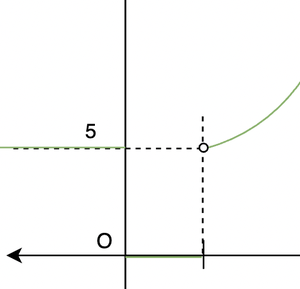
Question 5: Find out the limit at x = 0 for the given function,
In the figure, the given function is not continuous at origin. That means there will be two different values of the limit - one from left-hand side and another from right-hand side.
Left- Hand Limit for the function
Right - Hand Limit for the function,
1: Find the value of the limit of the function f(x) =
2: Find the value of the limit of the function f(x) =
3: Find the value of the limit of the function f(x) =
4: Find the value of the limit of the function f(x) =
5: Find the value of the limit of the function f(x) =
6: Find the value of the limit of the function f(x) =
7: For the function p(x) shown in the graph as x approaches infinity, determine .
8: Given the graph of q(x) what is ?
9: Estimate from the graph of r(x) where x approaches 4 from the right.
10: From the graph of s(x) determine where x approaches 5 from the left.