|
VOOZH | about |
|
VOOZH | about |
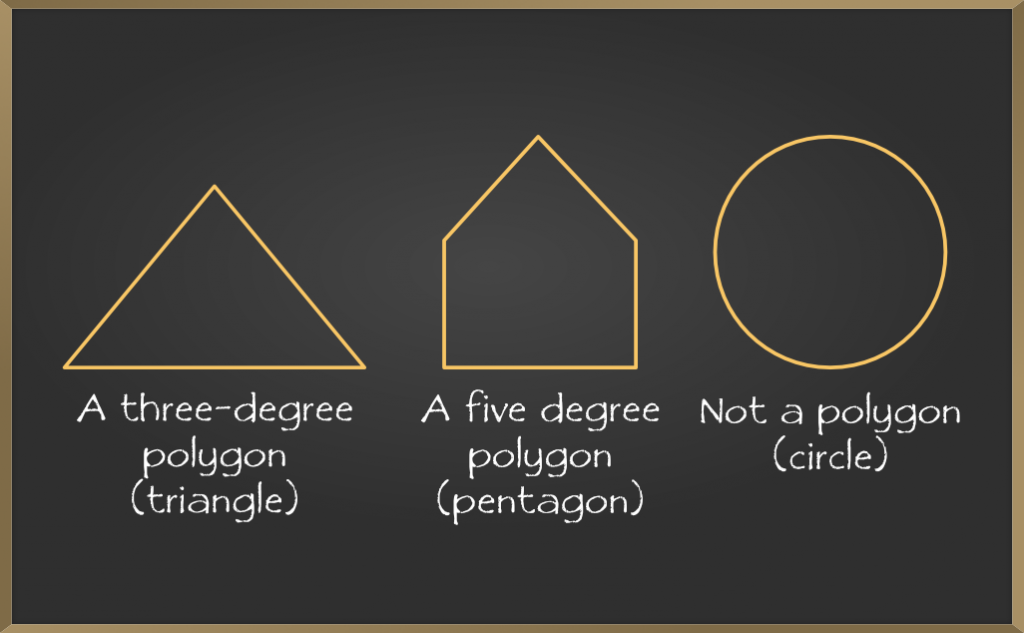
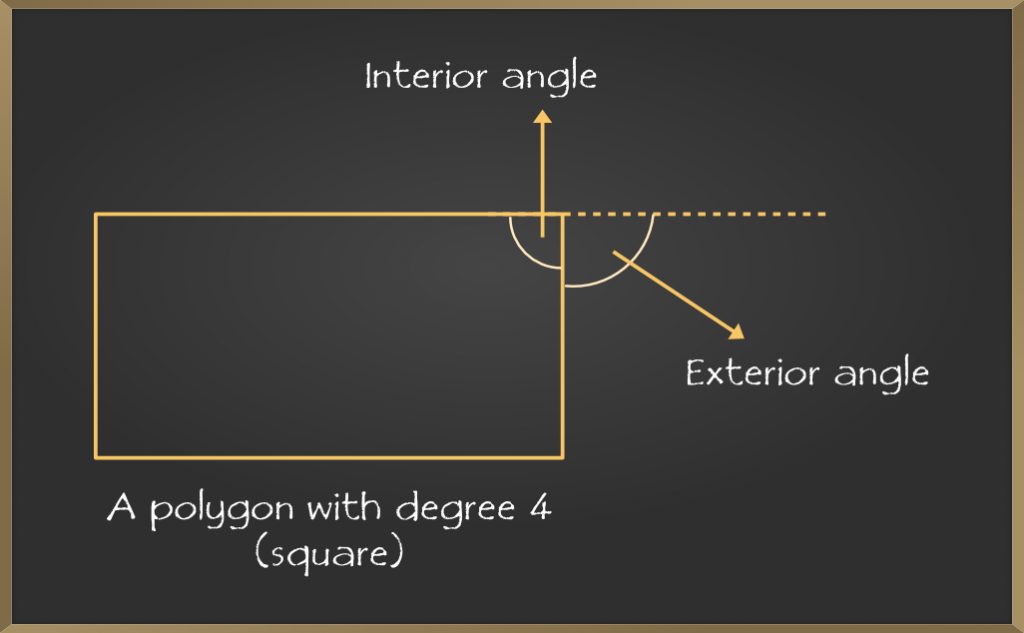
Polygon is a closed, connected shape made of straight lines. It may be a flat or a plane figure spanned across two-dimensions. A polygon is an enclosed figure that can have more than 3 sides. The lines forming the polygon are known as the edges or sides and the points where they meet are known as vertices. The sides that share a common vertex among them are known as adjacent sides. The angle enclosed within the adjacent side is called the interior angle and the outer angle is called the exterior angle.
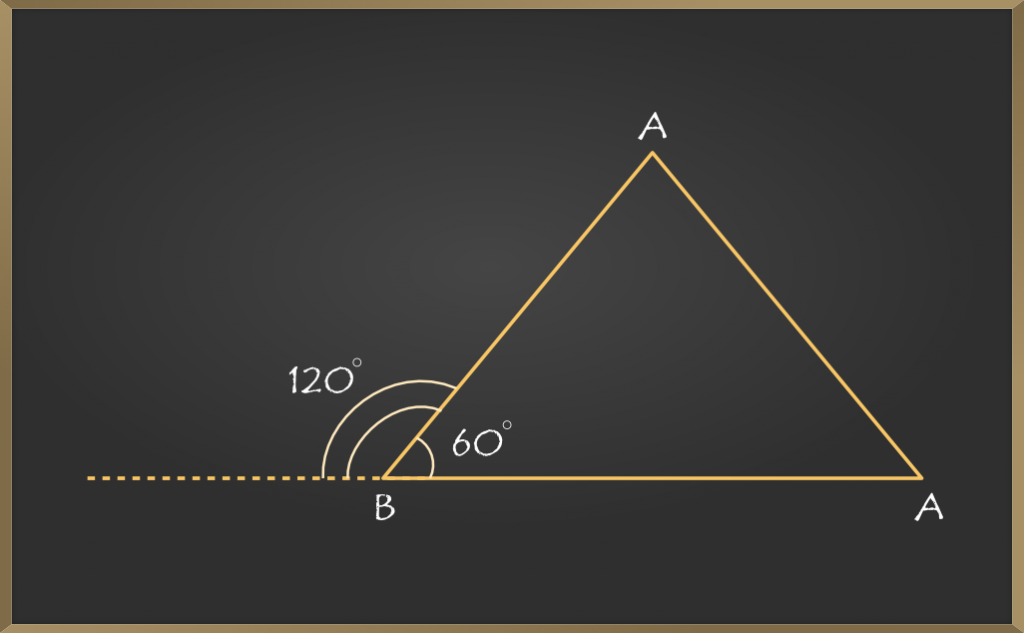
👁 Exterior-Angles-5An exterior angle basically is formed by the intersection of any of the sides of a polygon and extension of the adjacent side of the chosen side. Interior and exterior angles formed within a pair of adjacent sides form a complete 180 degrees angle.
👁 Exterior-Angles-4We can measure exterior angles using following steps:
For a regular polygon (a polygon with all sides and angles equal), the exterior angle can be calculated using the formula:
Exterior Angle = 360°/n
Where n is the number of sides of polygon.
The sum of the exterior angles of any polygon, one at each vertex, is always 360°.
Let us consider a polygon which has n number of sides. The sum of the exterior angles is N.
The sum of exterior angles of a polygon(N) = Difference between {the sum of the linear pairs (180n)} - {the sum of the interior angles.(180(n - 2))}
⇒ N = 180n − 180(n - 2)
⇒ N = 180n − 180n + 360
⇒ N = 360Hence, we have the sum of the exterior angle of a polygon is 360°.
The key differences between interior and exterior angles in any polygon are listed in the following table:
| Aspect | Interior Angles | Exterior Angles |
|---|---|---|
| Definition | Angles inside the polygon, formed by two adjacent sides. | Angles formed between one side of the polygon and the extension of an adjacent side. |
| Sum in a Polygon | (n−2) × 180° for an n-sided polygon. | Always 360° for any polygon. |
| Individual Angle in a Regular Polygon | Interior Angle =(n − 2) × 180° Where n is the number of sides. | Exterior Angle = 360°/n Where n is the number of sides. |
| Relationship to Each Other | Supplementary to the exterior angle. | Supplementary to the interior angle. |
| Visual Representation | Found inside the polygon. | Found outside the polygon, adjacent to each interior angle. |
Read More,
Example 1: Find the exterior angle marked with x.
👁 Solved Example of Exterior Angles of Polygon 01Solution:
Since the sum of exterior angles is 360 degrees, the following properties hold:
∠1 + ∠2 + ∠3 + ∠4 + ∠5 = 360°
⇒ 50° + 75° + 40° + 125° + x = 360°
⇒ x = 360°
Example 2: Determine each exterior angle of the quadrilateral.
👁 Solved Example of Exterior Angles of Polygon 02Solution:
Since, it is a regular polygon, where all interior and exterior angles are equal.
Thus, measure of each exterior angle = 360°/ Number of sides
⇒ Measure of each exterior angle = 360°/4
⇒ Measure of each exterior angle = 90°
Example 3: Find the regular polygon where each of the exterior angle is equivalent to 60°.
Solution:
Since it is a regular polygon, the number of sides can be calculated by the sum of all exterior angles, which is 360 degrees divided by the measure of each exterior angle.
Number of sides = (Sum of all exterior angles of a polygon)/n
⇒ Value of one pair of side = 360°/60° = 6Therefore, this is a polygon enclosed within 6 sides, that is hexagon.
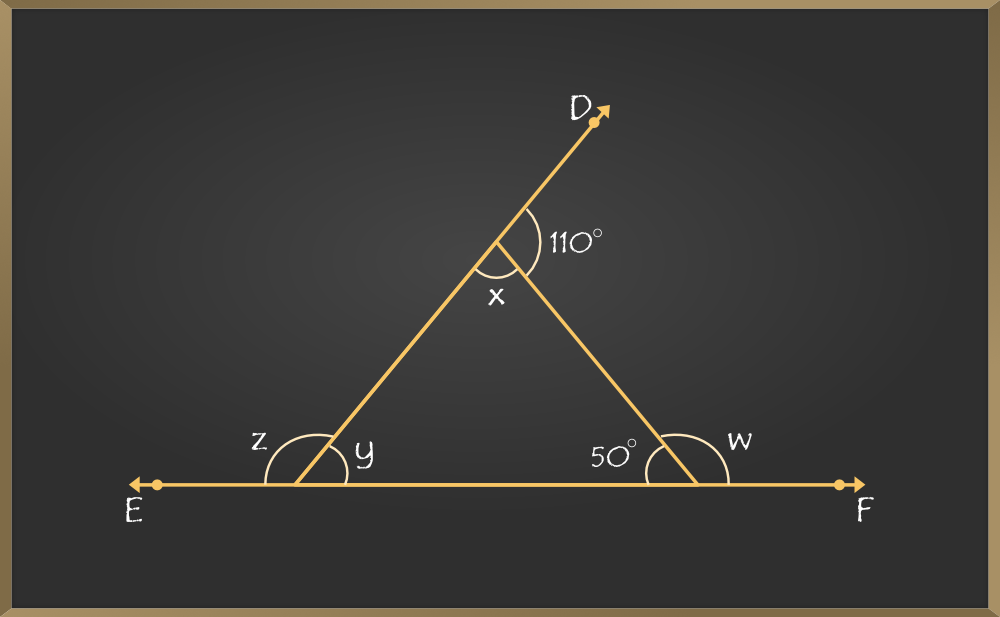
Example 4: Find the interior angles 'x, y', and exterior angles 'w, z' of this polygon?
👁 Solved Example of Exterior Angles of Polygon 04Solution:
Here we have ∠DAC = 110° that is an exterior angle and ∠ACB = 50° that is an interior angle.
Firstly we have to find interior angles 'x' and 'y'.
∠DAC + ∠x = 180° {Linear pairs}
⇒ 110° + ∠x = 180°
⇒ ∠x = 180° - 110°
⇒ ∠x = 70°Now,
∠x + ∠y + ∠ACB = 180° {Angle sum property of a triangle}
⇒ 70°+ ∠y + 50° = 180°
⇒ ∠y + 120° = 180°
⇒ ∠y = 180° - 120°
⇒ ∠y = 60°Secondly now we can find exterior angles 'w' and 'z'.
∠w + ∠ACB = 180° {Linear pairs}
⇒ ∠w + 50° = 180°
⇒ ∠w = 180° - 50°
⇒ ∠w = 130°Now we can use the theorem exterior angles sum of a polygon,
∠w + ∠z + ∠DAC = 360° {Sum of exterior angle of a polygon is 360°}
⇒ 130° + ∠z + 110° = 360°
⇒ 240° + ∠z = 360°
⇒ ∠z = 360° - 240°
⇒ ∠z = 120°