VOOZH about

URL: https://www.geeksforgeeks.org/maths/factor-theorem/

โ‡ฑ Factor Theorem - GeeksforGeeks


  • Courses
  • Tutorials
  • Interview Prep

Factor Theorem

Last Updated : 7 Apr, 2026

The Factor Theorem is a special case of the Remainder Theorem. It is a rule in algebra used to check whether a given expression is a factor of a polynomial.

Statement: If f(a) =0, then (x - a) is a factor of f(x).

If we calculate f(a) and it is 0, then the remainder is also 0, so (x - a) is a factor of f(x). We can understand this with numbers too.
For example, 20 รท 2 = 10 with no remainder, so 2 is a factor of 20.

Check whether (y + 5) is a factor of 2yยฒ + 7y โˆ’ 15.

First, find the value of y: y+5 = 0 โ‡’ y = โˆ’5

Now substitute in the polynomial:

g(โˆ’5) = 2(โˆ’5)ยฒ + 7(โˆ’5) โˆ’ 15
= 2(25) โˆ’ 35 โˆ’ 15
= 50 โˆ’ 35 โˆ’ 15
= 0

We got 0, which means the remainder is 0.

And this is exactly what the Factor Theorem says:

If f(a) = 0, then (x โˆ’ a) is a factor.

Hence, (y + 5) is a factor.

Proof

Let f(x) be a polynomial. When f(x) is divided by (x โˆ’ a), according to the division algorithm:

Dividend = (Divisor ร— Quotient) + Remainder

โŸน f(x) = (x โˆ’ a) q(x) + r

where q(x) is the quotient and r is the remainder.

Now, substitute x = a:

f(a) = (a โˆ’ a) q(a) + r
f(a) = r

So, the remainder r = f(a).

If f(a) = 0, then r = 0. Hence,

f(x) = (x โˆ’ a) q(x)

Therefore, (x โˆ’ a) is a factor of f(x).

Factor Theorem Formula

According to the Factor Theorem, for any polynomial g(y) of degree n โ‰ฅ 1, (y โˆ’ a) is a factor of g(y) if and only if g(a) = 0. In this case, the polynomial can be written as:

g(y) = (y โˆ’ a) q(y)

where, q(y) is the quotient polynomial.

Important Results

  • (y โˆ’ a) is a factor of g(y).
  • g(a) = 0
  • The remainder is zero when g(y) is divided by (y โˆ’ a).
  • a is a zero (root) of the polynomial g(y)

Factor a Cubic Polynomial

To factor a cubic polynomial, we use the Factor Theorem to find one root and then reduce it to a quadratic polynomial.

Factorise the cubic polynomial f(x) = axยณ + bxยฒ + cx + d

Steps:

  • Step 1: By the hit-and-trial method, find one of the zeros of the polynomial f(x). Say the zero of the polynomials is "a" such that f(a) is zero.
  • Step 2: Divide the polynomial f(x) by x-a using the synthetic division method.
  • Step 3: Using the division algorithm, write the given cubic polynomial as f(x) = (x-a)g(x), where g(x) is quadratic.
  • Step 4: Factor the cubic polynomial g(x). As g(x) = (x-b)(x-c) for any real numbers b and c.
  • Step 5: Express the given cubic polynomial as the product of these factors.

f(x) = (x -a)(x-b)(x-c)

Example: Using factor theorem factorize f(x) = xยณ + 10xยฒ + 23x + 14

Solution:

f(x) = x3 + 10x2 + 23x + 14

Now applying Factor Theorem.

(x - a) is a factor of f(x) if f(a) = 0.

And g(y) = (y-a)q(a)

Now, by hit and try method we get,

f(-1) = (-1)3 + 10(-1)2 + 23(-1) + 14

โ‡’ f(-1) = 24 - 24 = 0

Thus, x + 1 is a factor of  x3 + 10x2 + 23x + 14

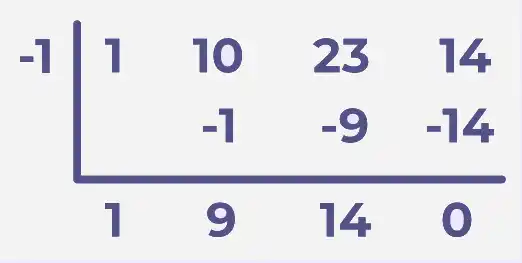
Now, by dividing x + 1 by  x3 + 10x2 + 23x + 14 we get,

๐Ÿ‘ Factor-theorem-1

f(x) = (x + 1)(x + 9x + 14)

โ‡’ f(x) = (x + 1)(x + 7x + 2x + 14)

โ‡’ f(x) = (x + 1){x(x +7) + 2(x + 2)}

โ‡’ f(x) = (x + 1)(x + 2)(x + 7)

Factor Theorem vs Remainder Theorem

Key differences between the factor and remainder theorems are listed as follows:

Remainder TheoremFactor Theorem
According to the Remainder Theorem, for any polynomial p(x) when divided by x - a, the remainder is p(a).According to the Factor Theorem, if (x - a) is a factor of p(x), then this is true only if f(a) = 0.
Remainder Theorem helps us to find the remainder of the polynomial without actually dividing it.The Factor Theorem helps us to find the factors of the given polynomial.

Example: Check whether (x โˆ’ 2) and (x โˆ’ 1) are factors of the polynomial f(x) = xยฒ + 3x โˆ’ 4.

Solution:

Given, f(x) = xยฒ + 3x โˆ’ 4

For (x โˆ’ 2): x = 2
f(2) = 2ยฒ + 3(2) โˆ’ 4 = 4 + 6 โˆ’ 4 = 6 โ‰  0
So, (x โˆ’ 2) is not a factor.

For (x โˆ’ 1): x = 1
f(1) = 1ยฒ + 3(1) โˆ’ 4 = 1 + 3 โˆ’ 4 = 0
So, (x โˆ’ 1) is a factor.

Related Articles

Solved Examples

Example 1: Find the root of the polynomial f(x) = xยฒ - 5x + 6 using the factor theorem.

Solution:

f(x) = x2 - 5x + 6.

Now applying factor theorem.

If (x - a) is a factor of f(x) then f(a) = 0

By hit and try method,

f(2) = 4 - 10 + 6 = 0

Thus, (x - 2) is a factor of f(x).

Example 2: Suppose a polynomial f(x) = x + 3x2 - 6x - 18. If x = -3 is a root, then show that x + 3 is a factor.

Solution:

f(x) = x3 + 3x2 - 6x - 18.

Now applying factor theorem.

If x = a is the root of f(x) then x - a is the factor of the f(x)

Now for, f(x) at x = -3

f(-3) = -27 + 27 + 18 - 18 = 0

Thus, (x + 3) is a factor of f(x).

Example 3: Using the factor theorem, check if y + 2 is a factor of the polynomial 2y4 + y3 โ€“ 2y2 + 4y - 8, or not.

Solution:

Given y + 2

If, y + 2 = 0, then y = -2

Substituting y = -2 in the given polynomial 2y4 + y3 โ€“ 2y2 + 4y -8

= 2(-2)4 + (-2)3 - 2(-2)2 + 4(-2) - 8

= 32 - 8 - 8 - 8 - 8

= 0

Thus, we can say that y + 2 is a factor of the polynomial 2y4 + y3 โ€“ 2y2 + 4y -8

Example 4: Check if x - 1 is a factor of the polynomial f(x) = 2xโด + 3xยฒ - 5x + 7.

Solution:

Given x - 1

If, x - 1 = 0, then x = 1

Substituting x = 1 in the given polynomial 2x4 + 3x2 - 5x + 7

= 2(1)4 + 3(1)2 - 5(1) + 7

= 2 + 3 - 5 + 7

= 7

As, f(-1) โ‰  0

We can say that x - 1 is not a factor of the polynomial  2x4 + 3x2 - 5x + 7

Example 5: Given a polynomial f(x) = x3 - x - 2x + 1. Factorize and find its roots.

Solution:

f(x) = x3 - x 2 - x + 1

Now applying Factor Theorem.

(x - a) is a factor of f(x) if f(a) = 0.

And g(y) = (y-a)q(a)

Now, by hit and try method we get,

f(-1) = (-1)3 - (-1)2 -(-1)

โ‡’ f(-1) = -8 + 4 + 4 = 0

Thus, x + 1 is a factor of x3 - x 2 - x + 1

Now, by dividing x + 1 byx3 - x 2 - x + 1 we get,

f(x) = (x + 1)(x2 - 2x + 2)

โ‡’ f(x) = (x + 1)(x - x - x -2)

โ‡’ f(x) = (x + 1){x(x - 1) - 1(x - 1)}

โ‡’ f(x) = (x + 1)(x - 1)(x - 1)

Comment
Article Tags:

Explore