|
VOOZH | about |
|
VOOZH | about |
In mathematics, functions help us understand how one quantity depends on another. But not all functions behave the same way when connecting inputs to outputs. Some functions match each input to a unique output, some make sure every output is used, and some do both!
To study these differences, we classify functions into three types: injective (one-one), surjective (onto), and bijective (both one-one and onto).
These types help us understand how functions work and are especially important in higher-level math like algebra, calculus, and computer science.
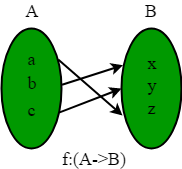
A function is called one-to-one if for all elements a and b in A, if f(a) = f(b), then it must be the case that a = b. It never maps distinct elements of its domain to the same element of its co-domain. 👁 fun_1
Properties of Injective Functions:
If every element b in B has a corresponding element a in A such that f(a) = b. It is not required that a is unique; The function f may map one or more elements of A to the same element of B.
👁 fun_2Properties of Surjective Functions
A function is a Bijective function if it is both one to one and onto function.
👁 8Properties of Bijective Functions
Let g be a function from B to C and f be a function from A to B, the composition of f and g, which is denoted as fog(a) = f(g(a)).
Understanding injective, surjective, and bijective functions is crucial in various engineering disciplines:
Problem 1: Determine if the function f(x) = 2x+1 is injective.
Solution:
To check if f is injective, assume f(x1) = f(x2)): 2x1+1 = 2x2+1
Subtract 1 from both sides: 2x1 = 2x2
Divide by 2: x1 = x2
Sincex1 = x2 follows from f(x1) = f(x2), f is injective.
Problem 2: Determine if the function f(x) = x2 for x∈R is surjective when the codomain is R.
Solution:
For f(x) = x2 to be surjective, every y∈R must have a corresponding x∈R such that x2 = y. However, x2 ≥ 0 for all real x, so f(x) = x2 cannot produce negative values. Therefore, f is not surjective when the codomain is R.
If the codomain were [0,∞), then f would be surjective.
Problem 3: Determine if the function f(x) = 3x − 2 is bijective if the domain and codomain are both R.
Solution:
- Injective Check: As shown in Example Problem 1, f(x) = 3x−2 is injective.
- Surjective Check: For any y∈R, solve y = 3x − 2 for x: x = y+2/3. Since x is always a real number for any real y, f is surjective.
Since f is both injective and surjective, it is bijective.