|
VOOZH | about |
|
VOOZH | about |
A geometric distribution is a discrete probability distribution that gives the probability that the first success occurs on a specific trial in a sequence of independent Bernoulli trials, where each trial has two outcomes—success or failure—and the probability of success p remains constant across trials.
Geometric distributions are probability distributions that are based on three key assumptions.
Example: Imagine you toss a fair coin repeatedly.
- Getting a head = success
- Getting a tail = failure
If you want to find the probability that the first head appears on the 4th toss, this situation follows a geometric distribution.
The geometric distribution is commonly used in various real-life circumstances. In the financial industry, it is used to estimate the financial rewards of making a given decision in a cost-benefit analysis.
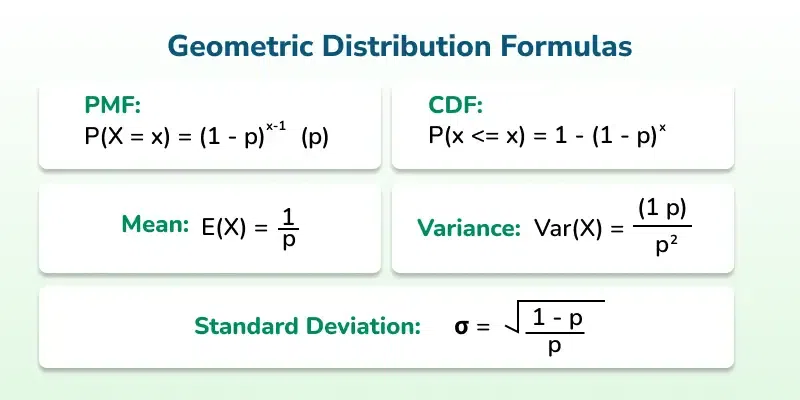
The geometric distribution is characterized by two important functions: the Probability Mass Function (PMF) and the Cumulative Distribution Function (CDF). These formulas help calculate the likelihood of achieving the first success after a certain number of trials. Below are the key formulas associated with the geometric distribution:
The likelihood that a discrete random variable, X, will be exactly identical to some value, x, is determined by the probability mass function.
P (X = x) = (1 - p)x -1p
where, 0 < p ≤ 1.
The probability that a random variable, X, will assume a value that is less than or equal to x can be described as the cumulative distribution function of a random variable, X, that is assessed at a point, x. The distribution function is another name for it.
P(X ≤ x) = 1 - (1 - p)x
The geometric distribution's mean is also the geometric distribution's expected value. The weighted average of all values of a random variable, X, is the expected value of X.
E[X] = 1 / p
Variance is a measure of dispersion that examines how far data in a distribution is spread out about the mean.
Var[X] = (1 - p) / p2
The square root of the variance can be used to calculate the standard deviation. The standard deviation also indicates how far the distribution deviates from the mean.
S.D. = √VAR[X]
S.D. = √1 - p / p
Solution:
Given,
p = 0.2
E[X] = 1 / p
= 1 / 0.2
= 5The expected number of donors who will be tested till a match is found is 5
Solution:
Given,
p = 0.4
P(X = x) = (1 - p)x - 1p
P(X = 3) = (1 - 0.4)3 - 1(0.4)
P(X = 3) = (0.6)2(0.4)
= 0.144The probability that you will hit the bullseye on the third try is 0.144
Solution:
Given,
p = 3 / 60 = 0.05
P(X = x) = (1 - p)x - 1p
P(X = 6) = (1 - 0.05)6 - 1(0.05)
P(X = 6) = (0.95)5(0.05)
P(X = 6) = 0.0386The probability that the first defective light bulb is found on the 6th trial is 0.0368
Solution:
Given that p = 0.42 and the value of x = 1, 2, 3
The formula of probability density of geometric distribution is
P(x) = p (1 - p) x-1; x = 1, 2, 3
P(x) = 0; otherwise
P(x) = 0.42 (1 - 0.42)
P(x) = 0; OtherwiseMean= 1/p
= 1/0.42
= 2.380Variance = 1 - p/p2
= 1 - 0.42 /(0.42)2
= 3.287
Solution:
Here,
X ∼ geo(0.4)Hence,
e(x) = 1/0.4 = 2.5
Var(x) = 0.6/0.4²
= 3.75Hence, standard deviation ( σ) = 1.94