|
VOOZH | about |
|
VOOZH | about |
Half-angle formulas are used to find various values of trigonometric angles, such as for 15°, 75°, and others, they are also used to solve various trigonometric problems.
Several trigonometric ratios and identities help in solving problems of trigonometry. The values of trigonometric angles 0°, 30°, 45°, 60°, 90°, and 180° for sin, cos, tan, cosec, sec, and cot are determined using a trigonometry table.
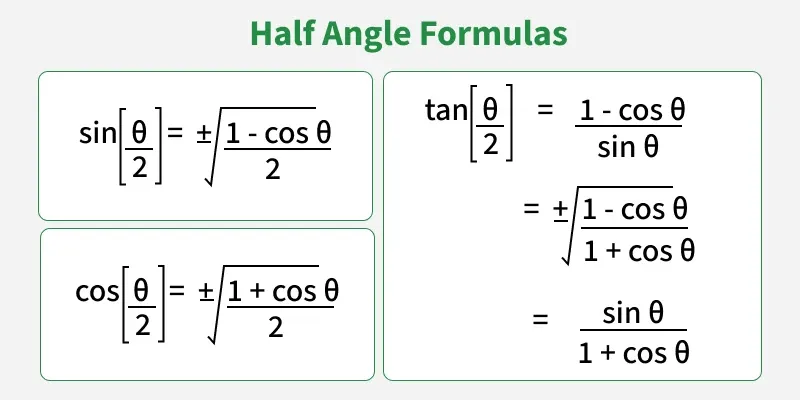
Half-angle formulas are trigonometric identities that express the sine, cosine, and tangent of half an angle (θ/2) in terms of the sine or cosine of the full angle θ. They are especially useful in simplifying expressions and solving trigonometric equations.
Half-angle formulas are derived using double-angle formulas. Before learning about half-angle formulas, we must learn about Double-angle in Trigonometry, The most commonly used double-angle formulas in trigonometry are:
Now replacing x with x/2 on both sides in the above formulas we get
Read More: Double Angled Formulas
We use cos2x = 2cos2x - 1 to find the Half-Angle Formula for Cos
Put x = 2y in the above formula
cos (2)(y/2) = 2cos2(y/2) - 1
cos y = 2cos2(y/2) - 1
1 + cos y = 2cos2(y/2)
2cos2(y/2) = 1 + cosy
cos2(y/2) = (1+ cosy)/2
cos(y/2) = ± √{(1+ cosy)/2}
We use cos 2x = 1 - 2sin2x for finding the Half-Angle Formula for Sin
Put x = 2y in the above formula
cos (2)(y/2) = 1 - 2sin2(y/2)
cos y = 1 - 2sin2(y/2)
2sin2(y/2) = 1 - cosy
sin2(y/2) = (1 - cosy)/2
sin(y/2) = ± √{(1 - cosy)/2}
We know that tan x = sin x / cos x such that,
tan(x/2) = sin(x/2) / cos(x/2)
Putting the values of half angle for sin and cos. We get,
tan(x/2) = ± [(√(1 - cosy)/2 ) / (√(1+ cosy)/2 )]
tan(x/2) = ± [√(1 - cosy)/(1+ cosy) ]
Rationalising the denominator
tan(x/2) = ± (√(1 - cosy)(1 - cosy)/(1+ cosy)(1 - cosy))
tan(x/2) = ± (√(1 - cosy)2/(1 - cos2y))
tan(x/2) = ± [√{(1 - cosy)2/( sin2y)}]
tan(x/2) = (1 - cosy)/( siny)
Example 1: Determine the value of sin 15°
Solution:
We know that the formula for half angle of sine is given by:
sin x/2 = ± ((1 - cos x)/ 2) 1/2
The value of sine 15° can be found by substituting x as 30° in the above formula
sin 30°/2 = ± ((1 - cos 30°)/ 2) 1/2
sin 15° = ± ((1 - 0.866)/ 2) 1/2
sin 15° = ± (0.134/ 2) 1/2
sin 15° = ± (0.067) 1/2
sin 15° = ± 0.2588
Example 2: Determine the value of sin 22.5°
Solution:
We know that the formula for half angle of sine is given by:
sin x/2 = ± ((1 - cos x)/ 2) 1/2
The value of sine 15° can be found by substituting x as 45° in the above formula
sin 45°/2 = ± ((1 - cos 45°)/ 2) 1/2
sin 22.5° = ± ((1 - 0.707)/ 2) 1/2
sin 22.5° = ± (0.293/ 2) 1/2
sin 22.5° = ± (0.146) 1/2
sin 22.5° = ± 0.382
Example 3: Determine the value of tan 15°
Solution:
We know that the formula for half angle of sine is given by:
tan x/2 = ± (1 - cos x)/ sin x
The value of tan 15° can be found by substituting x as 30° in the above formula
tan 30°/2 = ± (1 - cos 30°)/ sin 30°
tan 15° = ± (1 - 0.866)/ sin 30
tan 15° = ± (0.134)/ 0.5
tan 15° = ± 0.268
Example 4: Determine the value of tan 22.5°
Solution:
We know that the formula for half angle of sine is given by:
tan x/2 = ± (1 - cos x)/ sin x
The value of tan 22.5° can be found by substituting x as 45° in the above formula
tan 30°/2 = ± (1 - cos 45°)/ sin 45°
tan 22.5° = ± (1 - 0.707)/ sin 45°
tan 22.5° = ± (0.293)/ 0.707
tan 22.5° = ± 0.414
Example 5: Determine the value of cos 15°
Solution:
We know that the formula for half angle of sine is given by:
cos x/2 = ± ((1 + cos x)/ 2) 1/2
The value of sine 15° can be found by substituting x as 30° in the above formula
cos 30°/2 = ± ((1 + cos 30°)/ 2) 1/2
cos 15° = ± ((1 + 0.866)/ 2) 1/2
cos 15° = ± (1.866/ 2) 1/2
cos 15° = ± (0.933) 1/2
cos 15° = ± 0.965
Example 6: Determine the value of cos 22.5°
Solution:
We know that the formula for half angle of sine is given by:
cos x/2 = ± ((1 + cos x)/ 2) 1/2
The value of sine 15° can be found by substituting x as 45° in the above formula
cos 45°/2 = ± ((1 + cos 45°)/ 2) 1/2
cos 22.5° = ± ((1 + 0.707)/ 2) 1/2
cos 22.5° = ± (1.707/ 2) 1/2
cos 22.5° = ± ( 0.853 ) 1/2
cos 22.5° = ± 0.923