|
VOOZH | about |
|
VOOZH | about |
A square root is a value that gives the original number that multiplication of itself. e.g., 6 multiplied by itself gives 36 (i.e., 6 × 6 = 36), therefore, 6 is the square root of 36, or in other words, 36 is the square number of 6.
Question 1. Compute the square root of 144 by the Prime Factorization Method.
Solution:
⇒ 144 = {2 × 2} × {2 × 2} × {3 × 3}
⇒ 144 = 2 2 × 2 2 × 3 2
⇒ 144 = (2 × 2 × 3) 2
⇒ 144 = (12) 2
⇒ √144 = 12
Question 2. Solve: √(x + 2) = 4
Solution:
We know,
√(x + 2) = 4
On squaring both the sides, we obtain;
x + 2 = √4
⇒ x + 2 = ±4
⇒ x = ±4 – 2
Therefore, we have,
x = 2 or x = -6
Question 3. Can the square root of a negative number be a whole number? Explain.
Solution:
We know, the negative numbers cannot have a square root. The reason behind this is that if two negative numbers are multiplied together, the result obtained will always be a positive number. Therefore, the square root of a negative number will be in the form of complex number.
Question 4. Compute the square root of 25 by the method of repeated subtraction?
Solution:
Going by the above stated steps, we have,
25 - 1 = 24
24 - 3 = 21
21 - 5 = 16
16 - 7 = 9
9 - 9 = 0
Since the process is repeated 5 times, therefore, we have,√25 = 5.
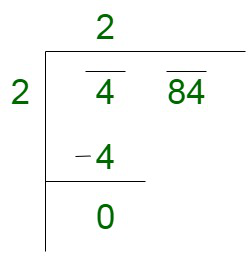
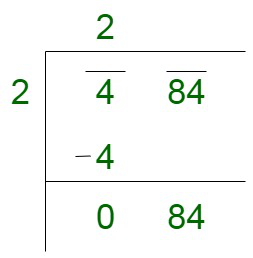
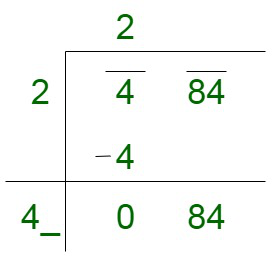
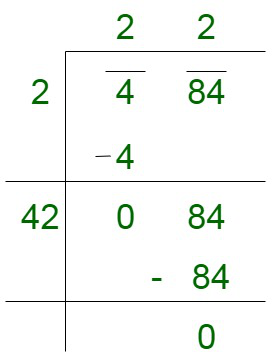
Question 5. Compute the square root of 484 by the long division method?
Solution:
By the long division method, we have,
👁 Image
👁 Image
👁 Image
👁 ImageNow,
The remainder is 0, therefore, 484 is a perfect square number, such that,
√484 = 22
Question 6: Determine the square root of 16 using the repeated subtraction method.
Solution:
In the repeated subtraction method, we subtract consecutive odd numbers starting from 1 until the result becomes zero:
- 16 - 1 = 15
- 15 - 3 = 12
- 12 - 5 = 7
- 7 - 7 = 0
Here it takes four steps to get the 0.
Hence, the square root of 16 is 4.
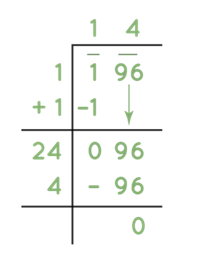
Question 7: Find the square root of 196 using the division method.
Solution:
The steps to determine the square root of 196 are:
Step 1: Start the division from the leftmost side. Here 1 is the number whose square is 1.
Step 2: Putting it in the divisor and the quotient and then doubling it will give.
👁 ImageStep 3: Now we need to find a number for the blanks in divisor and quotient. Let that number be x.
Step 4: We need to check when 2x multiplies by x give a number less than or equal to 96. Take x = 1, 2, 3 and so on and check.
In this case,
- 21 × 1 = 21
- 22 × 2 = 44
- 23 × 3 = 69
- 24 × 4 = 96
So, choose x = 4 as the new digit to be put in divisor and in the quotient.
The remainder here is 0 and hence 14 is the square root of 196.
Question 8: Find the square root of 9 + 40i.
Solution :
Let's use the following formula to determine the square root of the given complex number as:
For the given case, substitute a = 9 and b = 40 in the above formula,
which is the required solution.
Question 9: Find the square root of 3 + 4i.
Solution :
Let's use the following formula to determine the square root of the given complex number as:
For the given case, substitute a = 3 and b = 4 in the above formula,
which is the required solution.
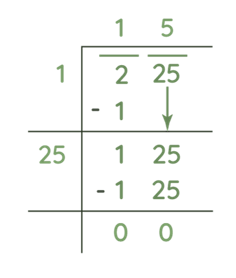
Question 10: Find the square root of 225 using the division method.
Solution:
The steps to determine the square root of 225 are:
Step 1: Start the division from the leftmost side. Here 1 is the number whose square is 1.
Step 2: Putting it in the divisor and the quotient and then doubling it will give.
👁 ImageStep 3: Now we need to find a number for the blanks in divisor and quotient. Let that number be x.
Step 4: We need to check when 2x multiplies by x gives a number which is either less than or equal to 125. Take x = 1, 2, 3 and so on and check.
In this case,
- 21 × 1 = 21
- 22 × 2 = 44
- 23 × 3 = 69
- 24 × 4 = 96
- 25 × 5 = 125
So we choose x = 5 as the new digit to be put in divisor and in the quotient.
The remainder here is 0 and hence 15 is the square root of 225.
Question 1. Find the square root of 256 using the Prime Factorization Method.
Question 2. Solve the equation:
Question 3. Can the square root of a negative number be a natural number? Give a reason.
Question 4. Compute the square root of 36 using the repeated subtraction method.
Question 5. Find the square root of 324 using the long division method.
If you want, I can also add full worked solutions, or simplify these for Grade-level practice (with shorter steps).