|
VOOZH | about |
|
VOOZH | about |
Probability is a fascinating and vital field of mathematics that deals with calculating the likelihood of events occurring. It is a concept that permeates our daily lives, from predicting weather patterns to making informed decisions in business and finance.
Probability is the measure of the likelihood that an event will occur. It is quantified as a number between 0 and 1, where 0 indicates impossibility and 1 indicates certainty.
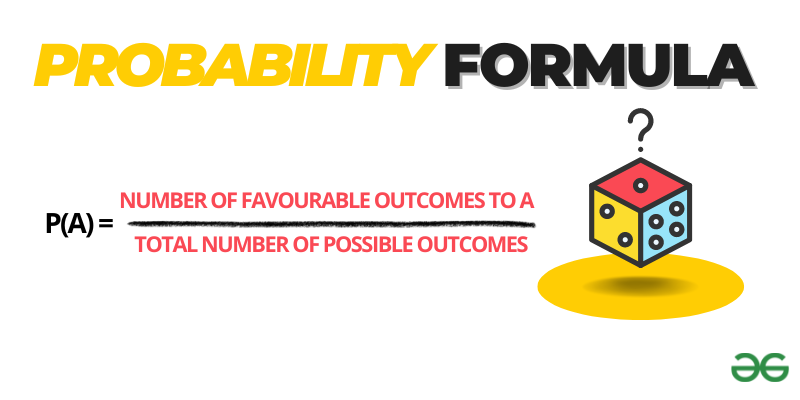
Probability of an event (A) is calculated using the following formula:
P(A) = n(A) / n(S)
where, n(A) is favorable number of outcomes
n(S) is the total number of outcomes.
Example 1:If you want to find the probability of drawing an Ace from a standard deck of cards:
Total number of cards in the deck (n(S)) = 52
Number of Ace cards (n(A)) = 4
Probability of selecting an Ace:
P(Ace) = n(A)/n(S) = 4/52 = 1/13
Example 2: You roll a fair six-sided die. What is the probability of rolling a number greater than or equal to 4?
Total Number of sides in die i.e n(S) = 6
Number of sides with number > 4 i.e n(A) = 3
P (rolling ≥ 4) = 3/6 = 1/2.
So, the probability of rolling a number greater than or equal to 4 is 1/2.
Read More: Basic Concepts of Probabaility
To find the probability of an event, you can use the following steps:
Determine the total number of possible outcomes in the experiment. This set of all possible outcomes is called the sample space and is often denoted by S.
Determine the number of outcomes that correspond to the event of interest (the event you are finding the probability for). These are the favorable outcomes.
The probability of an event A happening is given by the formula:
P(A) =
Simplify the fraction to its lowest terms to get the probability.
Probabilities are usually expressed as fractions, decimals, or percentages. The probability value will always be between 0 and 1 (or between 0% and 100%).
P(A ∪ B) = P(A) + P(B) - P(A ⋂ B)
P(A’) + P(A) = 1
P(A ⋂ B) = 0
P(A ⋂ B) = P(A) · P(B)
P(A|B) = P(A ⋂ B)/P(B)
Conditional Probability is the probability of an event occurring given that another event has already occurred. It is denoted by ( P(A|B) ), which reads as “the probability of A given B.”
Dependent Events: When the outcome of one event affects the outcome of another, the events are dependent.
Bayes’ Theorem: A way to find the probability of an event given the probabilities of other related events. It’s expressed as:
P(A|B) = P(B|A)P(A) / P(B)
P(A or B) = P(A) + P(B) - P(A and B)
Problem 1: If a coin is flipped three times, what is the probability of getting exactly two heads?
Solution:
When flipping a coin, there are two possible outcomes for each flip: Heads (H) or Tails (T).
Flipping a coin three times means there are 23 = 8 possible outcomes.
Favorable outcomes for getting exactly two heads are: HHT, HTH, and THH.
There are 3 favorable outcomes out of 8 possible outcomes.
Using the probability formula:
So, the probability of getting exactly two heads is .
Problem 2: In a deck of 52 cards, what is the probability of drawing an ace or a king?
Solution:
A standard deck of cards has 52 cards, with 4 aces and 4 kings.
Event of drawing an ace is mutually exclusive from the event of drawing a king (you can’t draw a card that is both an ace and a king).
Number of favorable outcomes for drawing an ace or a king is (4 + 4 = 8).
Using probability formula:
Simplifying the fraction gives us .
So, the probability of drawing an ace or a king is .