|
VOOZH | about |
|
VOOZH | about |
Imaginary numbers are numbers as the name suggests are the number that is not real numbers. All the numbers real and imaginary come under the categories of complex numbers. Imaginary numbers are very useful in solving quadratic equations and other equations whose solutions can not easily be found using general rules.
For example, the solution of x2 + x + 1 = 0 can easily be calculated using imaginary numbers. Let's learn about Imaginary numbers and their properties in detail in this article.
Table of Content
The number whose square results in negative results is called an Imaginary number.
In simple words, the square root of negative numbers is called an imaginary number. They are called imaginary numbers as we cannot associate them with any real-life examples.
They are represented by "i" and are pronounced as iota at its value is,
i = √-1
Some examples of imaginary numbers are:
. . . -3, -2i, -i, i, 2i, 3i . . .
Note:
Imaginary numbers were first encountered in the 16th century as solutions to seemingly unsolvable equations. They were first encountered by Italian mathematician Gerolamo Cardano while solving cubic equations. Later, in the 18th century, the term "imaginary" was coined for these numbers by Swiss mathematician Leonhard Euler.
Initially met with skepticism, they were eventually accepted as crucial tools in solving various mathematical problems, especially in areas like electrical engineering and quantum mechanics. Imaginary numbers are represented as multiples of the imaginary unit, "i," where i2 equals -1.
The term "iota" or "i" refers to the imaginary unit in mathematics. It is defined as the square root of -1, denoted by the symbol "i."
In mathematical notation,
i 2= −1 or i = √(-1)
The use of "i" allows mathematicians to extend the number system beyond real numbers, enabling solutions to equations that would otherwise be impossible to solve.
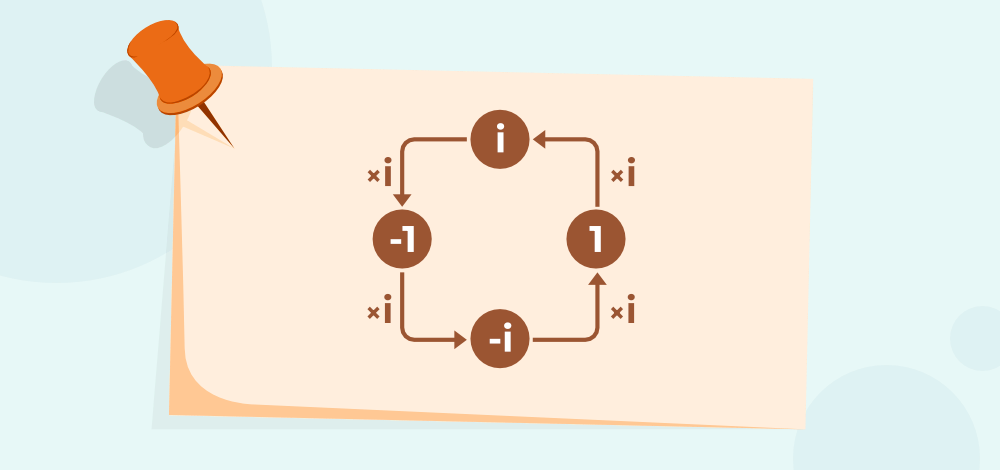
We know that i2 = -1 and using the power rules other powers of I can also be easily calculated.
On observing clearly we can see a pattern, there is a cycle of -i, 1, i... after power 2 thus,
The image given below explains the multiple of "i" with various numbers.
👁 cyclic nature of power of iota or "i"
Some of the important rules of Imaginary numbers are,
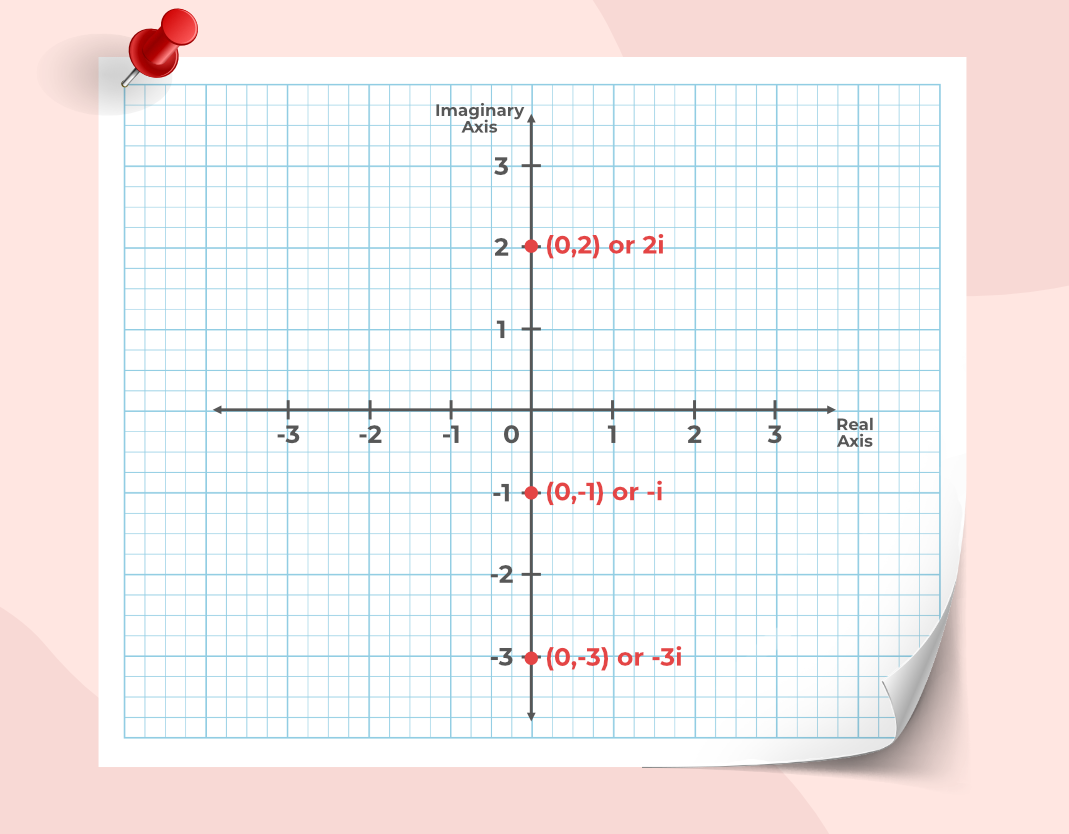
We usually represent a complex number a+bi by a point (a, b) in the Argand plane. For example, a complex number 5-6i is represented by the point (5, -6) on the Argand plane.
Imaginary numbers in the form of bi (written as 0 + bi) are represented by the point (0, b) on the plane, and hence it is a point on the vertical axis (imaginary axis). Thus, the imaginary numbers always lie on the vertical axis of an Argand plane.
Here are a few examples of the imaginary numbers shown in the image given below.
👁 Geometrical Interpretation of Imaginary NumbersWe can perform basic arithmetic operations such as
on the imaginary numbers so now let us discuss these operations on imaginary numbers in detail below,
Now take two complex numbers as a + bi and c + di then,
The addition of imaginary numbers can easily be achieved by using the basic rule of addition, i.e.
For two numbers, a+bi, and c+di when the addition is performed, then the real parts and the imaginary parts are added separately and then simplified.
Example: Add (3 + 11i) and (4 - 5i)
Solution:
(3 + 11i) + (4 - 5i) = (3 + 4) + (11i - 5i)
= 7 + 6i
The subtraction of imaginary numbers can easily be achieved by using the basic rule of subtraction, i.e.
For two numbers, a+bi, and c+di when the subtraction is performed, then the real parts and the imaginary parts are subtracted separately and then simplified.
Example: Subtract (3 + 11i) and (4 - 5i)
Solution:
(3 + 11i) - (4 - 5i) = (3 - 4) + (11i + 5i)
= -1 + 16i
The multiplication of imaginary numbers can easily be achieved by using the basic rule of multiplication and the distributive property of multiplication, i.e.
For two numbers, a+bi, and c+di the multiplication is explained with the help of the following example.
Example: Multiplying (3 + 11i) and (4 - 5i)
Solution:
(3 + 11i) × (4 - 5i) = (3 × 4) - (3 × 5i) + (11i × 4) - (11i × 5i)
⇒ (3 + 11i) × (4 - 5i) = 12 - 15i + 44i - 55i2
⇒ (3 + 11i) × (4 - 5i) = 12 + 29i -55(-1) {as i2 = -1}
⇒ (3 + 11i) × (4 - 5i) = 12 + 55 + 29i
⇒ (3 + 11i) × (4 - 5i) = 67 + 29i
The division of imaginary numbers can easily be achieved by using the basic rule of division and finding the conjugate of the imaginary numbers.
For two numbers, a+bi, and c+di the division is explained with the help of the following example.
Example: Divide (3 + 11i) and (4 - 5i)
Solution:
(3 + 11i) / (4 - 5i)
Multiplying the conjugate of the denominator (4 + 5i) to both numerator and denominator we get,
= (3 + 11i) / (4 - 5i) × (4 + 5i) / (4 + 5i)
= {(3 + 11i) × (4 + 5i)} / {(4 - 5i) × (4 + 5i)}
= (12 + 15i + 44i + 55i2) / (16 + 20i - 20i - 25i2)
= (12 - 55 + 59i) / (16 + 25)
= (- 43 + 59i) / 41
The common differences between Imaginary and Real Numbers are:
| Feature | Imaginary Numbers | Real Numbers |
|---|---|---|
| Definition | Multiples of the imaginary unit "i" | All rational and irrational numbers |
| Representation | Expressed as a multiple of "i" (e.g., 3i) | Written on the number line |
| Square Root of -1 | Defined as "i" | Undefined |
| Square | Not positive or negative, e.g., i² = -1 | Always positive, negative or zero |
| Example | 3i, -2i, 4i² | 3, -2, √2, π, -5.4, 0 |
Some lesser known facts related to imaginary numbers are:
Also, Check
Example 1: Evaluate the square root of -121.
Solution:
√(-121) = √(-1 × 121)
= √(-1) × √(121) {we know that √(-1) = 1}
= i × (±11)
= ±11i
Example 2: Evaluate the square root of -(1/9).
Solution:
√(-1/9) = √(-1 × 1/9)
⇒ √(-1/9) = √(-1) × √(1/9) {we know that √(-1) = 1}
⇒ √(-1/9) = i × (±1/3)
⇒ √(-1/9) = ±1/3i
Example 3: Solve the imaginary number i5
Solution:
Given Imaginary Number i5
i5 = i2 × i2 × i
⇒ i5 = -1 × -1 × i (i2 = -1)
⇒ i5 = 1 × i
⇒ i5 = – i
Therefore, i5 is i.