|
VOOZH | about |
|
VOOZH | about |
The domain is the set of all possible input values (the "x" values), and the range is the set of all possible output values (the "y" values) in a relation.
For any two non-empty sets A and B, we define the relation R as the subset of the Cartesian product of A × B where each member of set A is related to a member of set B through some unique rule.
We defined relation as,
R = {(x, y): x ∈ A and y ∈ B}
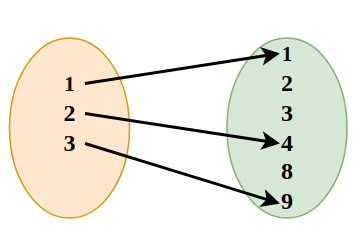
Example: The relation R = {(1, 1), (2, 4), (3, 9)} is represented using the following diagram:
As we know, any set of ordered pairs that are related to a unique relation we have domain and range, i.e., for R such that R(A × B,) such that {(a, b) where a ∈ A and b ∈ B} we have domain and range of R.
Here, the set of values of A is called the domain, and the set of values of b is called the range.
The domain of any Relation is the set of input values of the relation. For example, if we take two sets A and B, and define a relation R: {(a, b): a ∈ A, b ∈ B}, then the set of values of A is called the domain of the function.
The image given below represents the domain of a relation.
Range of any Relation is the set of output values of the relation. For example, if we take two sets A and B, and define a relation R: {(a,b): a ∈ A, b ∈ B}, then the set of values of B is called the range of the function.
The image given below represents the range of a relation.
We define the codomain of the relation R as the set B of the Cartesian product A×B on which the relation is defined. Now it is clear that the range of the function is a proper subset of the Codomain.
Range ⊆ Codomain
Example: Take a set S = {4, 5, 6, 9, 10, 11, 12, 13, 17} and define a relation A from S to S such that in the ordered pair (x, y) in A, y is two more than x.
Solution:
We define R as,
S = {4, 5, 6, 9, 10, 11, 12, 13, 17}
y = x + 2 , we want to pair it with another element y from the same set such that y is exactly 2 more than x.
Pairs:
x = 4, x + 2 = 6 ∈ S ⇒ (4, 6) ∈ A
x = 5, x + 2 = 7 ∉ S ⇒ (5, 7) ∉ A
.
.
.
Valid pairs we found: (4, 6), (9, 11), (10, 12),(11, 13)R = {(4, 6), (9, 11), (10, 12),(11, 13)}
Thus,
- Domain of R is (4, 9, 10, 11)
- Range of R is (6, 11, 12, 13)
- Codomain is (4, 5, 6, 9,10,11,12,13, 17)
Steps to find the Domain and Range of any relation are given as follows:
We can find the domain of relation in many different ways, depending on the provided information. Steps to find the domain are listed below:
From a Set of Ordered Pairs
From an Equation
From a Graph
We can find the range of relation in many different ways, depending on the provided information. Steps to find the domain are listed below:
From a Set of Ordered Pairs
From an Equation
From a Graph
Question 1: Find the domain and range of the relation R: {(a,a2) | a ∈ A, a2 ∈ A} which is defined on A×A and the set A = {1, 2, 3, 4, 5, 6, 7, 8, 9}.
Solution:
Set A = {1, 2, 3, 4, 5, 6, 7, 8, 9}
Relation R = {(a,a2) | a ∈ A, a2 ∈ A} , defined on A×A
If
a = 1 : a2 = 1 ⇒ (1, 1) a2∈ A
a = 2 : a2 = 4 ⇒ (2, 4) a2∈ A
a = 3 : a2 = 9 ⇒ (3, 9) a2∈ A
a = 4 : a2 = 16 ⇒ (4, 16) a2∉ ARelation R is defined as,
R = {(1,1), (2,4), (3,9)}
- Domain of R = {1,2,3}
- Range of R = {1,4,9}
- Codomain of R = Set A = = {1,2,3,4,5,6,7,8,9}
Question 2: Find the domain and range of the relation R: {(a, a+3) | a ∈ A, a + 3 ∈ A} which is defined on A×A and the set A = {1, 2, 3, 4, 5, 6, 7, 8, 9}.
Solution:
Set A = {1, 2, 3, 4, 5, 6, 7, 8, 9}
Relation R={(a, a + 3 ) | a ∈ A , a + 3 ∈ A}, defined on A × A
Check values of a in A for which a + 3 ∈ A
If
a = 1 : a + 3 = 4 ⇒ (1, 4) a + 3 ∈ A
a = 2 : a + 3 = 5 ⇒ (2, 5) a + 3 ∈ A
a = 3 : a + 3 = 6 ⇒ (3, 6) a + 3 ∈ A
a = 4 : a + 3 = 7 ⇒ (4, 7) a + 3 ∈ A|
a = 5 : a + 3 = 8 ⇒ (5, 8) a + 3 ∈ A
a = 6 : a + 3 = 9 ⇒ (6, 9) a + 3 ∈ A
a = 7 : a + 3 = 10 ⇒ (7, 10) a + 3 ∉ A
a = 8 : a + 3 = 11 ⇒ (8, 11) a + 3 ∉ A
a = 9 : a + 3 = 12 ⇒ (9, 12) a + 3 ∉ ANow form the ordered pairs (a, a + 3):
Fora = 1 : (1, 4)
a = 2 : (2, 5)
a = 3 : (3, 6)
a = 4 : (4, 7)
a = 5 : (5, 8)
a = 6 : (6, 9)Relation R is defined as,
R = {(1, 4),(2, 5),(3, 6), (4, 7), (5, 8), (6, 9)}
- Domain of R = {1, 2, 3, 4, 5, 6}
- Range of R = {4, 5, 6, 7, 8, 9}
- Codomain of R = Set A = {1, 2, 3, 4, 5, 6, 7, 8, 9}
Question 3: Find the domain and range of the relation R: {(a, b) | a+b = 7 a ∈ A, b ∈ B} which is defined on A×B and the set A = {1, 2, 3, 4} B = {5, 6, 7, 8, 9}.
Solution:
Set A={1, 2, 3, 4}
Set B={5, 6, 7, 8, 9}
Relation R={(a, b)∣a + b = 7, a ∈ A, b ∈ B}
If
a = 1 : a + b = 7, b = 6 ⇒ (1, 6) b ∈ B
a = 2 : a + b = 7, b = 5⇒ (2, 5) b ∈ B
a = 3 : a + b = 7, b = 4⇒ (3, 4) b ∉ B
a = 4 : a + b = 7, b = 3⇒ (4, 3) b ∉ BRelation R is defined as,
R = {(1,6), (2,5)}
- Domain of R = {1, 2}
- Range of R = {6, 5}
- Codomain of R = Set B = {5, 6, 7, 8, 9}