|
VOOZH | about |
|
VOOZH | about |
A parabola is a conic section defined as the locus of all points in a plane that are equidistant from a fixed point, called the focus, and a fixed straight line, called the directrix. It is a symmetric, U-shaped curve in coordinate geometry.
A parabola is a U-shaped curved line where every point on the line is at an equal distance from the focus and directrix of the parabola.
The equation of a parabola depends on its orientation and vertex.
y = a(x − h)² + k → vertical parabola
x = a(y − k)² + h → horizontal parabola
Here, (h, k) is the vertex.
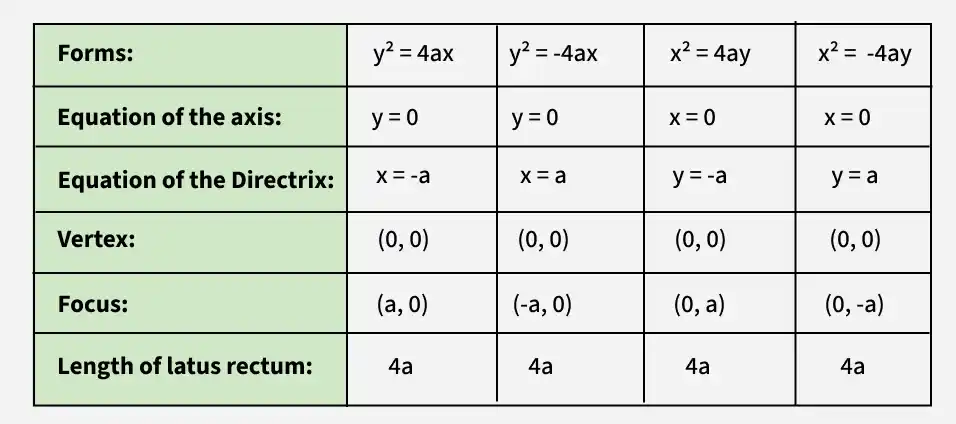
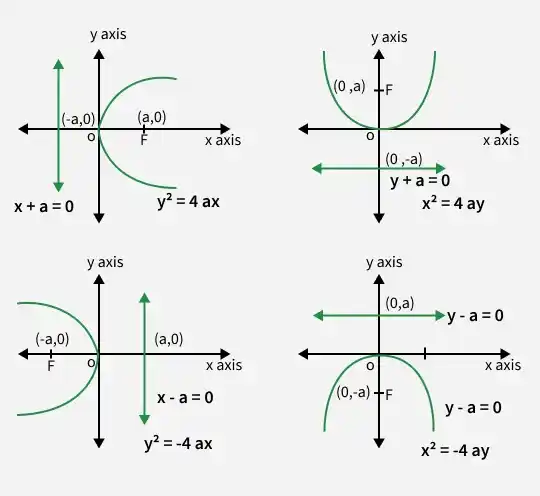
There are four standard equations of a parabola:
The image below presents the four standard equations and forms of the parabola.
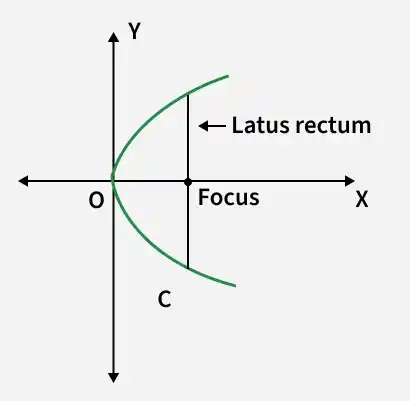
The latus rectum is a line segment of a parabola that passes through the focus and is perpendicular to the axis. Its endpoints lie on the parabola, and its length is 4a, where a is the distance between the vertex and the focus.
The eccentricity of a parabola is defined as the ratio of the distance of any point on the parabola from the focus to its perpendicular distance from the directrix.
For a parabola, this ratio is always equal to 1. This means that every point on the parabola is equally distant from the focus and the directrix.
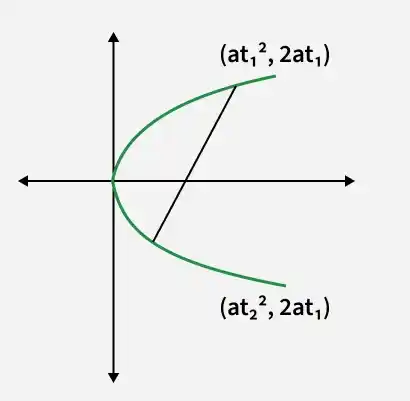
For the parabola y² = 4ax, the equation of the chord joining two points with parameters t₁ and t₂ is:
2x − y(t₁ + t₂) + 2a t₁t₂ = 0
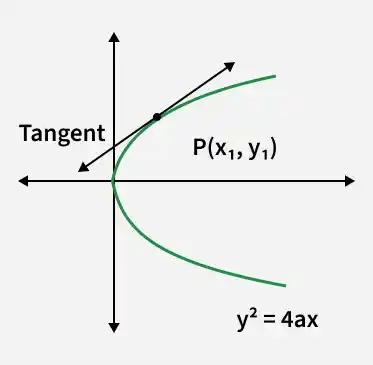
A tangent to a parabola is a straight line that touches the curve at exactly one point.
For the parabola y² = 4ax, the equation of the tangent can be written in the following forms:
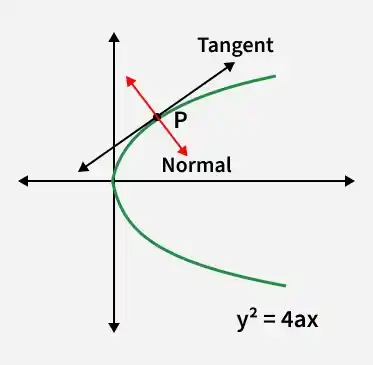
A normal to a parabola is a straight line that is perpendicular to the tangent at a given point and passes through that point.
For the parabola y² = 4ax, the equation of the normal can be written in the following forms:
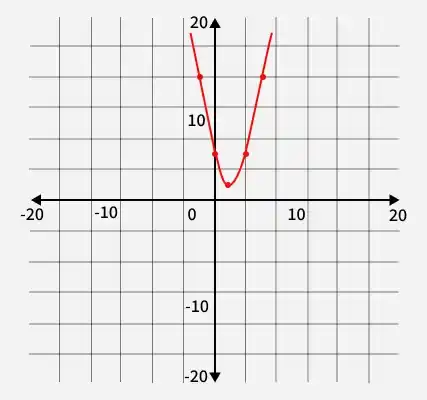
Consider the quadratic equation y = 3x² − 6x + 5
Here, a = 3, b = −6, and c = 5.
Solution:
- Direction: Since a > 0, the parabola opens upward.
- Vertex (h, k):
h = −b / 2a = 6 / (2 × 3) = 1
k = f(1) = 3(1)² − 6(1) + 5 = 2
⇒ Vertex = (1, 2)- Axis of Symmetry: x = 1
- Focus: h, k + 1/4a) = (1, 25/12)
- Directrix: y = k − 1/4a = 23/12
- Length of Latus Rectum: 1/a = 1/3
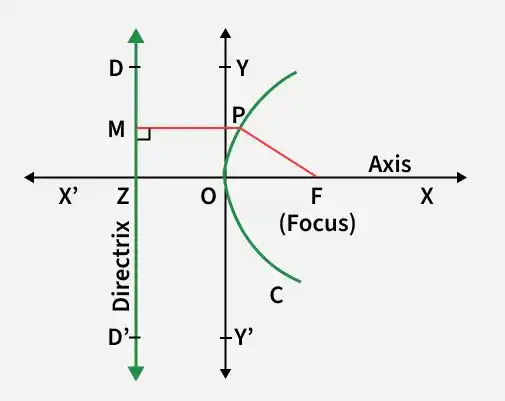
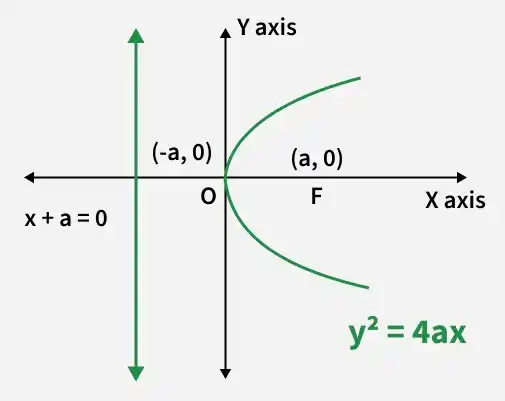
Take a point P with coordinates (x, y) on the parabola, which lies on the xy-plane. By the definition of the parabola, the distance of any point on the parabola from the focus and from the directrix is equal.
Now, the distance of P from the directrix is given by PB, where the coordinates of B are (-a, y) as it lies on the directrix, and the distance of P from the focus is PF.
An image of a parabola is shown below:
By the definition of parabola, PF = PB . . . .(1)
Using Distance Formula, we get
PF = √(x-a)2+(y-0)2= √{(x-a)2+y2} . . . .(2)
PB = √{(x+a)2} . . . .(3)
By using, equations (1), (2), and (3), we get
√{(x-a)2+y2} = √{(x+a)2}
⇒ (x - a)2 + y2 = (x + a)2
⇒ x2 + a2 - 2ax + y2 = x2 + a2 + 2ax
⇒ y2 - 2ax = 2ax
y2 = 4ax
Similarly, the equations for other parabolas, i.e., x2 = 4ay, y2 = -4ax, and x2 = -4ay, can also be proved.
Some important parabola formulas are added in the table below:
| Formula/Property | Equation or Description |
|---|---|
| Standard Equation of a Parabola | y2 = 4ax (or x2 = 4ay for a different orientation) |
| Focus | (a, 0) for y2 = 4ax (or (0, a) for x2 = 4ay) |
| Directrix | x = -a for y2 = 4ax (or y = -a for x2 = 4ay) |
| Latus Rectum | 4a |
| Eccentricity | 1 |
| General Equations of a Parabola | y = a(x – h)2 + k OR x = a(y – k)2 + h |
| Parametric Equation of a Parabola | x = 2at, y = at2 |
| Equation of Tangent | yy1 = 2a(x + x1) |
| Equation of Tangent in Parametric Form | ty = x + at2 [where, (at2, 2at) is the point of contact] |
| Equation of Tangent in Slope Form | y = mx + a/m [where m is the slope of the tangent] |
| Pair of Tangents from an External Point | (y2 - 4ax)( y12 -4ax1) = [yy1 – 2a(x + x1)]2 |
| Director Circle | Directrix, i.e., x = -a [For y2 = 4ax] |
| Chord of Contact | yy1 – 2a(x + x1) = 0 |
| Equation of Normal in Slope Form | y = mx – 2am – am3 |
| Equation of Normal in Normal Form | y – y1 = (-y1/2a)(x – x1) |
| Equation of Normal in Parametric Form | y = -tx + 2at + at3 |
Example 1: The ind. coordinates of the focus and axis, the equation of the directrix, and the latus rectum of the parabola y2 = 16x.
Solution:
Given equation of the parabola is: y2 = 16x
Comparing with the standard form y2 = 4ax,
4a = 16 ⇒ a = 4
The coefficient of x is positive so the parabola opens to the right.
Also, the axis of symmetry is along the positive x-axis.
Therefore,
Focus of the parabola is (a, 0) = (4, 0).
Equation of the directrix is x = -a, i.e. x = -4
Length of the latus rectum = 4a = 4(4) = 16
Example 2: Find the equation of the parabola that is symmetric about the y-axis and passes through the point (3, 4).
Solution:
Since the parabola is symmetric about the y-axis and has vertex at the origin, its equation is of the form:
x² = 4aySubstituting the point (3, 4):
(3)² = 4a(4)
9 = 16a
a = 9/16So, the equation becomes:
x² = 4 × (9/16)y
x² = (9/4)yMultiplying both sides by 4:
4x² = 9y
Example 3: Find the coordinates of the focus and axis and the equation of the directrix and latus rectum of the parabola y2 = 8x.
Solution:
Given equation of the parabola is: y2 = 8x
Comparing with the standard form y2 = 4ax,
4a = 8
a = 2
The coefficient of x is positive so the parabola opens to the right.
Also, the axis of symmetry is along the positive x-axis.
Therefore,
Focus of the parabola is (a, 0) = (2, 0).
Equation of the directrix is x = -a, i.e. x = -2
Length of the latus rectum = 4a = 4(2) = 8
Example 4: Find the coordinates of the focus, the axis, the equation of the directrix, and the latus rectum of the parabola y2 = 52x.
Solution:
Given equation of parabola is: y2 = 52x
Comparing with the standard form y2 = 4ax,
4a = 52
a = 13
The coefficient of x is positive so the parabola opens to the right.
Also, the axis of symmetry is along the positive x-axis.
Therefore,
Focus of the parabola is (a, 0) = (13, 0).
Equation of the directrix is x = -a, i.e. x = -13
Length of the latus rectum = 4a = 4(13) = 52
Example 5: Find the coordinates of the focus, the axis, the equation of the directrix, and the latus rectum of the parabola x2 = 16y.
Solution:
Given equation of parabola is: x2 = 16y
Comparing with standard form x2 = 4ay,
4a = 16
a = 4
The coefficient of x is positive so the parabola opens upward.
Also, the axis of symmetry is along the positive x-axis.
Therefore,
Focus of the parabola is (0,a) = (0, 4).
Equation of the directrix is y= -a, i.e. y = -4
Length of the latus rectum = 4a = 4(4) = 16
Q1. Find the vertex, focus, and directrix of the parabola with the equation y = x² - 4x + 3.
Q2. Determine whether the parabola with the equation y = -2x² + 4x - 1 opens upward or downward, and find its vertex.
Q3. Given the equation 4x - 16y = 0, rewrite it in standard form and find the vertex, focus, and directrix of the parabola.
Q4. Solve for x in the equation 2x - 3x - 5 = 0, and determine the nature of the roots with respect to the corresponding parabola.
Answer:-
- Vertex: (2, −1), Focus: (2, −3/4), Directrix: y = −5/4.
- downward, Vertex: (1, 1).
- Vertex: (0, 0), Focus: (0, 1), Directrix: y = −1.
- x = -1, 5/2 real and distinct.