|
VOOZH | about |
|
VOOZH | about |
A quadratic equation is a polynomial equation of degree 2 in one variable. For example, x2 - 11x + 28, 3x2 - 11x + 23 = 0, etc.
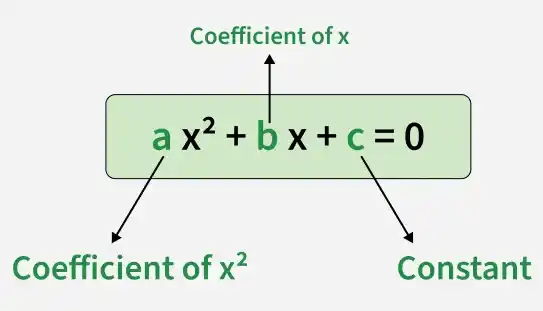
Its standard form is:
- Where a, b, and c are constants, x is the variable, and a ≠ 0.
The values of x that satisfy the equation are called the roots (or solutions) of the quadratic equation
The roots of a quadratic equation are the values of x that make the equation equal to zero. In simple terms, roots are the solutions of the quadratic equation.
A quadratic equation is written in the standard form ax² + bx + c = 0, where a ≠ 0.
The values of x that satisfy this equation are called the roots or zeros of the quadratic equation. These roots also represent the points where the graph of the quadratic function (a parabola) intersects the x-axis.
Example: Consider the quadratic equation x² − 3x − 4 = 0
The roots of this equation are x = −1 and x = 4, because both values satisfy the equation.
For x = −1
(−1)² − 3(−1) − 4 = 1 + 3 − 4 = 0For x = 4
(4)² − 3(4) − 4 = 16 − 12 − 4 = 0
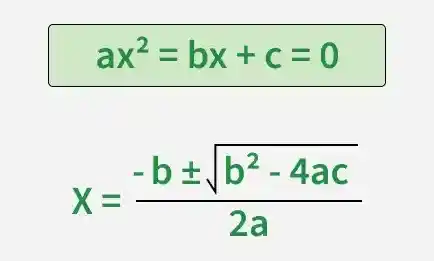
The quadratic formula is a method used to find the roots of a quadratic equation, especially when the equation cannot be easily factored. For a quadratic equation of the form ax² + bx + c = 0, the roots are given by:
The ± sign gives the two possible roots of the equation. This formula is also known as the Sridharacharya formula.
Example: Find the roots of the quadratic equation x² − 3x − 4 = 0 using the quadratic formula.
Solution:
Here, a = 1 ,b = −3 and c = −4
Using the quadratic formula:
x = (-b ± √(b² − 4ac)) / 2aSubstitute the values:
x = [−(−3) ± √((−3)² − 4(1)(−4))] / 2(1)
= [3 ± √(9 + 16)] / 2
= [3 ± √25] / 2
= (3 + 5) / 2 or (3 − 5) / 2
= 8/2 or −2/2
x = 4 or x = −1
Therefore, the roots of the equation are 4 and −1.
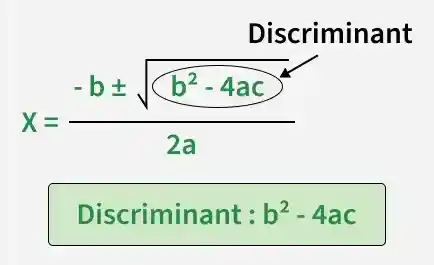
The nature of the roots of a quadratic equation can be determined without actually solving the equation. This is done using the discriminant.
For a quadratic equation ax² + bx + c = 0, the discriminant is given by:
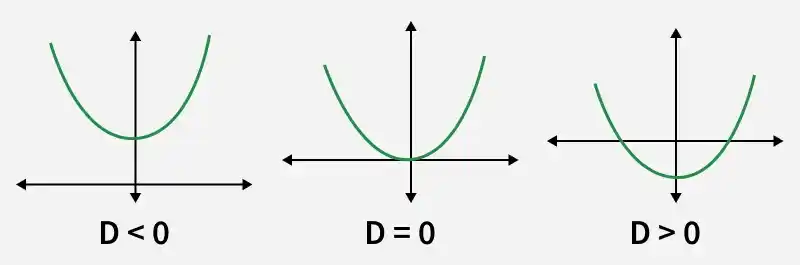
The value of the discriminant helps us understand the type of roots of the equation.
Thus, the discriminant determines the nature of the roots of a quadratic equation.
For a quadratic equation of the form ax² + bx + c = 0, the sum and product of the roots can be found directly using the coefficients of the equation without actually solving it.
Let the roots of the equation be α and β.
- Sum of the roots: α + β = −b/a
- Product of the roots: αβ = c/a
Example: Find the sum and the product of the roots of the equation 2x2 + 5x + 3 = 0.
Solution:
Given quadratic equation, 2x2 + 5x + 3 = 0
Comparing with, ax2 + bx + c = 0
We get, a = 2, b = 5, c =3
- Sum of Roots = α + β = -b/a = -5/2
- Product of Roots = αβ = c/a = 3/2
If α and β are the roots of a quadratic equation, the equation can be written using the formula x² − (α + β)x + αβ = 0
This means the sum of the roots (α + β) and the product of the roots (αβ) help in forming the quadratic equation.
Example: Find the quadratic equation whose roots are 4 and −1.
Solution:
Given, α = 4 and β = −1
Sum of roots: α + β = 4 + (−1) = 3
Product of roots: αβ = 4 × (−1) = −4
Using the formula: x² − (α + β)x + αβ = 0
x² − 3x − 4 = 0
Therefore, x² − 3x − 4 = 0 is the required quadratic equation.
Two quadratic equations are said to have common roots if they share at least one solution.
Consider two quadratic equations:
- a₁x² + b₁x + c₁ = 0
- a₂x² + b₂x + c₂ = 0
If these equations have one common root, then the following condition must be satisfied: (a₁b₂ − a₂b₁)(b₁c₂ − b₂c₁) = (a₂c₁ − a₁c₂)²
If both roots are common, then the coefficients of the equations are proportional:
a₁/a₂ = b₁/b₂ = c₁/c₂
Thus, two quadratic equations can have either one common root or both roots common, depending on the relationship between their coefficients.
Example: Find the value of k such that the quadratic equations x² − 5x + 6 = 0 and x² − 3x + k = 0 have a common root.
Solution:
Let the common root be α.
From the first equation:
α² − 5α + 6 = 0 ...(1)From the second equation:
α² − 3α + k = 0 ...(2)Subtract (2) from (1): (α² − 5α + 6) − (α² − 3α + k) = 0
−2α + 6 − k = 0
α = (6 − k)/2
Substitute in equation (1):
((6 − k)/2)² − 5((6 − k)/2) + 6 = 0
k² − 2k = 0
k(k − 2) = 0
k = 0 or k = 2
Therefore, the values of k are 0 and 2.
Finding the roots of a quadratic equation means determining the values of x that satisfy the equation ax² + bx + c = 0. The points that satisfy this equation are called solutions or roots of this quadratic equation.
These are the four common methods for solving a quadratic equation:
where a, b, and c are the coefficients from the quadratic equation ax + bx + c = 0.
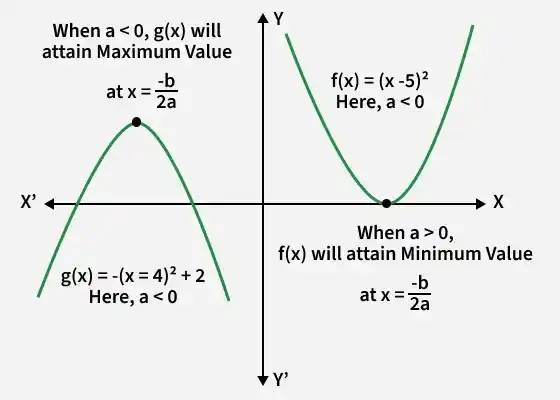
A quadratic function is written as f(x) = ax² + bx + c. Its graph is a parabola. The maximum or minimum value of the function occurs at the vertex of the parabola, whose x-coordinate is x = −b / 2a
The domain of a quadratic function is all real numbers (−∞, ∞).
Example 1: Check whether the following equation is a quadratic equation or not. (x - 2)(x + 1) = (x - 1)(x + 3)
Solution:
We know that a quadratic equation must be of degree 2.
Let's simplify and check the given equation.
(x - 2)(x + 1) = (x - 1)(x + 3)
⇒ x2 + x - 2x - 2 = x2 + 3x - x - 3
⇒ x2 - x - 2 = x2 + 2x - 3
⇒ -x - 2 = 2x - 3
⇒ -3x + 1 = 0This equation is of degree 1. Thus, it cannot be a quadratic equation.
Example 2: Find the quadratic equation having the roots 4 and 9, respectively.
Solution:
The quadratic equation having the roots α, β, is (x - α)(x - β) = 0
Given,
α = 4, and β = 9Therefore the required quadratic equation is,
(x - 4)(x - 9) = 0
x2 - 9x - 4x + 36 = 0
x2 - 13x + 36 = 0Thus, the required quadratic equation is x2 - 13x + 36 = 0
Example 3: The equation 3x² + 5x + 9 = 0 has roots α and β. Find the quadratic equation whose roots are 1/α and 1/β.
Solution:
Given equation 3x2 + 5x + 9 = 0
Comparing with ax2 + bx + c = 0
a = 3, b = 5 and c = 9α + β = -b/a = -5/3
αβ = c/a = 9/3 = 3Roots of the new equation are 1/α and 1/β.
Sum of Roots = (α + β)/α β = (-5/3)/(3) = -5/9
x2 - (-5/9)x + 1/3 = 0
Simplifying,9x2 + 5x + 3 = 0