|
VOOZH | about |
|
VOOZH | about |
A vector space V over a field F is a collection of vectors that is closed under vector addition and scalar multiplication. These operations satisfy certain axioms that ensure the structure is well-defined and widely applicable in various mathematical and real-world contexts, such as linear algebra, geometry, physics, and computer science.
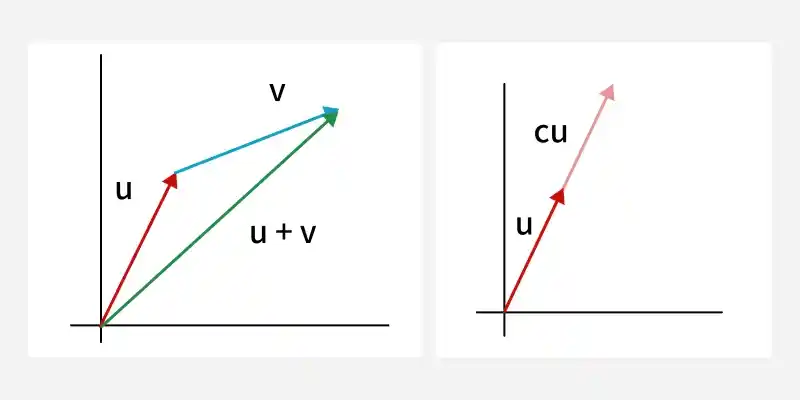
- Vector Addition - An operation in which two vectors u and v are added to produce a new vector u + v that also belongs to the vector space V (u + v ∈ V).
- Scalar Multiplication - An operation in which a scalar c and a vector v are multiplied to produce a new vector cv that also belongs to the vector space V (cv ∈ V).
Ten axioms can define a vector space. Let x, y, & z be the elements of the vector space V, and a & b be the elements of the field F.
1. Closed Under Addition
For every element x and y in V, x + y is also in V.
2. Closed Under Scalar Multiplication
For every element x in V and scalar a in F, ax is in V.
3. Commutativity of Addition
For every element x and y in V, x + y = y + x.
4. Associativity of Addition
For every element x, y, and z in V, (x + y) + z = x + (y + z).
5. Existence of the Additive Identity
There exists an element in V which is denoted as 0 such that x + 0 = x, for all x in V.
6. Existence of the Additive Inverse
For every element x in V, there exists another element in V that we can call -x such that x + (-x) = 0.
7. Existence of the Multiplicative Identity
There exists an element in F notated as 1 so that for all x in V, 1x = x.
8. Associativity of Scalar Multiplication
For every element x in V, and for each pair of elements a and b in F, (ab)x = a(bx).
9. Distribution of Elements to Scalars
For every element a in F and every pair of elements x and y in V, a(x + y) = ax + ay.
10. Distribution of Scalars to Elements
For every element x in V, and every pair of elements a and b in F, (a + b)x = ax + bx
Real Numbers (ℝ): The Set of all real numbers forms a vector space under standard addition and scalar multiplication. For example, any two real numbers can be added together (resulting in another real number), and any real number can be multiplied by a scalar (another real number) to give another real number.
Euclidean Space (ℝn): This is the classic n-dimensional vector space where vectors are represented as n-tuples of real numbers. For example, in ℝ3 (3-dimensional Euclidean space), vectors could be defined as (x, y, z), where x, y, and z are real numbers.
Polynomials: A Set of all polynomials with coefficients from a field (like ℝ or ℂ) forms a vector space.
For example, the set of all quadratic polynomials ax2 + bx + c, where a, b, and c are real numbers, is a vector space under polynomial addition and scalar multiplication. This set includes the zero polynomial 0 = 0x² + 0x + 0, and for any p(x), 0·p(x) = 0 ∈ P₂, ensuring closure under scalar multiplication.
Matrices: A Set of all matrices of a fixed size (e.g., m x n matrices) with entries from a field forms a vector space. Matrices can be added together element-wise, and scalar multiplication involves multiplying each element of the matrix by a scalar.
Is the set of all 2×2 matrices with real entries a vector space? Explain by verifying if the set satisfies the vector space axioms.
Solution:- Let two Matrices A = and B = then
1. Closure under Addition:
A+B=
Since the sum of two 2×2 matrices is also a 2×2 matrix, the set is closed under addition.
2. Closure under Scalar Multiplication:
For a matrix A and scalar c∈R , scalar multiplication results in
cA=Since multiplying a 2×2 matrix by a scalar produces another 2×2 matrix, the set is closed under scalar multiplication.
3. Commutativity of Addition
In matrix addition, the dimension does not change and always remains the same, so matrix addition is commutative.
A + B = B + A
4. Associativity of Addition:
For any three matrices A, B, and C, matrix addition is associative,
(A + B) + C = A + (B + C)
This property holds because matrix addition satisfies the associativity property by the definition of matrix addition.
5. Existence of the Additive Identity:
The additive identity in the set of 2×2 matrices is the zero matrix, so the matrix remain same .
6. Existence of the Additive Inverse:
For a matrix A , its additive is, - A
so , A+(-A)=Thus, every matrix has an additive inverse.
7. Existence of the Multiplicative Identity:
The multiplicative identity in the scalar multiplication of matrices is 1. For any matrix A, multiplying it by 1 results in the original matrix
1⋅A = A, So, the set is closed under scalar multiplication by 1.
8. Associativity of Scalar Multiplication:
For any scalar c,d∈R and matrix A, scalar multiplication is associative
c (dA) = (cd)AThis property holds because scalar multiplication satisfies associativity by the definition of scalar operations on matrices.
9. Distributive Property of Scalar Multiplication over Vector Addition:
For any scalars c and matrices A and B,
c(A + B) = cA + cBThis property is satisfied because matrix addition and scalar multiplication are defined in such a way that this distributive property holds.
10. Distributive Property of Scalar Multiplication over Scalar Addition:
For any scalars c and d and matrix A,
(c + d)A = cA + dAThis property holds due to the distributive property of scalar multiplication with respect to scalar addition.
Since the set of all 2×2 matrices with real entries satisfies all 10 axioms of a vector space, it forms a vector space under matrix addition and scalar multiplication.
Number of vectors in a basis for V is called the dimension of V.
For example, the dimension of Rn is n. The dimension of the vector space of polynomials in x with real coefficients having degree at most two is 3.
Let V be a subspace of Rn for some n. A collection B = {v1, v2, …, vr} of vectors from V is said to be a basis for V if B is linearly independent and spans V. If either one of these criteria is not satisfied, then the collection is not a basis for V.
If a collection of vectors spans V, then it contains enough vectors so that every vector in V can be written as a linear combination of those in the collection. If the collection is linearly independent, then it doesn't contain so many vectors that some become dependent on the others.
Vector addition and scalar multiplication are two main concepts in vector space:
Vector Addition: When you add two vectors, you add their corresponding components.
For example, if you have two vectors v = ⟨v1, v2, v3⟩and w = ⟨w1, w2, w3⟩ their sum v+ w is ⟨v1+w1, v2+w2, v3+w3⟩. Geometrically, vector addition represents the process of moving one vector's endpoint to the other vector's endpoint, forming a new vector from the initial point of the first vector to the final point of the second vector.
Scalar Multiplication: Scalar multiplication involves multiplying a vector by a scalar.
For example, if you have a vector ⟨v = v1, v2, v3⟩ and a scalar k, then the scalar multiple k is ⟨kv1, kv2, kv3⟩. Geometrically, scalar multiplication stretches or compresses the vector without changing its direction, depending on whether the scalar is greater than 1 or between 0 and 1
Let v1, v2,…, vr be vectors in Rn. A linear combination of these vectors is any expression of the form
k1v1 + k2v2 + ......... + krVr
where the coefficients k1, k2,…, kr are scalars.
A subset W of a vector space V is called a subspace of V if W is itself a vector space under the addition and scalar multiplication defined on V.
Subspaces are subsets of a vector space that themselves form vector spaces. Operations of vector addition and scalar multiplication from the larger vector space are applicable to the vector space. Subspaces satisfy all axion/properties of a vector space.
They can be lower-dimensional spaces within the larger vector space and can provide insights into the structure and properties of the vector space as a whole.
Vector Space | Euclidean Space |
|---|---|
A vector space is an abstract algebraic structure defined by vector addition and scalar multiplication. | Euclidean space is a geometric space characterized by distances and coordinates. |
A vector space focuses on the algebraic properties of vectors and their operations. | Euclidean space focuses on the geometric properties of points, lines, distances, and angles within a specific coordinate system. |
Vector spaces are used in linear algebra and various mathematical theories. | Euclidean spaces are used extensively in geometry, physics, engineering, and other fields where spatial relationships and measurements are important. |
Vector Spaces are also used in Machine Learning, and their various other uses are:
Question 1. For scalars α = 3, β = 4, and vectors u = (1, 2) and v = (3, 4), verify the following properties of scalar multiplication
i) α(u + v) = αu + αv and
ii) (α+β)u = αu + βu.
Question 2. Let V = {(x, y) ∈ R2∣x ≥ 0,y ≥ 0} be the set of vectors in the first quadrant. Is this set closed under addition?
Question 3. Let v = (3, −4) be an element of R2. Find the additive inverse of v and verify that v + (−v) = 0, where 0 is the zero vector in R2.
Question 4. Consider the set V = of all 2 × 2 matrices with real entries. Is this set a vector space?