|
VOOZH | about |
|
VOOZH | about |
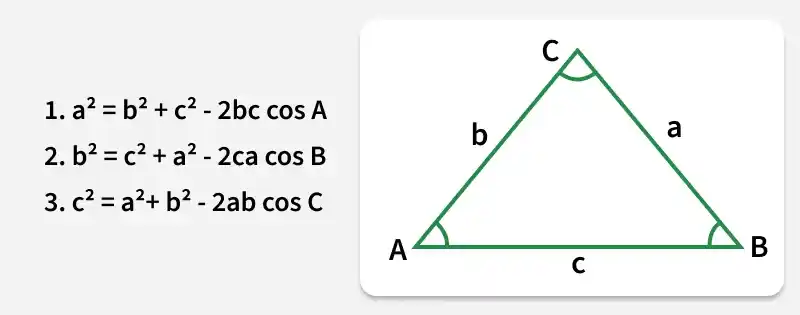
The law of cosines is used to find the relation between sides and the angles of the triangle. Suppose we are given the sides of the triangle, and then the angle of the triangle is found.
Where a, b, and c are the sides of the triangle and A, B, and C are the angles of the triangle. This law is also called the Cosine Rule or the Cosine Formula.
Defined as the law that gives the relation between sides and angles of the triangle.
We can also find the angles of the triangle by the formulas.
- cos A = [b2 + c2 – a2]/2bc
- cos B = [a2 + c2 – b2]/2ac
- cos C = [b2 + a2 – c2]/2ab
The Law of Cosines is a powerful tool for solving triangles that are not right-angled. In particular, it helps in situations where the Law of Sines may not be applicable, such as the following:
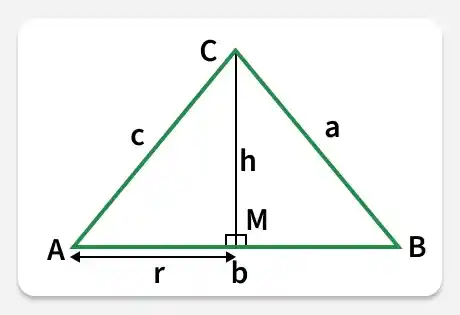
Law of cosines is proved using trigonometric identities. Suppose we are given a triangle ABC and BM is the altitude of the triangle and its height is h and AM is equal to r. Also, sides of the triangle a, b, and c; the image for the same is added below.
In ΔABM,
From equation (i) (ii),
By Pythagoras Theorem in ΔBMC,
a2 = h2 + (b - r)2
Then,
Using h = c(sin A) and r = c(cos A) in above equation
⇒ a2 = {c(sinA)}2 + {b - c(cosA)}2
⇒ a2 = c2sin2A + b2 + c2cos2A - 2bc cosA
⇒ a2 = c2(sin2A + cos2A) + b2 - 2bc cosA
a2 =b2 + c2 - 2bc cosA
This is the cosine formula.
Similarly, the other two formulas are also proved.
Example 1: If two sides of the triangle are 12 cm and 16 cm and the angle between them is 30°, then find the third side of the triangle.
Given,
- b = 12 cm
- c = 16 cm
- ∠A = 30°
Law of Cosines Formula,
a2 = b2 + c2 - 2bc·cosA
⇒ a2 = (12)2 + (16)2 - 2(12)(16)cos30°
⇒ a2 = 144 + 256 - (384)(1/2) = 208
⇒ a = 14.4 cm
Thus, the third side of the triangle is 14.4 cm
Example 2: If two sides of the triangle are 8 cm, 10 cm, and 6 cm, then find the angle 'A' of the triangle.
Given,
- a = 8 cm
- b = 10 cm
- c = 6 cm
Using Cosines Law,
a2 = b2 + c2 – 2bc cos(A)
⇒ cos A = (b2 + c2 – a2)/2bc
Substituting the given value,
cos(A) = (102 + 62 – 82)/(2 × 10 × 6)
⇒ cos(A) = (100 + 36 - 64)/120 = 72/120 = 3/5
⇒ A = cos-1 (3/5)
Example 3: Find ∠A of triangle ABC, where sides of the triangle, a, b, and c, are 1 cm, 1 cm, and √2 cm.
Using cosine rule,
cos A = [b2 + c2 – a2]/2bc
⇒ cos A = {(1)2 + (√2)2 - (1)2}/2(1)(√2) = 2/2√(2)
⇒ cos A = 1/√(2)
⇒ A = cos-1(1/√(2)) = 45°
Problem 1: If two sides of the triangle are 20 cm and 22 cm and the angle between them is 45°, then find the third side of the triangle.
Problem 2: If two sides of the triangle are 3 cm, 4 cm, and 5 cm, then find the angle 'A' of the triangle.
Probelm 3: If two sides of the triangle are 8 cm and 12 cm and the angle between them is 60° then find the third side of the triangle.
Problem 4: If two sides of the triangle are 12 cm, 18 cm, and 16 cm, then find the angle 'A' of the triangle.