|
VOOZH | about |
|
VOOZH | about |
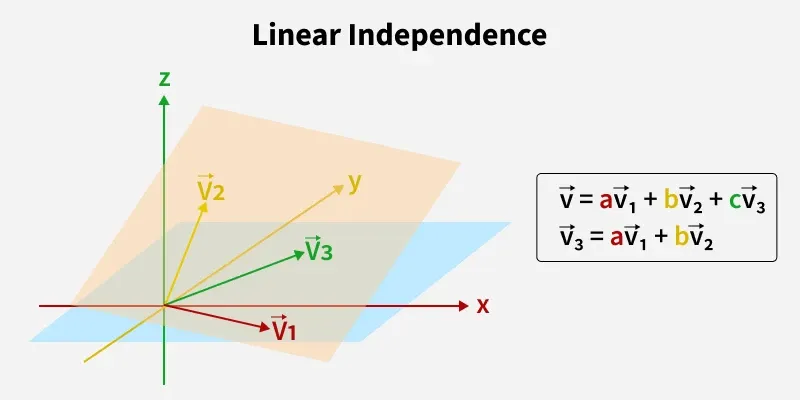
Linear independence is a fundamental concept of linear algebra. It has numerous applications in fields like physics, engineering, and computer science. It is necessary for determining the size of a vector space and finding solutions for optimization problems.
In a vector space, a set of vectors is said to be linearly independent if no vector in the set can be expressed as a linear combination of the other vectors in the set.
For example, in a two-dimensional vector space, the vectors (1, 0) and (0, 1) are linearly independent because no scalar multiple of one can produce the other.
However, the vectors (1, 2) and (2, 4) are linearly dependent because the second vector is simply twice the first.
Note: Each vector in the set provides specific or different directions of the space.
A set of vectors {v1, v2, . . . , vn} is linearly independent if the equation:
c1v1 + c2v2 + . . . + cnvn = 0; has only the trivial solution c1 = c2 = . . . = cn = 0.
In contrast, if there exist non-zero scalars c1, c2 . . . cn such that the equation above holds, then the set of vectors is linearly dependent.
For a set of vectors v1, v2, ..., vn in n-dimensional space, create a matrix M with these vectors as its columns. Then, calculate the determinant of M. If the determinant is
Note: If the set of vectors forms an orthogonal set (i.e., each pair of vectors in the set is orthogonal to each other), then they are linearly independent.
To check for linear independence using matrices:
Step 1: Form a matrix where each column corresponds to one of the vectors.
The first step in determining linear independence is to form a coefficient matrix using the given vectors. Let's denote the given vectors as v1, v2, ..., vn, where each vi is a column vector.
Step 2: Perform row operations to simplify the matrix, then calculate the determinant.
Once we have formed the coefficient matrix A, the next step is to calculate its determinant.
The determinant of a matrix is a scalar value that provides important information about the matrix. For an n × n matrix, the determinant can be computed using various methods such as cofactor expansion, Gaussian elimination, or using properties of determinants
Step 3: If the resulting matrix has a non-zero determinant, the vectors are linearly independent.
If the determinant is non-zero, it implies that the system of equations represented by the coefficient matrix has only the trivial solution (where all coefficients are zero), indicating that the vectors are linearly independent.
On the other hand, if the determinant is zero, it suggests the existence of non-trivial solutions, indicating linear dependence among the vectors.
Example: Consider the following set of vectors in R³:
We want to determine whether these vectors are linearly independent.
Solution:
To test for linear independence, we'll form a matrix where each column represents one of the vectors.
⇒ det(A) = 1[(-1)(1) - (0)(0)] - 2[(2)(1) - (3)(0)] + 3[(2)(0) - (-1)(3)]
⇒ det(A) = 1(-1) - 2(2) + 3(3)
⇒ det(A) = -1 - 4 + 9 = 4Since det(A) ≠ 0, the vectors are linearly independent.
Vectors are considered linearly independent if no vector in a set can be represented as a linear combination of the others. In other words, a set of vectors {v1, v2, . . . , vn} is linearly independent if the only solution to the equation:
c1v1 + c2v2 + . . . + cnvn = 0
(where c1, c2 . . . cn are scalars, not all zero) is the trivial solution where all scalars are zero.
Consider a set of vectors in ℝ³: {(1, 0, 0), (0, 1, 0), (0, 0, 1)}.
These vectors are linearly independent because no vector can be expressed as a linear combination of the others.
Now consider, {(1, 0, 0), (2, 0, 0), (3, 0, 0)}. It would be linearly dependent, as the third vector is a scalar multiple of the first.
Linear independence finds applications in various fields:
To prove linear independence, set up the equation c1v1 + c2v2 + . . . + cnvn = 0. Organize the vectors into a matrix, solve the system AC = 0, and determine if the only solution is c1 = c2 = . . . = cn = 0. If so, the vectors are linearly independent; otherwise, they are dependent.
Problem: Determine if the vectors are linearly independent.
Solution:
We can construct a matrix with these vectors as columns and perform row reduction:
Performing row reduction(R₂ → R₂ − 2R₁), we find:
The matrix has 2 pivot columns (columns 1 and 2), but there are 3 columns total. This means column 3 is a free variable, so the system has a non-trivial solution.
Therefore, the vectors are linearly dependent.
Question 1: Determine whether the vectors are linearly independent or linearly dependent.
Solution:
To check linear independence, we examine the equation:
c1v1 + c2v2 + c3v3 = 0
Substitute the vectors:
\
This gives the system:
Write the augmented matrix:
Apply Gaussian elimination:
R2 ← R2 − 2R1,
R3 ← R3 − 3R1R3 ← R3 − 2R2
The last row is all zeros, indicating a free variable.
Since a non-trivial solution exists (not all constants are zero), the vectors are linearly dependent.
Question 2: Let x be a real number.
Define the following 2×1 Are A1 and A2 linearly independent?
Solution:
Case 1: x ≠ 0
From the second equation:
x = λx
⇒λ = 1Plug into the first:
2+x = 1⋅(1+x)
⇒ 2+x = 1+x
⇒ FalseContradiction → So not linearly dependent in this case.
Case 2: x = 0
Then the vectors become:
So they are linearly dependent when x = 0.
Question 1: Determine whether the following vectors are linearly independent:
Question 2: Let
For what values of x are and linearly independent?
Question 3: Are the following vectors linearly independent?
Question 4: Let
For which values of a,b,c are vector , , are linearly independent?