|
VOOZH | about |
|
VOOZH | about |
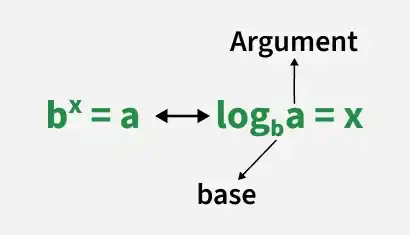
A logarithm is a mathematical concept that provides an alternative way of expressing exponents.
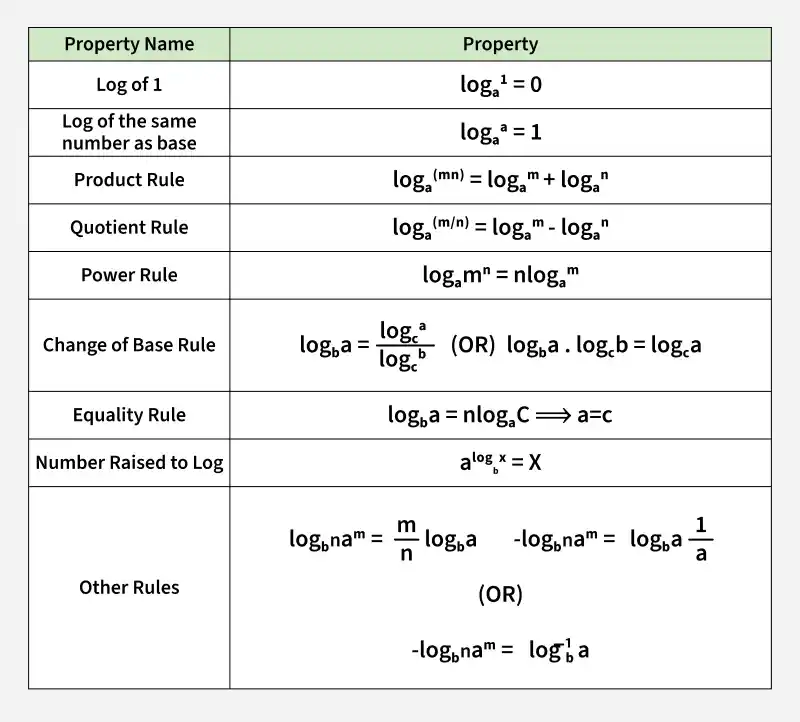
The properties of logarithms are a set of rules that help simplify and solve logarithmic expressions by applying the laws of exponents and are given below.
Various other Logarithm Formulas are:
Example 1: Solve log2(x) = 4
Solution:
log2(x) = 4
24 = x
x = 16
Example 2: Solve log2(8) = x
Solution:
log2(8) = x
⇒ 2x = 8
⇒ 2x = 23
⇒ x = 3
Example 3: Find the value of x if log6(x - 3) = 1.
Solution:
log6(x - 3) = 1
⇒ 61 = (x - 3)
⇒ x - 3 = 6
⇒ x = 9
Example 4: Find x if log(x - 2) + log(x + 2) = log21
Solution:
log(x - 2) + log(x + 2) = log21
⇒ log(x - 2) + log(x + 2) = 0 [log(1) =0]
⇒ log[(x - 2)(x + 2)] = 0 [Product Rule]
⇒ (x - 2)(x + 2) = 1 [Antilog(0) = 1]
⇒ x2 - 4 = 1
⇒ x2 = 5
⇒ x = ±√5 [Log of Negative Number is Not Defined]
⇒ x = √5
Example 5: Find the value of log9(59049).
Solution:
Given log9 (59049) [95= 59049]
= log9(9)5
= 5.log9(9) (identity rule i.e logaa]
= 5
Example 6: Express log10(5) + 1 in form of log10x
Solution:
Given log10(5) + 1
= log10(5) + log1010 [Identity Rule]
= log10(5 × 10) [Product Rule]
= log1050
Example 7: Find the value of x if log10(x2 - 15) = 1.
Solution:
log10(x2 - 15) = 1
log10(x2 - 15) = log1010 [Identity Rule]Applying Antilog,
⇒ (x2 - 15) = 10
⇒ x2 = 25
⇒ x = ±5