|
VOOZH | about |
|
VOOZH | about |
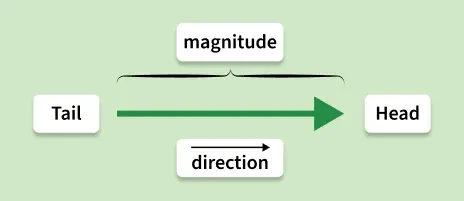
Vector quantities are physical quantities that have both direction and magnitude, like displacement, velocity, force, etc.
For example, if a force of 5i N works on an object, then its magnitude is 5 N, which signifies that the strength of the force applied is 5 N, and ‘i’ in 5i represents that it is applied in the positive x direction.
The magnitude of a vector (sometimes called the length or norm) is a measure of how long the vector is.
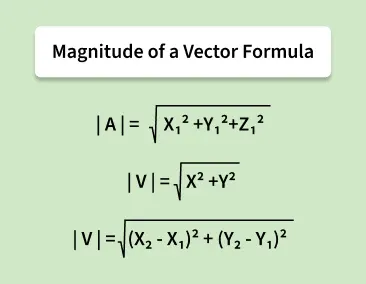
Depending upon the information given, different formulas can be used to find the magnitude of a vector.
The following image shows the different methods used to find the magnitude of the vector.
1. Magnitude of a vector given its Components
This formula extends to any number of dimensions, where the magnitude is the square root of the sum of the squares of all its components.
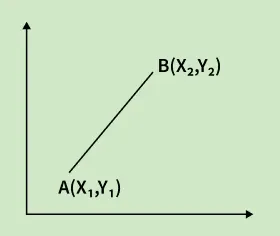
The magnitude of a vector, when the start and endpoints of a vector are given, is nothing but the distance between the points. The formula for finding magnitude is given by
For 3D space, if the points are (x1, y1, z1) and (x2, y2, z2), the formula becomes:
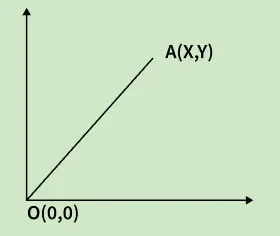
3. Magnitude of a Position Vector (From Origin)
Then the formula for finding the magnitude of a vector where one of the ends of a vector is at the origin is given by
Similarly, in 3D space, if the endpoint is A(x, y, z), the magnitude is:
The magnitude of the vector is calculated using the steps discussed below,
Step 1: Identify the x, y, and z components of the vector.
Step 2: Find the square of all the x, y, and z components.
Step 3: Add all the squares found in Step 2.
Step 4: Find the square root of the sum obtained in Step 3.
The value obtained after step 4 is the magnitude of the given vector.
Example: Find the magnitude of the vector A = 3i + 4j
Solution:
The magnitude of vector A is calculated using the steps discussed above.
Step 1: Comparing A = 3i + 4j with xi + yj we get x = 3 and y = 4
Step 2: x2 = 32 = 9 and y2 = 42 = 16
Step 3: x2 + y2 = 9 + 16 = 25
Step 4: √(25) = 5Thus, the magnitude of the vector A = 3i + 4j is 5 units.
Example 1: Find the magnitude of the vector Ā = 2i + 3ĵ + 4k.
Solution:
Given, Ā = 2i + 3ĵ + 4k
Magnitude |A| =
=
= √29
= 5.38The magnitude of vector 2i+ 3ĵ + 4k is 5.38 unit
Example 2: Find the magnitude for the vector Ā = 3i + 3ĵ - 6k.
Solution:
Given, Ā = 3i + 3ĵ - 6k
Magnitude |A| =
=
= √54
= 7.35The magnitude of vector 3i+ 3ĵ - 6k is 7.35 unit.
Example 3: What is the magnitude of the vector that starts at the origin and endpoint at (3, 4).
Solution:
Given,
Starting Point of vector is O(0, 0)
End Point (x, y) = (3, 4)
Magnitude of Vector (|Ā|) = √(x2+y2)
= √(32 + 42)
= √(9 + 16)
= √25 = 5Thus, the magnitude of the given vector is 5 unit.
Example 4: Find the magnitude of the vector in which one of the endpoints is at the origin and the other point is at (1, 4, 3).
Solution:
Given,
End Point of vector is O(0, 0)
Other Point (x, y, z) = (1, 4, 3)Magnitude of Vector (|Ā|) = √(x2+y2+z2)
=
=
= √26 = 5.09Thus, the magnitude of the given vector is 5.09 unit.
Example 5: Find the magnitude of the vector if the starting point of a vector is (3, 4) and the ending point is (6, 2).
Solution:
Given,
(x1, y1) = (3, 4)
(x2, y2) = (6, 2)|Ā|=
=
= √(32 + (-2)2)
= √(9+4)
= √13
= 3.6Thus, the magnitude of the given vector is 3.6 unit.
Example 6: Find the magnitude of the vector if the starting point of a vector is (2, 1, 4) and the ending point is (5, 2, 6).
Solution:
Given,
(x1, y1, z1) = (2, 1, 4)
(x2, y2, z2) = (5, 2, 6)|Ā| =
=
=
= √(9 +1 + 4)
= √14 = 3.74Thus, the magnitude of the given vector is 3.74 unit.