|
VOOZH | about |
|
VOOZH | about |
Before diving into unimodal and bimodal functions, it's essential to understand the term "modal." A mode refers to the value at which a function reaches a peak, typically a maximum point. The behavior of functions can vary depending on how many peaks or modes they contain, giving rise to classifications like unimodal, bimodal, and even multimodal functions.
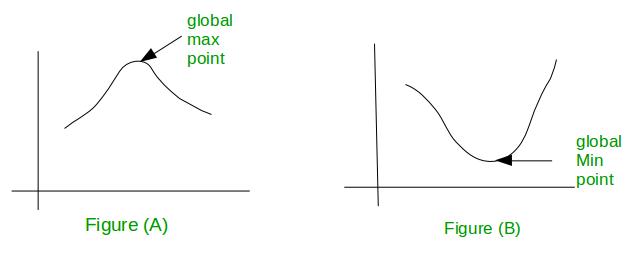
A function f(x) is said to be unimodal function if for some value m it is monotonically increasing for x ≤ m and monotonically decreasing for x ≥ m. For function f(x), maximum value is f(m) and there is no other local maximum.
See figure (A) and (B):
👁 ImageIn figure (A), graph has only one maximum point and rest of the graph goes down from there and in figure (B) graph has only one minimum point and rest of the graph goes up from there. Thus, we can say that if a function has global maximum or global minimum is considered as Unimodal function. Consider a function f(x) in the interval [a, b] and we have to determine value of x for which the function is maximized. The function strictly increase in the interval [a, x] and strictly decrease in the interval [x, b]. For this purpose we can use modified binary search to determine the maximum or value of that function.
Click herefor the program.
Several well-known functions in mathematics exhibit unimodal behavior, including:
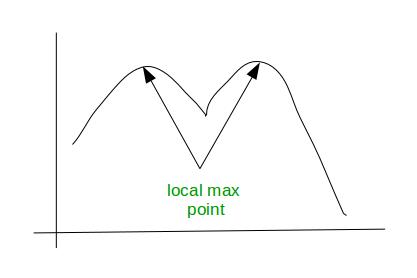
A function is said to be bimodal function if it has two local minima or maxima. Generally bimodal function indicates two different groups. For example, In a class there are lot of students getting grade A and a lot getting grade D. This tell us that in a class there are two different group of student, one group is under-prepared and other group is over-prepared. See this figure for better understanding:
👁 ImageSeveral functions exhibit bimodal behavior, especially in probability theory and statistics:
Understanding whether a function is unimodal or bimodal is crucial in various fields, including:
Unimodal and bimodal functions play a critical role in mathematics, statistics, and applied fields. While unimodal functions are characterized by a single peak, bimodal functions feature two distinct peaks. Understanding these differences helps in analyzing data and solving problems across various domains, from economics to machine learning.
What is the difference between unimodal and bimodal functions?
Unimodal functions have one peak or mode, while bimodal functions have two distinct peaks.
Are all probability distributions unimodal or bimodal?
No, probability distributions can be unimodal, bimodal, or even multimodal, depending on the data they represent.
Why are unimodal functions important in optimization?
In optimization, unimodal functions are crucial because they have a single peak, making it easier to find the global maximum or minimum.