|
VOOZH | about |
|
VOOZH | about |
When data is collected in large amounts, it is often arranged into class intervals. Such data is called grouped data. To understand and analyze this type of data, we use certain representative values known as measures of central tendency.
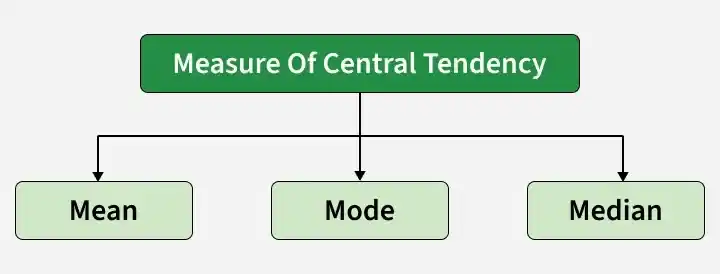
The three main measures used to describe grouped data are the mean, median, and mode.
The mean (or average) of observations is the sum of the values of all the observations divided by the total number of observations. The mean of the data is given by x = f1x1 + f2x2 + .... + fnxn/f1 + f2+... + fn. The mean Formula is given by:
Mean = ∑(fi.xi)/∑fi
To calculate the mean of grouped data, we can use the following methods:
Method 1: Direct Method for Calculating Mean
To find the mean using the direct method, we can use the following steps:
Step 1: For each class, find the class mark xi, as
x = 1/2(lower limit + upper limit)
Step 2: Calculate fi.xi for each i.
Step 3: Use the formula Mean = ∑(fi.xi)/∑fi.
Example: Find the mean of the following data.
Class Interval | 0-10 | 10-20 | 20-30 | 30-40 | 40-50 |
|---|---|---|---|---|---|
Frequency | 12 | 16 | 6 | 7 | 9 |
Solution:
We may prepare the table given below:
Class Interval
Frequency fi
Class Mark xi
( fi.xi )
0-10
12
5
60
10-20
16
15
240
20-30
6
25
150
30-40
7
35
245
40-50
9
45
405
∑fi=50
∑fi.xi=1100
Mean = ∑(fi.xi)/∑fi = 1100/50 = 22
Method 2: Assumed - Mean Method For Calculating Mean
For calculating the mean in such cases, we proceed as under.
Step 1: For each class interval, calculate the class mark x by using the formula: xi = 1/2 (lower limit + upper limit).
Step 2: Choose a suitable value of mean and denote it by A. x in the middle as the assumed mean and denote it by A.
Step 3: Calculate the deviations di = (x, -A) for each i.
Step 4: Calculate the product (fi x di) for each i.
Step 5: Find n = ∑fi
Step 6: Calculate the mean, x, by using the formula: X = A + ∑fidi/n.
Example: Using the assumed-mean method, find the mean of the following data:
Class Interval | 0-10 | 10-20 | 20-30 | 30-40 | 40-50 |
|---|---|---|---|---|---|
Frequency | 7 | 8 | 12 | 13 | 10 |
Solution:
Let A = 25 be the assumed mean. Then we have,
Class Interval Frequency
fi
Mid value
xi
Deviation
di=(xi-25)
(fixdi) 0-10 7 5 -20 -140 10-20 8 15 -10 -80 20-30 12 25 = A 0 0 30-40 13 35 10 130 40-50 10 45 20 200 ∑fi = 50 ∑(fixdi) = 100 Mean = X = A + ∑fidi/n = (25 + 110/50) = 27.2
Check: Arithmetic Mean
Method 3: Step-Deviation Method for Calculating Mean
When the values of x and f are large, the calculation of the mean by the above methods becomes tedious. In such cases, we use the step-deviation method, given below.
Step 1: For each class interval, calculate the class mark x, where X = 1/2 (lower limit + upper limit).
Step 2: Choose a suitable value of x, in the middle of the x, column as the assumed mean and denote it by A.
Step 3: Calculate h = [(upper limit) - (lower limit)], which is the same for all the classes.
Step 4: Calculate ui = (xi -A) /h for each class.
Step 5: Calculate fu for each class and hence find ∑(fi × ui).
Step 6: Calculate the mean by using the formula: x = A + {h × ∑(fi × ui)/ ∑fi}
Example: Find the mean of the following frequency distribution:
Class | 50-70 | 70-90 | 90-110 | 110-130 | 130-150 | 150-170 |
|---|---|---|---|---|---|---|
Frequency | 18 | 12 | 13 | 27 | 8 | 22 |
Solution:
We prepare the given table below,
Class
Frequency
fi
Mid Value
xi
ui=(xi-A)/h
=(xi-100)20
(fixui)
50-70
18
60
-2
-36
70-90
12
80
-1
-12
90-110
13
100=A
0
0
110-130
27
120
1
27
130-150
8
140
2
16
150-170
22
160
3
66
∑fi = 100
∑(fixui) = 61
A = 100, h = 20, ∑fi = 100 and ∑(fi x ui) = 61
x = A + {h × ∑(fi x ui) / ∑fi}
=100 + {20 × 61/100} = (100 + 12.2) = 112.2
We first arrange the given data values of the observations in ascending order. Then, if n is odd, the median is the (n + 1/2). And if n is even, then the median will be the average of the n/2th and the (n/2 + 1)th observation.
The formula for Calculating Median:
Median, Me = l + {h x (N/2 - cf )/f}
Where,
- l = lower limit of median class.
- h = width of median class.
- f = frequency of median class,
- cf = cumulative frequency of the class preceding the median class.
- N = ∑fi
Example: Calculate the median for the following frequency distribution.
Class Interval | 0-8 | 8-16 | 16-24 | 24-32 | 32-40 | 40-48 |
|---|---|---|---|---|---|---|
Frequency | 8 | 10 | 16 | 24 | 15 | 7 |
Solution:
We may prepare cumulative frequency table as given below,
Class
Frequency
Cumulative Frequency
0-8
8
8
8-16
10
18
16-24
16
34
24-32
24
58
32-40
15
73
40-48
7
80
N = ∑fi = 80
Now, N = 80 = (N/2) = 40.
The cumulative frequency just greater than 40 is 58 and the corresponding class is 24-32.
Thus, the median class is 24-32.
l = 24, h = 8, f = 24, cf = c.f. of preceding class = 34, and (N/2) = 40.
Median, Me = l+ h{(N/2-cf)/f}
= 24 + 8 {(40 - 34)/ 24}
= 26Hence, median = 26.
Mode is the,value of a variety that occurs most often. More precisely, the mode is the value of the variable at which the concentration of the data is maximum.
Modal Class: In a frequency distribution, the class having the maximum frequency is called the modal class.
The formula for Calculating Mode:
Mo = xk + h{(fk - fk-1)/(2fk - fk-1 - fk+1)}
Where,
- xk = lower limit of the modal class interval.
- fk = frequency of the modal class.
- fk-1= frequency of the class preceding the modal class.
- fk+1 = frequency of the class succeeding the modal class.
- h = width of the class interval.
Example 1: Calculate the mode for the following frequency distribution.
Class | 0-10 | 10-20 | 20-30 | 30-40 | 40-50 | 50-60 | 60-70 | 70-80 |
|---|---|---|---|---|---|---|---|---|
Frequency | 5 | 8 | 7 | 12 | 28 | 20 | 10 | 10 |
Solution:
Class 40-50 has the maximum frequency, so it is called the modal class.
xk = 40, h = 10, fk = 28, fk-1 = 12, fk+1 = 20
Mode, Mo= xk + h{(fk - fk-1)/(2fk - fk-1 - fk+1)}
= 40 + 10{(28 - 12)/(2 × 28 - 12 - 20)}
= 46.67Hence, mode = 46.67
Note: Relationship among mean, median and mode: Mode = 3(Median) - 2(Mean)
Example 2: Find the mean, mode, and median for the following data.
Class | 0-10 | 10-20 | 20-30 | 30-40 | 40-50 | Total |
|---|---|---|---|---|---|---|
Frequency | 8 | 16 | 36 | 34 | 6 | 100 |
Solution:
We have,
Class
Mid Value xi
Frequency fi
Cumulative Frequency
fi . xi
0-10
5
8
8
40
10-20
15
16
24
240
20-30
25
36
60
900
30-40
35
34
94
1190
40-50
45
6
100
270
∑fi=100
∑fi. xi=2640
Mean = ∑(fi.xi)/∑f
= 2640/100
= 26.4Here, N = 100 ⇒ N / 2 = 50.
Cumulative frequency just greater than 50 is 60 and corresponding class is 20-30.
Thus, the median class is 20-30.
Hence, l = 20, h = 10, f = 36, c = c. f. of preceding class = 24 and N/2=50
Median, Me = l + h{(N/2 - cf)/f}
= 20 + 10{(50-24)/36}
Median = 27.2.Mode = 3(median) – 2(mean) = (3 × 27.2 - 2 × 26.4) = 28.8.
Question 1: The following table shows the distribution of marks obtained by students in a test:
| Marks | Number of Students |
|---|---|
| 0 - 10 | 5 |
| 10 - 20 | 8 |
| 20 - 30 | 12 |
| 30 - 40 | 7 |
| 40 - 50 | 3 |
Calculate the mean marks of the students.
Question 2: A survey was conducted to find the number of hours teenagers spend on social media per week. The data is presented below:
| Hours | Frequency |
|---|---|
| 0 - 5 | 4 |
| 5 - 10 | 6 |
| 10 - 15 | 10 |
| 15 - 20 | 12 |
| 20 - 25 | 8 |
Determine the mean number of hours spent on social media.
Question 3: The heights of students in a school are grouped as follows:
| Height (cm) | Frequency |
|---|---|
| 120 - 130 | 10 |
| 130 - 140 | 14 |
| 140 - 150 | 16 |
| 150 - 160 | 8 |
| 160 - 170 | 2 |
Calculate the median height of the students.
Question 4: The following table shows the distribution of monthly incomes of families in a town:
| Income (in $) | Frequency |
|---|---|
| 2000 - 3000 | 20 |
| 3000 - 4000 | 25 |
| 4000 - 5000 | 15 |
| 5000 - 6000 | 10 |
| 6000 - 7000 | 5 |
Determine the median monthly income.
Question 5: The following table shows the scores of students in a mathematics exam:
| Scores | Frequency |
|---|---|
| 0 - 20 | 3 |
| 20 - 40 | 7 |
| 40 - 60 | 12 |
| 60 - 80 | 18 |
| 80 - 100 | 10 |
Calculate the mode of the scores.
Question 6: A shopkeeper recorded the sales of different quantities of an item in a week:
| Quantity Sold | Frequency |
|---|---|
| 0 - 10 | 5 |
| 10 - 20 | 9 |
| 20 - 30 | 15 |
| 30 - 40 | 10 |
| 40 - 50 | 6 |
Determine the mode of the quantity sold.