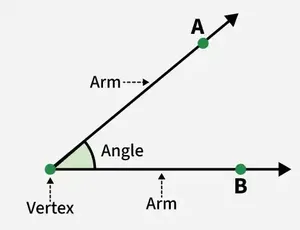
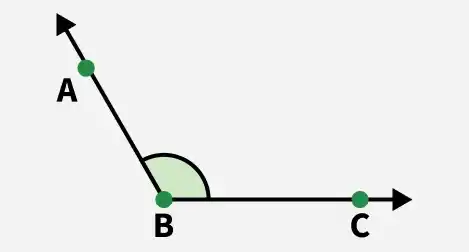
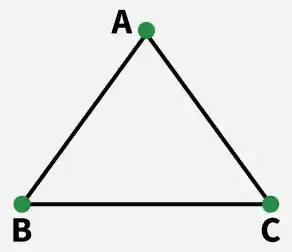
An angle is formed when two rays meet at a common endpoint. This endpoint is called the vertex, and the two rays are called the arms of the angle. The amount of rotation or opening between the arms is called the measure of the angle, which is usually expressed in degrees or radians.
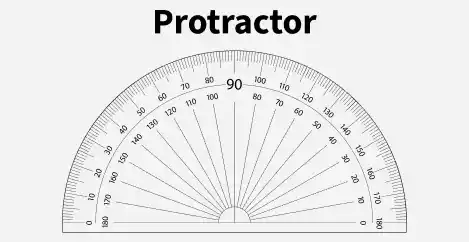
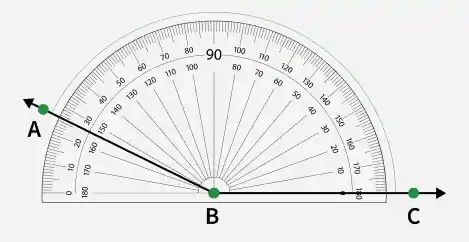
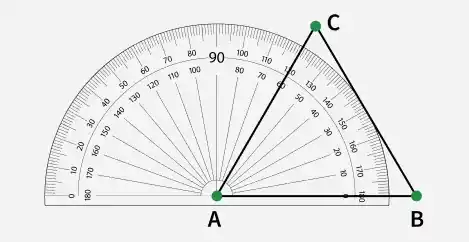
The outer scale measures angles in the clockwise direction from 0° to 180°.
The inner scale measures angles in the anticlockwise direction from 0° to 180°.
Angles are commonly measured in three units: degrees, radians, and revolutions.
Degrees (°): A full circle is divided into 360°, and a semicircle measures 180°. One complete rotation is equal to 360°.
Radians (rad): This is the SI unit of angle measurement. It is defined as the ratio of the arc length to the radius of a circle. One complete rotation equals 2π radians, so π radians equals 180°.
Revolution: It represents one complete turn of a circle. One revolution is equal to 360° or 2π radians.
Degrees and Radians Conversion
A circle subtends 2π radians or 360° at its centre. So, 2π radians = 360°
From this, we get:
π radians = 180°
1 radian = 180° / π ≈ 57.3°
1° = π / 180 ≈ 0.0174 radians.
Formulas
Angle in Radian = Angle in Degree × π/180
Angle in Degree = Angle in Radian × 180/π
Measuring Angles Using a Protractor
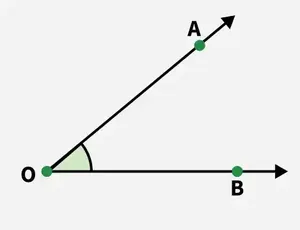
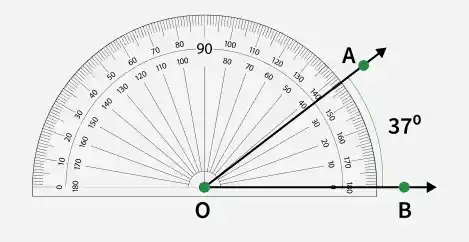
We use a protractor to measure angles. Consider ∠AOB shown below. From its opening, it appears to be an acute angle, meaning its measure lies between 0° and 90°.
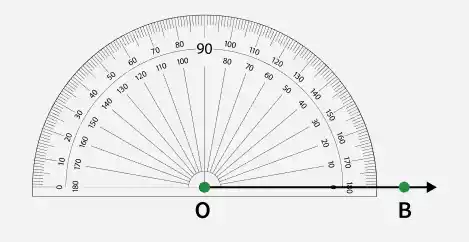
Step 1: Place the protractor such that its centre coincides with point O and align the baseline with ray OB. Start reading from the 0° mark on the inner scale.
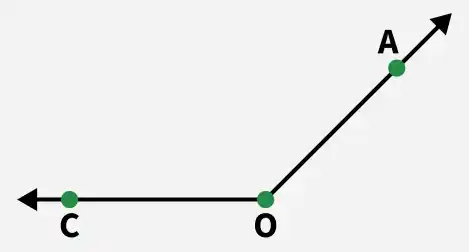
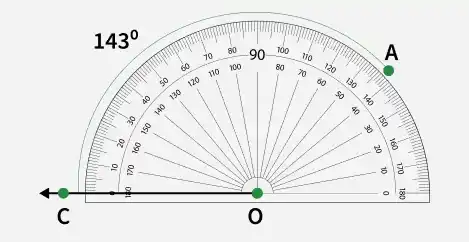
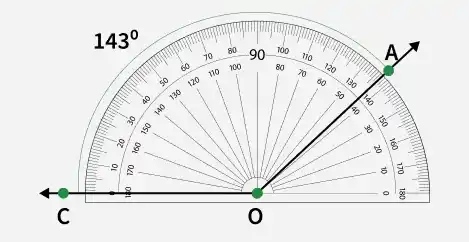
Step 1: Place the protractor such that its centre coincides with point O and align the baseline with ray OC. Start reading from the 0° mark on the outer scale (bottom-left side).