|
VOOZH | about |
|
VOOZH | about |
Integration can be defined as the summation of values when the number of terms tends to infinity. It is used to unite a part of the whole. Integration is just the reverse of differentiation and has various applications in all spheres, such as physics, chemistry, space, engineering, etc.
Integration of a function or a curve can be used to find useful information, such as the area under the curve or volume of the curve, etc. Integration may be of 2 types, which are definite and indefinite integration, depending upon whether the limits of integration are mentioned or not.
We know that integration is represented using the symbol ∫ over a function f(x) as follows:
∫f(x)dx
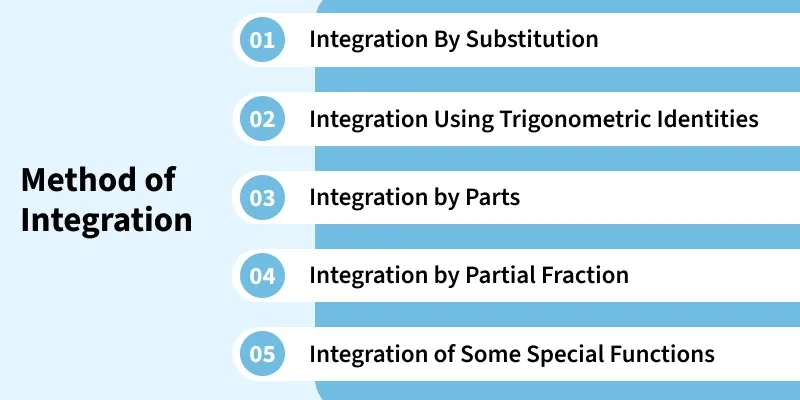
The substitution method is used when we find it difficult to integrate a function as it is. In this method, a certain term in the function is substituted as a new variable, and the whole function is changed to a new function of a new variable.
Example: Solve ∫(x - 4) dx.
Solution:
Given
Substitute (x-4) = u
Differentiate both sides w.r.t x to get
dx = d
Thus
Again putting u = (x-4)
Integration using Trigonometric identites involves integrating the given function by transforming it using trigonometric identities. The value of the given function is substituted using some other function that is derived by using trigonometric identities.
Example: Solve
Solution:
Given
We know that cos(2x) = 2cos2x -1
2cos2x = cos(2x)+1
Substituting the value of 2cos2x, we get
This method is used in cases where the function to be integrated is a product of two or more functions. Let f(x) = g(x)h(x), then f(x) can be integrated by parts by using the below formula:
∫g(x) · h(x) · dx = g(x) · ∫h(x) dx – ∫(g′(x) · ∫h(x) dx) dx
The sequence of h(x) and g(x) should be decided using the ILATE rule which tells the priority of functions and stands for Inverse trigonometric, logarithmic, algebraic, trigonometric, and exponential functions. This means that inverse trigonometric function should be written before logarithmic, logarithmic should be written before algebraic and so on.
Example:Solve
Solution:
Given
From ILATE rule, we know that logarithmic function has higher priority than algebraic function. Hence,
Using integration by parts,
If the function to be integrated is of the form f(x) = g(x)/h(x) where g(x) and h(x) are polynomials, then we use the method of partial fraction. There are multiple cases in partial fractions depending upon the type of f(x).
| Type of function f(x) | Partial Fraction |
|---|---|
| where a ≠ b |
In all these cases, we need to take the LCM of the partial fractions to make the denominator the same. After that, we compare the numerator on the LHS and RHS. Then substitute the suitable value of x in order to make any one part of the numerator zero and determine the value of A, B and C.
Example: Integrate the function f(x) = x/(x-2)(x+3).
Solution:
Given f(x) = x/(x-2)(x+3)
It is of the form
So it can be written as
Taking LCM on RHS, we get,
Comparing numerators on LHS and RHS:
Put x = 2 to get,
2 = 5A or A = 2/5
similarly put x = -3 to get
-3 = -5B or B = 3/5
Thus
In Mathematics, we have some special functions which have pre-defined integration formulas. These functions and their integration are shown below:
Example 1: Solve .
Solution:
Given: I = \int \log x~dx = \int \log x.1~dx
The functions are already written according to ILATE rule. Using integration by parts we get,
Example 2: Solve
Solution:
Given: I = \int x \sin x~dx
The functions are already written according to ILATE rule. Using integration by parts we get,
Example 3: Solve
Solution:
Given:
Substitute (2x3+1) = u
Differentiate both sides w.r.t x to get
6x2 dx = du
x2dx = du/6
Rewriting the given function as
Example 4: Solve
Solution:
Given
We know that cos(2x) = 1 - 2sin2x
(1-cos2x)/2 = sin2x
Substituting the value of sin2x, we get
Example 5: Solve .
Solution:
Given:
Using
Problem 1: Calculate the following integrals:
Problem 2: Use the substitution method to evaluate the following integrals:
Problem 3: Apply integration by parts to solve the following integrals:
Problem 4: Use partial fraction decomposition to integrate: