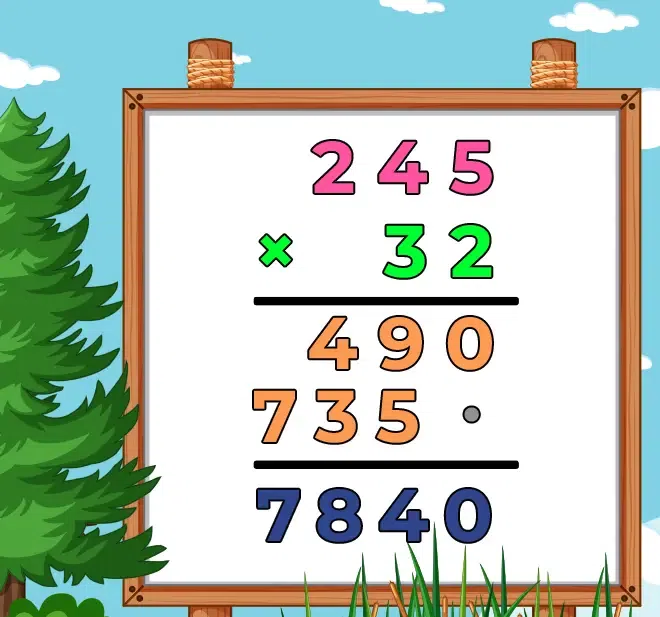
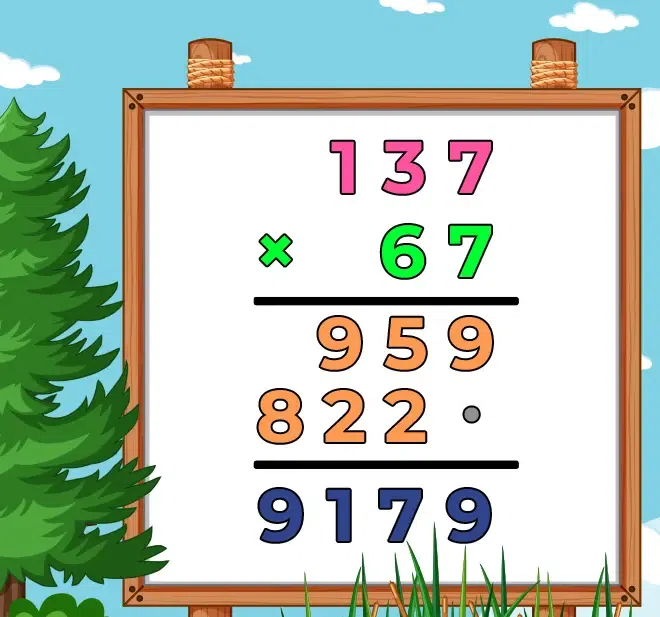
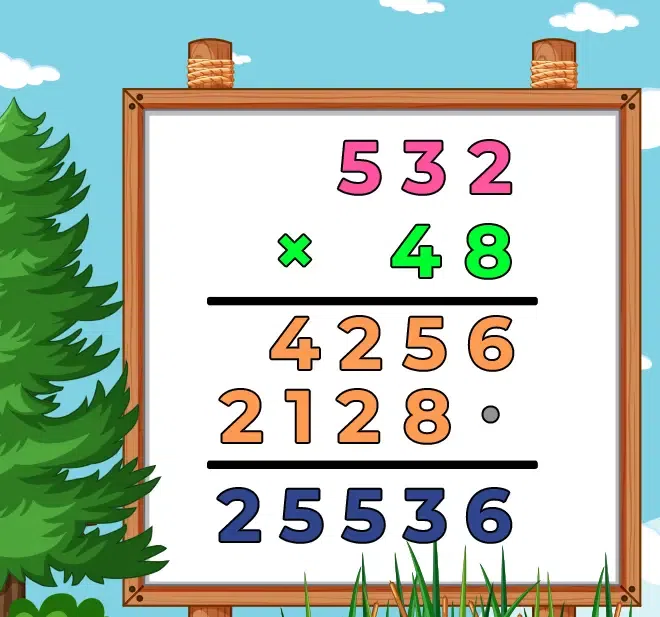
Multiplication with regrouping, also known as carrying, is a fundamental concept in mathematics that allows students to multiply multi-digit numbers accurately. This method involves breaking down numbers into more manageable parts, multiplying them, and regrouping any value over ten to the next place value.
Let us understand this way - When performing multiplication, if the product of two digits exceeds 9, we carry over the extra value to the next column. This process of carrying over is called regrouping. It is necessary to ensure that place values are correctly aligned in multi-digit multiplication.
In this article, we will discuss this method in detail.
In multiplication, if the multiplication of two-digit figures exceeds 9, then we add the excess to the next number column. This process of carrying over is termed as regrouping. There is a need to pay a lot of attention to the formation of place values while solving multi-digit multiplication problems.
Steps for Multiplication with Regrouping
Let’s understand the process of multiplication with regrouping using examples:
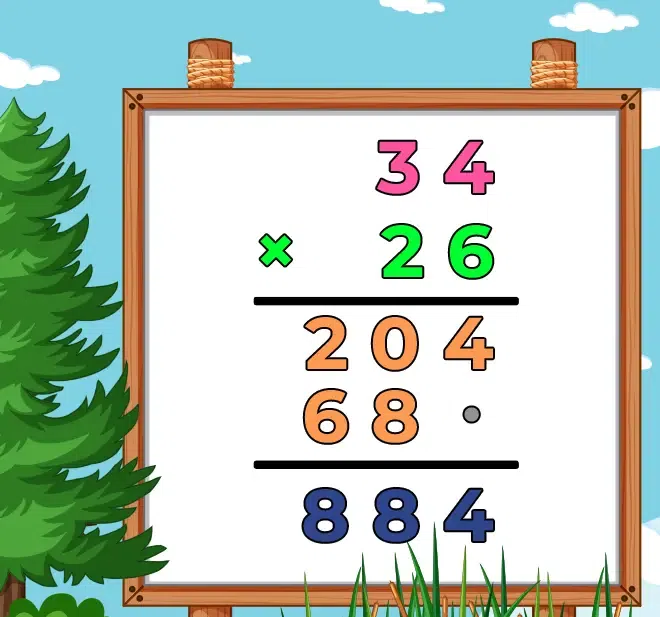
Example 1: Multiply 34 × 26.
Solution:
Step 1: Multiply the ones in place
Multiply 6 (ones place of 26) by 4 (ones place of 34).
6 × 4 = 24. Write 4 in the ones column and carry over 2 to the tens place.
Step 2: Multiply the tens place
Multiply 6 by 3 (tens place of 34).
6 × 3 = 18. Add the carried 2, giving 20. Write 20 below the line.
Step 3: Multiply the next row
Multiply 2 (tens place of 26) by 4. Write the result in the second row, starting from the tens column.
Multiply 2 by 3. Add the results.
Step 4: Add both rows
After multiplying and regrouping, add the two results to get the final answer.
Thus, 34 × 26 = 884.
This can represented as the following illustration:
In conclusion, multiplication with regrouping helps us handle larger numbers by breaking the process into simpler steps. When multiplying, if a product in a column is more than 9, we regroup by carrying over the extra value to the next column.