|
VOOZH | about |
|
VOOZH | about |
Solution:
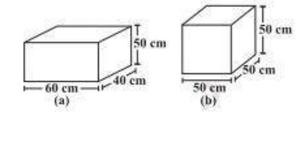
(a) For finding which box requires the lesser amount of material to make we have to calculate total surface area of both these boxes.
So, Length of first cuboidal box (l) = 60 cm
Breadth of first cuboidal box (b) = 40 cm
Height of first cuboidal box (h) = 50 cm
Total surface area of first cuboidal box = 2 × (lb + bh + hl)
= 2 × (60 × 40 + 40 × 50 + 50 × 60)
= 2 × (2400 + 2000 + 3000)
= 14800 cm2
Total surface area of first cuboidal box is 14800 cm².
(b) Also,
Length of second cubical box (l) = 50 cm
Breadth of second cubicalbox (b) = 50 cm
Height of second cubicalbox (h) = 50 cm
Total surface area of second cubical box = 6 (side)2
= 6 (50 × 50)
= 6 × 2500
= 15000 cm²
Total surface area of the second cubical box is 15000 cm2
From both of these result we found that cuboidal box (observation "a") requires the lesser amount of material to make.
Solution:
Length of suitcase box (l)= 80 cm,
Breadth of suitcase box (b) = 48 cm
Height of cuboidal box (h) = 24 cm
Total surface area of suitcase box = 2 × (lb + bh + hl)
= 2 × (80 × 48 + 48 × 24 + 24 × 80)
= 2 × (3840 + 1152 + 1920)
= 2 × 6912
= 13824 cm²
Hence, Total surface area of suitcase box is 13824 cm²
As suitcase is fully covered by tarpaulin
Area of Tarpaulin cloth = Surface area of suitcase
(l × b) = 13824
(l × 96) = 13824
l = 144m
Required tarpaulin for 100 suitcases = 144 × 100 = 14400 cm = 144 m
Hence, tarpaulin cloth required to cover 100 suitcases is 144 m.
Solution:
Given that
Surface area of cube = 600 cm²
Formula for surface area of a cube = 6(side)²
Substituting the values, we get
6 × (side)² = 600
(side)² = 100
Or side = ±10
We can't take side as negative
Hence, the measure of each side of a cube is 10 cm
Solution:
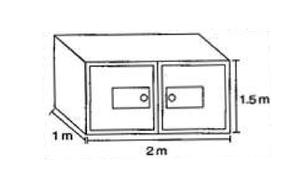
Length of cabinet (l) = 2 m,
Breadth of cabinet (b) = 1 m,
and Height of cabinet (h) = 1.5 m
Surface area of cabinet = 2 × (lb + bh + hl) - lb
= 2 × (2 × 1 + 1 × 1.5 + 1.5 × 2) - 2 × 1
= 2 × (2 + 1.5 + 3.0) - 2
= 2 × (6.5) - 2
= 13 - 2
= 11m²
Required surface area of cabinet is 11m²
Solution:
Length of wall (l) = 15 m,
Breadth of wall (b) = 10 m
Height of wall, (h) = 7 m
Total Surface area of classroom = 2 × (lb + bh + hl) - lb
= 2 × (15 × 10 + 10 × 7 + 7 × 15) - (15 × 10)
= 2 × (150 + 70 + 105) - 150
= 650 - 150
= 500
Now, Required number of cans = Area of hall/Area of one can
= 500/100 = 5
Therefore, 5 cans are required to paint the room.
Solution:
Given that,
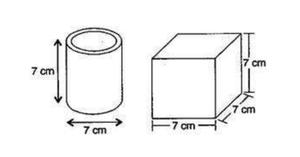
Diameter of cylinder = 7 cm
Radius of cylinder (r) = 7 / 2 cm
Height of cylinder (h) = 7 cm
Surface area of cylinder = 2πrh
= 2 × (22 / 7) × (7 / 2) × 7 = 154
So, Lateral surface area of cylinder is 154 cm²
Now, lateral surface area of cube = 4 (side)² = 4 × 72 = 4 × 49 = 196
Lateral surface area of cube is 196 cm²
Hence, the cube has larger lateral surface area.
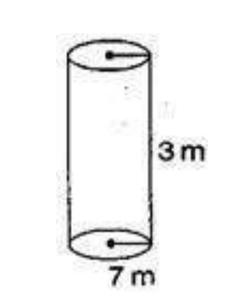
Radius of cylindrical tank (r) = 7 m
Height of cylindrical tank (h) = 3 m
Total surface area of cylindrical tank = 2πrh + 2πr² = 2πr × (h + r)
= 2 × (22 / 7) × 7 (3 + 7)
= 44 × 10 = 440
Therefore, 440 m² metal sheet is required.
Solution:
Lateral surface area of hollow cylinder = 4224 cm²
Height of hollow cylinder, h = 33 cm
and say r be the radius of the hollow cylinder
Curved surface area of hollow cylinder = 2πrh
4224 = 2 × π × r × 33
r = (4224) / (2π × 33)
r = 64 × 7/ 22
Now, Length of rectangular sheet, l = 2πr
l = 2 × 22 / 7× (64 × 7/ 22) = 128
So the length of the rectangular sheet is 128 cm.
Also, Perimeter of rectangular sheet = 2 × (l + b)
= 2 × (128 + 33)
= 322
The perimeter of rectangular sheet is 322 cm.
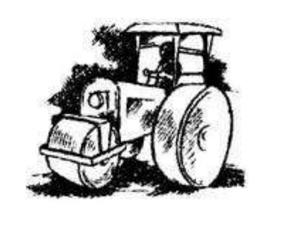
Solution:
Diameter of road roller (d) = 84 cm
Radius of road roller (r) = d / 2 = 84 / 2 = 42 cm
Length of road roller (h) = 1 m = 100 cm
Curved surface area of road roller = 2πrh
= 2 × (22 / 7) × 42 × 100 = 26400
Curved surface area of road roller is 26400 cm²
Again, Area covered by road roller in 750 revolutions = 26400 × 750cm²
= 1,98,00,000 cm²
= 1,98,00,000 × (1 / 10,000) m² (1cm²= 1 / 10,000m²)
Hence, the area of the road is 1980 m².
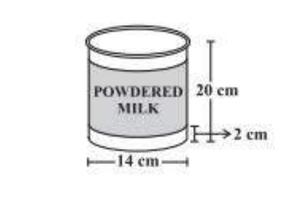
Solution:
Diameter of cylindrical container (d) = 14 cm
Radius of cylindrical container (r) = d / 2 = 14 / 2 = 7 cm
Height of cylindrical container (H) = 20 cm
Height of the label (h) = Height of container - free space
= 20 – 2 (2)
= 16 cm
Area of label = 2πrh
= 2 × (22 / 7) × 7 × 16
= 704 cm²
Hence, the area of the label is 704 cm².