|
VOOZH | about |
|
VOOZH | about |
A tangent to a circle is a line that touches the circle at exactly one point, called the point of contact. The number of tangents that can be drawn to a circle depends on the position of a point relative to the circle.
There are three possible cases:
Case 1: Point Inside the Circle (No Tangent)
No tangent can be drawn to a circle from a point lying inside the circle.
👁 ImageCase 2: Point on the Circle (One Tangent)
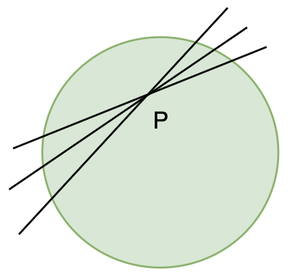
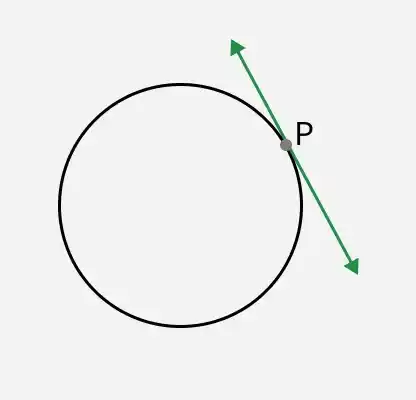
Exactly one tangent can be drawn to a circle from a point lying on the circle.
Case 3: Point Outside the Circle (Two Tangents)
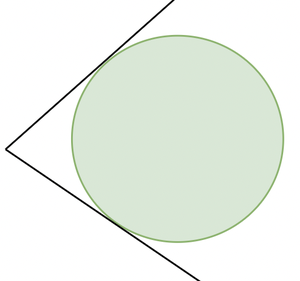
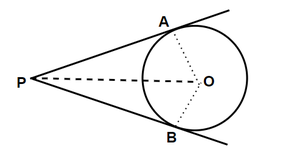
Exactly two tangents can be drawn to a circle from a point lying outside the circle.
👁 ImageThe following are some of the key properties of tangents:
Theorem 1:
The tangent at any point of a circle is perpendicular to the radius through the point of contact.
This theorem allows us to conclude some other properties also:
Theorem 2:
If two tangents are drawn from an external point to a circle, then the lengths of the two tangents are equal.
Theorem 3:
The lengths of tangents drawn from an external point to a circle are equal.
Proof:
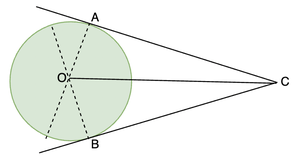
Let's assume a circle with centre O, a point C lying outside the circle and the tangents from that point to the circle. AC and BC are the tangents from the point. Our goal is to prove AC = BC.
👁 ImageLet's join OA and OB and consider the two triangles OAC and OBC.
- OC is common.
- ∠OAC = ∠OBC (Right angled triangle)
- OA = OB (Radii of the circle)
Using RHS property we can say that these two triangles are congruent. Thus, AC = BC.
Theorem 4:
If two tangents are drawn from an external point then
- They subtend an equal angle at the centre, and
- They are equally inclined to the line segment joining the centre to that point.
Proof:
👁 ImageIn the given figure, we need to prove that
∠POA = ∠POB and ∠OPA = ∠OPB.
Let us consider the two triangles, POA and POB.
PA = PB (By previous theorem)
OA = OB (radii of the circle)
OP = OP (Common)
Thus, these two triangles are congruent. [by SSS]
Hence, ∠POA = ∠POB and ∠OPA = ∠OPB.
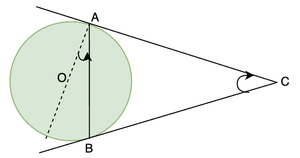
Question 1: In the given figure, AC and BC are the two tangents drawn from point C. Prove that 2∠OAB = ∠ACB.
👁 ImageSolution:
We know from the previous theorem that, AC = BC. This concludes that triangle ABC is an isosceles triangle.
We also know that ∠OAC = 90°. So,
∠BAC = 90° - ∠OAB
In triangle BAC
∠BAC + ∠ABC + ∠ACB = 180°
2∠BAC + ∠ACB = 180°
2(90° - ∠OAB) + ∠ACB = 180°
180° - 2∠OAB + ∠ACB = 180°
∠ACB = 2∠OAB
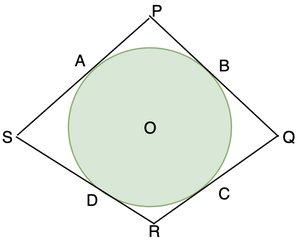
Question 2: There is a circle inscribed in a quadrilateral PQRS; prove that PQ + RS = PS + QR.
👁 ImageSolution:
A circle is inscribed inside the quadrilateral PQRS. Notice that the sides of the quadrilateral are actually tangents to the circle.
PA = PB,
BQ = QC
DR = RC
SA = SD
We need to prove PQ + RS = PS + QR.
Taking the L.H.S,
PQ + RS
⇒ PB + BQ + DR + DS
⇒ PA + CQ + RC + AS (From the relations stated above)
⇒ (PA + AS) + (CQ + RC)
⇒ PS + QR
Hence Proved
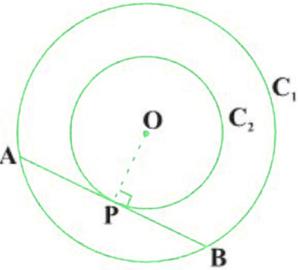
Question 3: In concentric circles, prove that the chord of the larger circle that touches the smaller circle is bisected at the point of contact.
Answer:
👁 ImageLet's say C1 and C2 are two concentric circles. Centre is O and AB is the chord of larger circle. From the previous theorems we know that, OP is perpendicular to AB. As we know from the properties of circle, that perpendicular from the centre bisects the chord.
AB is chord to larger circle C1 and OP is perpendicular to it. Thus is bisects the chord.
1. A tangent AB is drawn to a circle with center O and radius 5 cm from a point A. If OA = 13 cm, then find the length of the tangent AB.
2. Two tangents, PA and PB, are drawn from a point P outside a circle. If the distance from P to O is 10 cm and the radius of the circle is 6 cm, find the length of each tangent.
3. In a quadrilateral ABCD, a circle is inscribed, and the sides AB, BC, CD, and DA are tangents to this circle. Prove that AB + CD = BC + DA.
4. Prove that the tangent at any point of a circle is perpendicular to the radius through the point of contact.
5. A chord of length 6 cm is drawn in a circle of radius 4 cm. Determine the distance of the chord from the center of the circle.