|
VOOZH | about |
|
VOOZH | about |
In Set Theory, ordered pairs are often used to define relations between elements of different sets. An ordered pair (a, b) signifies that 'a' is related to 'b' in some way, distinct from the pair (b, a) if 'a' and 'b' are different elements.
In set theory, ordered pairs are instrumental in establishing relations between elements of different sets. For example, an ordered pair (a, b) indicates that 'a' is related to 'b' in some manner.
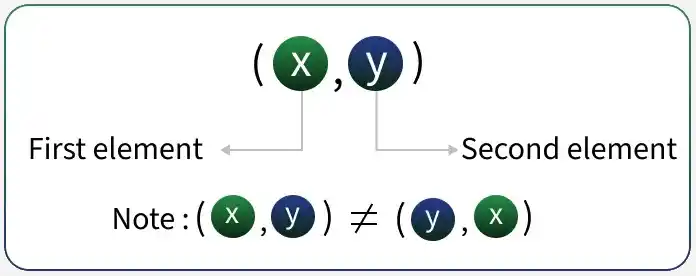
An ordered pair represents a pair of elements arranged in a specific order. In mathematical notation, an ordered pair is typically written as (x, y) where 'x' and 'y' are the elements of the pair. An ordered pair denoted as (x, y) maintains the sequence of its elements, while an unordered pair does not consider the order.
For example, (1, 2) is distinct from (2, 1) in ordered pairs, but they represent the same set in unordered pairs.
Note: A pair of quantities (a, b) where ordering is significant, so (a, b) is considered distinct from (b, a) for a ≠ b, is called ordered
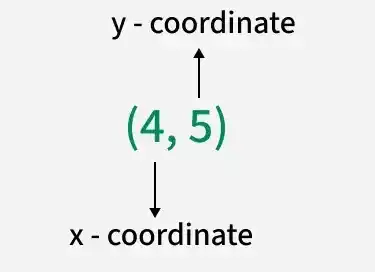
In a Cartesian coordinate system, the plane is divided into four quadrants. The signs of the x and y coordinates determine which quadrant an ordered pair belongs to, providing information about the location of the point relative to the origin.
Analyzing the signs of the x and y coordinates, one can identify which quadrant an ordered pair belongs to. All four quadrants in the Cartesian plane are shown in the image below:
👁 Ordered Pairs in Different QuadrantsGraphing ordered pairs involves plotting points on a coordinate plane using their respective x and y coordinates. This graphical representation helps visualize relationships between various points and geometric shapes.
Follow the steps added below to graph the ordered pair.
Step 1: Imagine you're standing at the beginning point, let's call it the starting line. Now, if someone tells you to move horizontally, here's what you do:
- If they say "go right" (that's when x is positive), you move to the right by the number of steps equal to how far x is from zero.
- If they say "go left" (when x is negative), you move to the left by the number of steps equal to how far x is from zero. Then, you stop right there.
Step 2: Now that you've stopped somewhere horizontally, let's talk about going up or down.
- If someone tells you to "go up" (when y is positive), you move up by the number of steps equal to how far y is from zero.
- If they say "go down" (when y is negative), you move down by the number of steps equal to how far y is from zero. Then, you stop again.
Step 3: After doing both horizontal and vertical movements, you're now standing at a specific point on a grid. Imagine dropping a dot right at this spot where you've stopped. This dot represents the ordered pair (x, y), which tells you exactly where you are on the grid.
Ordered pairs exhibit several properties including reflexivity, symmetry and transitivity. These properties govern how ordered pairs behave in mathematical operations and relations:
Equality Property of ordered pairs states that two pairs are considered equal if and only if their corresponding elements are equal. In other words, (a, b) equals (c, d) if 'a' equals 'c' and 'b' equals 'd'. This property ensures consistency when comparing and identifying equivalent pairs.
Two ordered pairs are considered equal if and only if their corresponding elements are equal.
Example 1: Plot the point (2, -3) on a Cartesian coordinate plane.
Solution:
Start at the origin (0, 0)
Move 2 units to the right (positive x-direction)
Move 3 units downward (negative y-direction)
Plot the point at (2, -3)
Example 2: Determine which quadrant the point (-4, 5) lies in.
Solution:
Since x-coordinate is negative and the y-coordinate is positive, the point lies in the second quadrant.
Example 3: Find the Cartesian product of the sets {1, 2} and {a, b}.
Solution:
Cartesian product is {(1, a), (1, b), (2, a), (2, b)}.
Example 4: Verify if the ordered pairs (3, 4) and (4, 3) are equal.
Solution:
Since first elements are different (3 ≠ 4), and the second elements are also different (4 ≠ 3), the ordered pairs are not equal.
Example 5: Determine the midpoint of the line segment with endpoints (1, 3) and (5, -1).
Solution:
Midpoint formula: ((x₁ + x₂) / 2, (y₁ + y₂) / 2)
Midpoint = ((1 + 5) / 2, (3 + (-1)) / 2)
= (6 / 2, 2 / 2)
= (3, 1)
Example 6: If (a, b) = (3, -2), what are the values of 'a' and 'b'?
Solution:
- 'a' is First element of the ordered pair, so a = 3
- 'b' is Second element of the ordered pair, so b = -2
Question 1: Find the Cartesian product of the sets A = {1, 2} and B = {x, y}.
Question 2: List all ordered pairs for the Cartesian product of A = {a, b, c} and B = {1, 2}.
Question 3: Determine if the ordered pairs (3, 4) and (4, 3) are equal.
Question 4: Consider the sets A = {p, q} and B = {m, n}. Define the relation R = {(p, m),(q, n)}. Verify whether R is a subset of A × B.
Question 5: Let A = {1, 2, 3} and B = {a, b}. How many ordered pairs are there in A × B ?
Question 6: Plot the points (3, −2) and (−1, 4) on the Cartesian plane. Find the midpoint of the line segment joining them and identify the quadrant in which the midpoint lies.
Question 7: Let A = {1, 2, 3} and B = {x, y, z}. If a relation R is defined as “a is less than the numerical position of b in B”, form the set of ordered pairs representing R.
Question 8: Given sets A = {2, 4, 6} and B = {1, 3, 5}, define a relation R from A to B as “a is double of b”. Write R in the form of ordered pairs and represent it using a Cartesian graph.