|
VOOZH | about |
|
VOOZH | about |
Prime and Composite Numbers are subsets of Natural Numbers based on divisibility. A prime number is divisible by only 1 and itself and a composite number is divisible by one or two more other
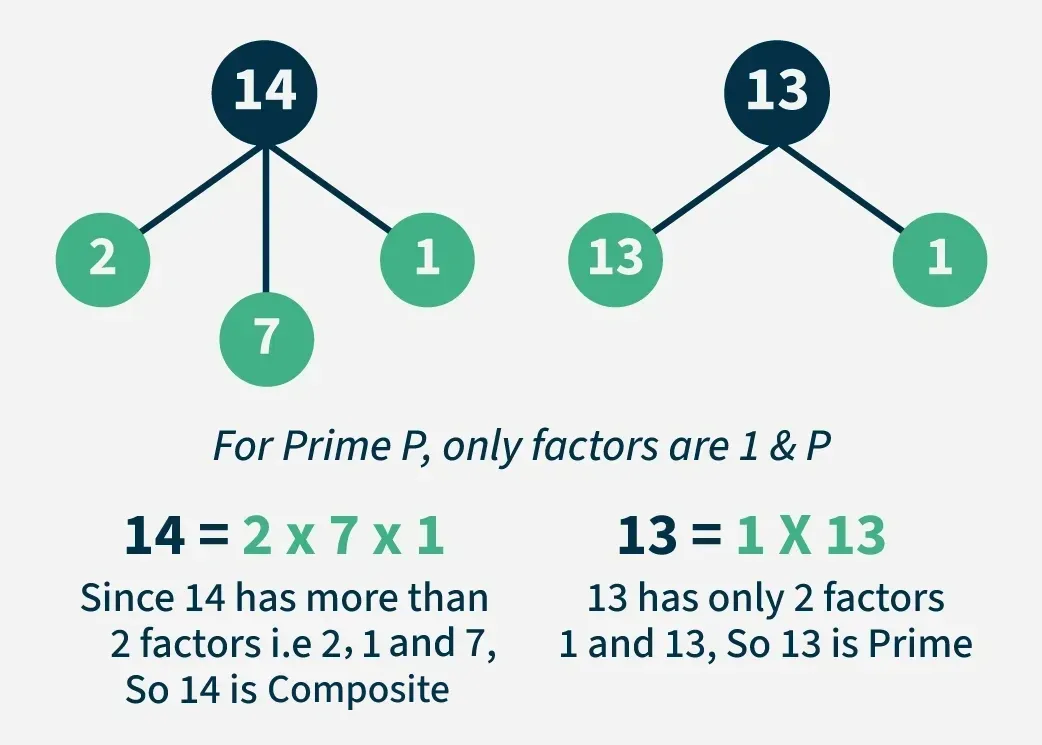
👁 Prime-vs-CompositeEvery natural number, except 0 or 1, is either prime or composite.
The following table lists five differences between a prime and composite number:
| Prime Numbers | Composite Numbers |
|---|---|
| All the natural numbers greater than 1 that have only two factors - one and the number itself are called prime numbers. | All natural numbers that can be expressed as a product of at least two smaller natural numbers are known as composite numbers. |
| Prime numbers have exactly two factors - 1 and the number itself. | Composite numbers have at least 3 or more factors. |
| All the prime numbers except 2 are odd numbers. | There is no such pattern for composite numbers. They can be odd or even both. |
| Their prime factorization has only one prime factor i.e., the number itself. | Their prime factorization has one or more other prime factors. For example, 49 has a prime factor of 7 and |
The product of two prime numbers is a composite number | The product of two composite numbers is also a composite number |
| Examples: 2, 3, 5, 7, ... | Examples: 4, 6, 8, 9, 10, ... |
A prime and composite numbers chart is a table that lists all the numbers from 1 to 100 and identifies them as either prime or composite. Here is the prime and composite numbers chart
👁 Prime-and-Composite-NumbersWe can use below quick steps.
Also Check:
Read More:
Here are some practice questions/problems based on prime and composite numbers:
1. Is 1 a composite number?
2. Check whether 23 is a prime number.
3. Check whether 56 is a prime number.
4. Check whether 2779 is a prime number. (Hint: Use Efficient Primarility Test)
5. Use Eratosthenes sieve to find all the prime numbers from 1 to 100.
6. Find the prime factors of 69.