|
VOOZH | about |
|
VOOZH | about |
Prime factorization means breaking a number down into the prime numbers that multiply together to make it.
More Examples of Prime Factorization:
12 can be written as 2 × 6
6 can be further factorized as 2 × 3.
So 12 can be rewritten as 2 × 2 × 3
No more factorization possible as 2 and 3 cannot be divide further, so 2 × 2 × 3 is our prime factorization54 can written as 2 × 27.
27 can be further factorized as 3 × 9.
So we rewrite 54 as 2 × 3 × 9
9 can be further factorized as 3 × 3.
So we rewrite 54 as 2 × 3 × 3 × 3.
No more factorization possible, so 2 × 3 × 3 × 3 is our prime factorization
When a number is expressed as a product of its prime factors, it is said to be in its prime factorization form.Prime Factorization Example Table
Prime factorization of some of the common composite numbers are:
| Numbers | Prime Factorization | Numbers | Prime Factorization |
|---|---|---|---|
| 36 | 22 × 32 | 40 | 23 × 5 |
| 24 | 23 × 3 | 50 | 2 × 52 |
| 60 | 22 × 3 × 5 | 48 | 24 × 3 |
| 18 | 2 × 32 | 30 | 2 × 3 × 5 |
| 72 | 23 × 32 | 42 | 2 × 3 × 7 |
| 45 | 32 × 5 | 20 | 22 × 5 |
Two common methods of Prime Factorization are:
In this method, the number is successively divided by prime numbers until the quotient becomes 1, with each division identifying a prime factor.
Steps to identify the prime factors of a number by the Division Method :
- Step 1: Divide the number by the smallest prime number (i.e. 2) until we are able to divide the given number without leaving any remainder.
- Step 2: Move on to the next prime number and repeat the division until the quotient becomes 1.
- Step 3: The prime factors are the divisors used in the division process.
Example 1: Find the Prime Factorization of 60 using the Division Method.
👁 Prime Factorization Example By Division MethodExample 2: Find the Prime Factorization of 210 using the Division Method.
👁 Prime Factorization using Division MethodExample 3: Express 56 as the product of its Prime Factors.
👁 Prime Factorization by Division MethodThe Factor Tree Method involves breaking down a number into its prime factors by constructing a tree-like structure called a factor tree.
Steps to identify the prime factors of a number by the Factor Tree Method:
- Step 1: Identify two factors of the number that are not prime.
- Step 2: Write these two factors as branches of the factor tree.
- Step 3: Repeat steps 1 and 2 for each non-prime factor until all branches end with prime numbers.
- Step 4: The prime factors are the numbers at the end of the branches.
Example 1: Find the factorization of 60 by the Factor Tree Method.
👁 Example of prime factorization using a factor treeExample 2: Make the Factor Tree of 210.
👁 Prime Factorization By Factor Tree MethodSome examples of prime factorization are listed below:
| Number | Prime Factorization |
|---|---|
| 72 | 2 × 2 × 2 × 3 × 3 |
| 36 | 2 × 2 × 3 × 3 |
| 48 | 2 × 2 × 2 × 2 × 3 |
| 12 | 2 × 2 × 3 |
| 100 | 2 × 2 × 5 × 5 |
| 84 | 2 × 2 × 3 × 7 |
| 8 | 2 × 2 × 2 |
| 32 | 2 × 2 × 2 × 2 × 2 |
| 24 | 2 × 2 × 2 × 3 |
| 91 | 7 × 13 |
| 15 | 3 × 5 |
HCF and LCM can be easily calculated by the method of prime factorization:
For the HCF, take the lowest power of each common prime factor from both numbers.
For Example:
So, the HCF is:
HCF = 22 × 31 = 4 × 3 = 12
For the LCM, take the highest power of each prime factor present in either number.
For Example:
So, the LCM is:
LCM = 24 × 31 × 51 = 16 × 3 × 5 = 240
Problem 1: What is the Prime Factorization of 80?
Solution:
To find the prime factorization of 80, we can start by dividing it by the smallest prime number, which is 2.
- 80 divided by 2 equals 40.
- 40 divided by 2 equals 20.
- 20 divided by 2 equals 10.
- 10 divided by 2 equals 5.
Now, since 5 is a prime number, we can stop dividing. Therefore, the prime factorization of 80 is: 2 × 2 × 2 × 2 × 5.
Problem 2: Prime factorization of 120.
Solution:
Starting with the smallest prime number, which is 2.
- 120 divided by 2 equals 60.
- 60 divided by 2 equals 30.
- 30 divided by 2 equals 15.
- Now, since 15 is not divisible by 2, we move on to the next prime number (i.e, 3)
- 15 divided by 3 equals 5.
Now, since 5 is a prime number, we can stop dividing. Therefore, the prime factorization of 120 is: 2 × 2 × 2 × 3 × 5
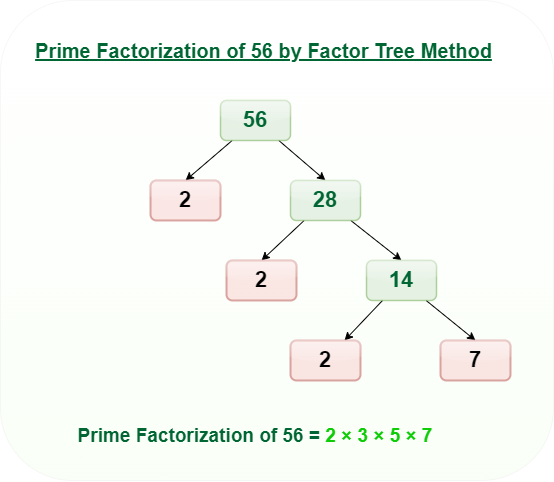
Problem 3: What is the Factor Tree of 56?
👁 Prime Factorization by Factor Tree MethodExample 1. Find the prime factorization of 36.
Example 2. Determine the prime factorization of 90.
Example 3. What is the prime factorization of 48?
Example 4. Find the prime factorization of 105.
Example 5. What is the prime factorization of 84?
Example 6. Determine the prime factorization of 100.
Example 7. Find the prime factorization of 2310.
Example 8. What is the prime factorization of 56?
Example 9. Determine the prime factorization of 150.
Example 10. What is the prime factorization of 1250?