|
VOOZH | about |
|
VOOZH | about |
A parallelogram is a quadrilateral in which opposite sides are parallel and equal in length. Also, opposite angles are equal. A few of the important properties of a parallelogram are:
Various properties of the diagonal of a parallelogram are:
A few important theorems on properties of a Parallelogram are:
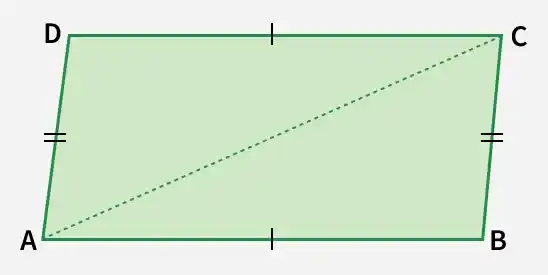
Given: ABCD is a parallelogram
To Prove: AB = CD & DA = BC
Proof:
Given ABCD is a parallelogram. Therefore,
AB || DC & AD || BC
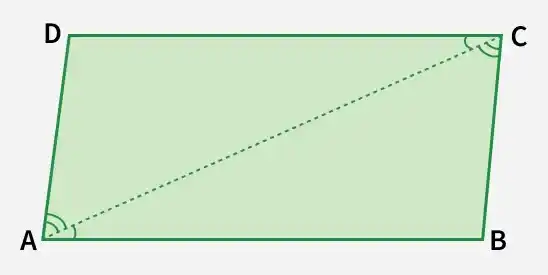
Now, AD || BC and AC is intersecting A and C respectively.
∠DAC = ∠BCA...(i) [Alternate Interior Angles]
Now, AB || DC and AC is intersecting A and C respectively.
∠BAC = ∠D ...(ii) [Alternate Interior Angles]
Now, In ΔADC & ΔCBA
∠DAC = ∠BCA [ From (i) ]
AC = AC [ Common Side ]
∠DCA = ∠BAC [ From (ii) ]So, by ASA(Angle-Side-Angle) criterion of congruence
ΔADC ≅ ΔCBA
AB = CD & DA = BC [ Corresponding part of congruent triangles are equal ]
Hence Proved
Given: Opposite sides in a quadrilateral ABCD are equal, AB = CD, and BC = AD.
To Prove: Quadrilateral ABCD is a parallelogram.
In quadrilateral ABCD, AB = CD and AD = BC. In triangles ABC, and CDA we have
AC = AC (Common sides)
AD = BC (given)
AB = CD (since alternate interior angles are equal)So by the SSS congruency criterion, triangles ABC, and CDA are congruent, thus by CPCT corresponding angles of triangles are equal. Thus, ∠BAC = ∠DCA, and ∠BCA = ∠DAC.
Now AB || CD, BC || AD and thus ABCD is a parallelogram.
Given: ABCD is a parallelogram
To Prove: ∠A = ∠C and ∠B = ∠D
Proof:
Given ABCD is a parallelogram. Therefore,
AB || DC & AD || BC
Now, AB || DC and AD is Intersecting them at A and D respectively.
∠A + ∠D = 180º ...(i) [ Sum of consecutive interior angles is 180º]
Now, AD || BC and DC is Intersecting them at D and C respectively.
∠D + ∠C = 180º ...(ii) [ Sum of consecutive interior angles is 180º]
From (i) and (ii) , we get
∠A + ∠D = ∠D + ∠C
So, ∠A = ∠C
Similarly, ∠B = ∠D
∠A = ∠C and ∠B = ∠D
Hence Proved
Given: In the quadrilateral ABCD ∠A = ∠C and ∠B = ∠D
To Prove: ABCD is a parallelogram.
Proof:
Given ∠A = ∠C and ∠B = ∠D in quadrilateral ABCD. We have to prove ABCD is a parallelogram
∠A + ∠B + ∠C + ∠D = 360º (given ∠A = ∠C and ∠B = ∠D )
2(∠A + ∠B) =360º
∠A + ∠B = 180º.
Thus AD || BC. Similarly, we can show that AB || CD.
Hence, AD || BC, and AB || CD. Therefore ABCD is a parallelogram.
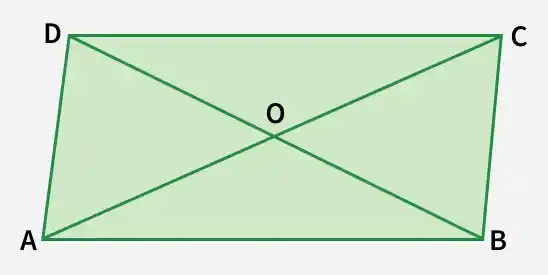
Given: ABCD is a parallelogram
To Prove: OA = OC & OB = OD
Proof:
AB || DC & AD || BC
Now, AB || DC and AC is intersecting A and C respectively.
∠BAC = ∠DCA [ Alternate Interior Angles are equal ]
So, ∠BAO = ∠DCO
Now, AB || DC and BD is intersecting B and D respectively.
∠ABD = ∠CDB [ Alternate Interior Angles are equal ]
So, ∠ABO = ∠CDO
Now, in ΔAOB & ΔCOD we have,
∠BAO = ∠DCO [ Opposite sides of a parallelogram are equal ]
AB = CD
∠ABO = ∠CDO
So, by ASA(Angle-Side-Angle) congruence criterion
ΔAOB ≅ ΔCOD
OA = OC and OB = OD
Hence Proved
Given: The diagonals AC and BD bisect each other.
To Prove: ABCD is a parallelogram.
Proof:
If the diagonals AB and CD bisect each other. Then in Δ AOB, and Δ COD
AO = CO (Diagonals bisect each other)
BO = DO (Diagonals bisect each other)
∠AOB =∠COD (vertically opposite angles)Thus, by SAS congruency criterion, triangles are congruent. So ∠CAB = ∠DCA, and ∠DBA = ∠CDB. Hence, AB || CD, and BC || AD. Thus ABCD is a parallelogram.
Example 1: ABCD is a quadrilateral with AB = 10 cm. Diagonals of ABCD bisect each other at right angles. Then find the perimeter of ABCD.
We know that, if diagonals of a quadrilateral bisect each other at right angles then it is a rhombus.
Thus, ABCD is a rhombus and AB = BC = CD = DA.
Thus, the perimeter of ABCD = 4(AB) = 4(10) = 40 cm
Example 2: Find area of a parallelogram where the base is 6 cm and the height is 12 cm.
Given, Base = 6 cm and Height = 12 cm.
We know,
Area = Base x Height
Area = 6 × 12
Area = 72 cm2
1. In parallelogram ABCD, if ∠A=70∘, find the measures of ∠B, ∠C, and ∠D.
2. In parallelogram EFGH, the lengths of sides EF and EH are given as 8 cm and 12 cm, respectively. If the perimeter of the parallelogram is 40 cm, find the lengths of the other two sides FG and GH.
3. In parallelogram JKLM, the diagonals intersect at point O. If JO = 5 cm and OL = 7 cm, find the lengths of diagonals JL and KM.
4. In parallelogram PQRS, side PQ is parallel to side RS and the length of side PQ is 15 cm. If the area of parallelogram PQRS is 90 square cm and the height corresponding to base PQ is 6 cm, find the height corresponding to base PS.
5. In parallelogram ABCD, the diagonals AC and BD bisect each other at point O. If AO = 3x + 2 and OC = 2x + 5, find the value of x and the lengths of AO and OC.