|
VOOZH | about |
|
VOOZH | about |
Vectors are quantities that have both magnitude and direction. Vector properties are the mathematical rules that govern operations such as vector addition, scalar multiplication, dot products, and cross products.
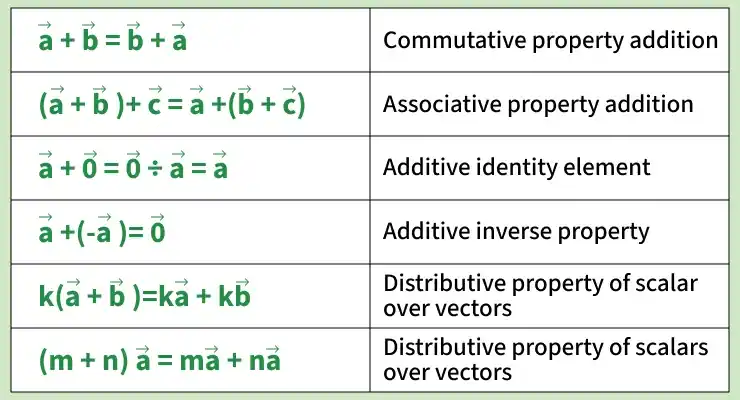
1. Commutative Property of Vector Addition: The order in which two vectors are added does not affect the result.
Formula:
Example: Let, ,
Then, and
Hence,
2. Associative Property of Vector Addition: When adding three vectors, the grouping of vectors does not change the result.
Formula:
Example: Let ,
Then, and
Thus, both sides are equal.
3. Additive Identity Property: Adding the zero vector to any vector leaves it unchanged.
Formula: , where
Example: (5,-2)+(0,0) = (5,-2)
Therefore, the zero vector acts as the additive identity.
4. Additive Inverse Property: Every vector has an opposite vector known as its additive inverse.
Formula:
Example:
Its inverse is
Therefore, (3,-4)+(-3,4)=(0,0)
5. Distributive Property of Scalar Multiplication over Vector Addition: A scalar can be distributed across the sum of vectors.
Formula:
Example: Let, k=2
Then, 2(4,6) = (8,12)
and (2,4)+(6,8) = (8,12)
Hence, the property is verified.
6. Associative Property of Scalar Multiplication: When multiple scalars multiply a vector, the grouping does not matter.
Formula:
Example: Let k=2, m=3,
Then, 2(3,6) = (6,12) and 6(1,2) = (6,12)
7. Zero Property of Scalar Multiplication: Multiplying a vector by zero produces the zero vector.
Formula:
Example: (0,0)
Example 1: Verify the commutative property for vectors (2,1)) and ((3,4)
Commutative property states: a+b = b+a ,
(2,1)+(3,4) = (5,5) and (3,4)+(2,1) = (5,5)
Therefore, the property holds.
Example 2: Find 3[(1,2)+(2,3)].
Adding terms inside big bracket then multiplying: 3[3,5]=(9,15)
Example 3: Find the additive inverse of (4,-7).
The additive inverse will be (-4,7)
Example 4 : Find dot product of (1,2).(3,4).
The dot product of two vectors is obtained by multiplying the corresponding components and then adding the products.
1(3)+2(4) = 11