|
VOOZH | about |
|
VOOZH | about |
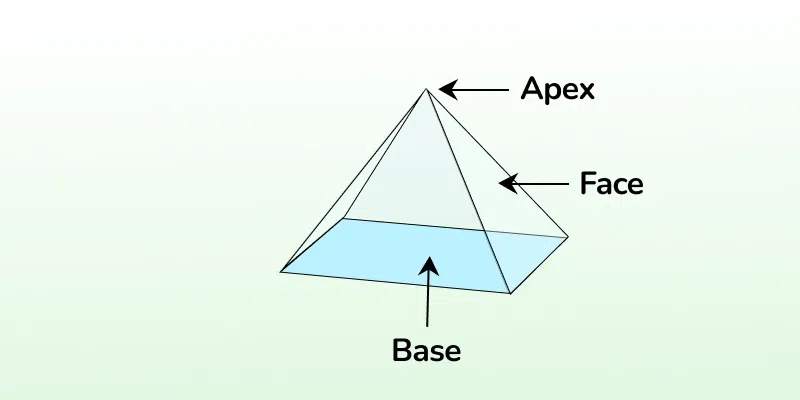
A pyramid is a 3D shape with a polygonal base and triangular faces that meet at a single point, the apex.
Here are some of the examples of Pyramid:
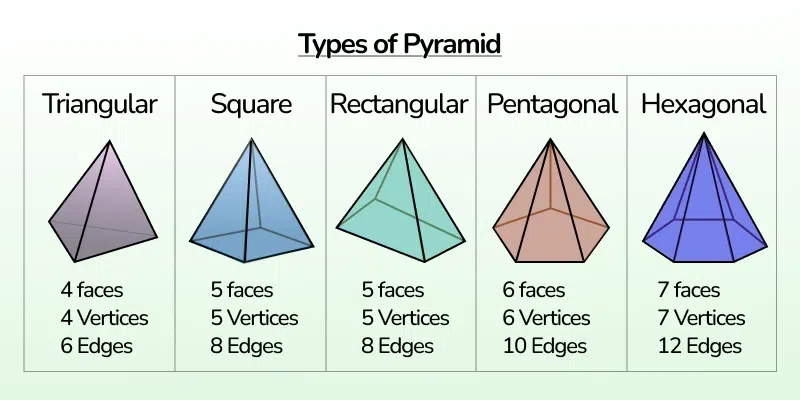
Pyramids have different types based on their base shape, like squares, triangles, and pentagons. Each type has its special geometric features.
Right Pyramid vs Oblique Pyramid
In a right pyramid, all triangular sides meet the base at right angles, while in an oblique pyramid, at least one side doesn't.
Regular vs Irregular Pyramid
A regular pyramid has equal sides and angles with a regular base shape, while an irregular pyramid can have varying sides and angles with an irregular base.
A pyramid is a 3D shape with a flat, polygonal base and triangular sides meeting at a point. Pyramid Formulas deal with the following two formulas:
To find the volume of a pyramid, you take the area of its base, multiply it by the height, and then divide the result by 3.
V= 1/3 × Base Area × Height
The formula for finding the surface area (A) of a pyramid is to add the area of its base to the sum of the areas of its triangular sides.
- For a square base, use the formula: B = (side)2
- For a rectangular base, use: B = length × width
- For a triangular base, use: B = (1 / 2) × base length × height
Add up the areas of each triangular side using:
T = ∑ [(1 / 2) × (base length of each side) × (slant height of each side)]
Finally, calculate the total surface area A by adding B and T.
Total surface area of Pyramid A = B + T
The net of a pyramid is a two-dimensional representation that, when folded, constructs the three-dimensional pyramid. It serves as a flattened layout showcasing the various surfaces of the pyramid, including the base and triangular faces. The edges on the net correspond to the connecting points of the pyramid's surfaces. This process of unfolding and folding helps visualize the spatial arrangement of the pyramid in a simpler form. Exploring nets is a valuable tool for comprehending the geometric structure of three-dimensional shapes.
The properties of the Pyramid are mentioned below:
Also, Check
Example 1: Find the volume of a triangular pyramid if the base area is 36 cm² and the height is 12 cm.
Solution:
Given:
Base area of the triangular pyramid = 36 cm²
Height = 12 cm
The volume of the triangular pyramid is given by the formula: Volume = (1/3) × (Base area) × (Height).Substitute the values into the formula:
Volume = (1/3) × 36 × 12
Volume = (1/3) × 432
Volume = 144 cm³Therefore, the volume of the triangular pyramid is 144 cm³.
Example 2: Determine the total surface area of a pentagonal pyramid if the slant height is 8 cm, and the apothem (distance from the center to the midpoint of a side) is 6 cm.
Solution:
Given:
Slant height = 8 cm
Apothem = 6 cmThe total surface area of the pentagonal pyramid is given by the formula: TSA = (1/2) × Perimeter of the base × Slant height + Area of the base.
The perimeter of the base, P = 5 × side length.P = 5 × 8
P = 40 cmThe area of the base, B = (1/2) × P × Apothem.
B = (1/2) × 40 × 6
B = 120 cm²Now, substitute the values into the total surface area formula:
TSA = (1/2) × 40 × 8 + 120
TSA = 160 + 120
TSA = 280 cm²Hence, the total surface area of the pentagonal pyramid is 280 cm².