|
VOOZH | about |
|
VOOZH | about |
A quadratic function is a type of polynomial function in which the highest degree of the variable is 2; it can be written in the general form:
f(x) = ax2 + bx + c
where:
• x is the variable,
• a, b, and c are constants with a ≠ 0 (if a = 0, the function would be linear, not quadratic),
• The highest exponent of x is 2 (hence the term "quadratic").
Examples: f(x) = 3x2 + 7x + 2, g(x) = x2 – 2, h(x) = 9x2 + 5x
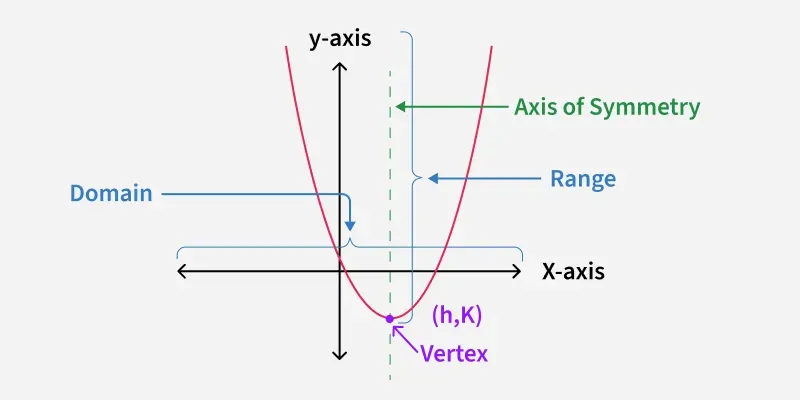
Some of the key features of quadratic functions are vertex, axis of symmetry, domain and range, and maximum or minimum value.
The vertex is the point where the axis of symmetry intersects the parabola. It represents the highest or lowest point on the graph, depending on whether the parabola opens upwards or downwards.
The axis of symmetry is the vertical line that passes through the vertex, dividing the parabola into two symmetric halves.
Domain: The set of all real values for x, so the domain of a quadratic function is (−∞, ∞).
Range: The set of possible values for f(x), or the y-values, which depend on the vertex and the direction of the parabola:
The maximum or minimum value of a quadratic function occurs at the vertex. The sign of the leading coefficient a determines whether the value is a maximum or minimum:
The standard or general form of a quadratic function is given as follows:
f(x) = ax2 + bx + c
Where,
a, b, and c are real numbers and a ≠ 0.
In the vertex form of a quadratic function, the quadratic function is of the form:
f(x) = a(x - h)2 + k
Where a ≠ 0 and (h, k) is the vertex of the parabola that represents quadratic function.
In the intercept form of a quadratic function, the quadratic function is of the form:
f(x) = a (x - p) (x - q)
where, a ≠ 0 and (p, 0) and (q, 0) are the x-intercepts of the parabola representing the quadratic function.
Note: For the standard form of quadratic function, i.e., f(x) = ax² + bx + c
Vertex of quadratic function = (h, k) = ((- b / 2a), f (- b / 2a))
There are three types of quadratic functions:
The quadratic function that involves only one variable is called the univariate quadratic function, and all the discussion throughout this article involves only this type of quadratic function. Thus, the general form of a univariate quadratic function is given as:
f(x) = px2 + qx + r
Where,
x is the variables, and p, q, and r are the coefficients of variables.
The quadratic function that involves two variables is called the bivariate quadratic function, and the general form of the bivariate quadratic function is given as
f(x) = ax2 + by2 + cx + dy + exy + f
Where,
x, and y are variables, and a, b, c, d, e, and f are the coefficients of variables.
The quadratic function that involves three or more variables is called the multivariate quadratic function. The general form of a multivariate quadratic function with three variables is given as:
f(x) = ax2 + by2 + cz2 + dx + ey + fxy + gyz + hxz + i
Where,
x, y, and z are variables, and a, b, c, d, e, f, g, h, and i are the coefficients of variables.
The graph of the quadratic function is a U-shaped parabola whose direction is either upwards or downwards.
Steps to plot a graph of a quadratic function:
Example: Plot the graph for the quadratic function f(x) = x2 - x - 6.
Solution:
For function, f(x) = x2 - x - 6
Here, a = 1, b = -1, c = -6
Step 1: The vertex of above quadratic function = (-b / a, f(-b/a))
f(-b/a) = f [-(-1)/1] = f(1) = -6
The vertex of above quadratic function = (1, -6)
Step 2: Following is the quadratic function table
x
-2
-1
0
1
2
y
0
- 4
-6
-6
-4
Step 3: Plot the graph from above table.
👁 Graphing Quadratic Function
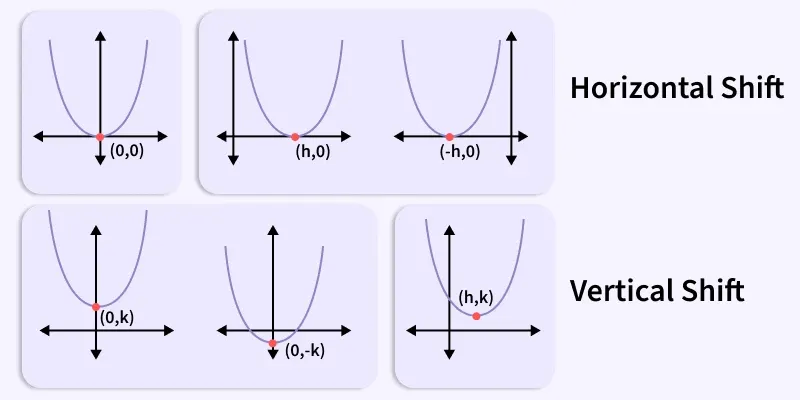
By changing the vertex we can shift the graph in the cartesian plane anywhere. we can make two kinds of shifts by changing the vertex parameters i.e.,
Horizontal Shift
The quadratic function graph of f(x) = (x - h)2 shifts the graph of f(x) = x2 by h units horizontally.
Vertical Shift
The quadratic function graph of f(x) = x2 + k shifts the graph of f(x) = x2 by k units vertically.
For a quadratic function f(x), you can form it into any quadratic equation by equating it to any quadratic, linear or, constant function i.e., f(x) = g(x) when f(x) is a quadratic function and g(x) has a maximum degree of 2. To solve such an equation, we have various methods such as:
In the quadratic equation ax2 +bx + c , where a ≠ 0, the discriminant of the equation is given by:
Discriminant (D) = b2 - 4ac
The nature of the roots depends on the discriminant of the quadratic equation.
Problem 1: Find the vertex of the quadratic function f(x) = 5(x - 3)2 + 6.
f(x) = 5(x - 3)2 + 6
The above quadratic function represents the vertex form of the quadratic equation which can be written as:
f(x) = a(x - h)2 + k
where, (h, k) is the vertex of quadratic function.
Here, h = 3 and k = 6
The vertex of the quadratic equation f(x) = 5(x - 3)2 + 6 is (3, 6).
Problem 2: Find the roots of the quadratic function f(x) = x2 + 5x + 6 using the quadratic function formula.
f(x) = x2 + 5x + 6
The quadratic equation formula: x = [-b ± √ (b2 - 4ac)] / 2a
Here, a =1, b =5 and c= 6
x = [-5 ± √ (52 - 4 × 1 × 6)] / 2 × 1
x = [-5 ± √ (25 - 24)] / 2
x = [-5 ± √1)] / 2
x = [-5 ± 1)] / 2
x = [-5 + 1)] / 2 or x = [-5 - 1)] / 2
x = -4 / 2 or x = -6 / 2
x = -2 or x = -3
Problem 3: Convert the quadratic function f(x) = (x - 4) (x + 5) in standard form.
f(x) = (x - 4) (x + 5)
Multiplying both brackets
f(x) = x(x + 5) - 4(x + 5)
f(x) = x2 + 5x - 4x - 20
f(x) = x2 + x - 20The quadratic function f(x) = (x - 4) (x + 5) in standard form is f(x) = x2 + x - 20
Problem 4: Solve f(x) = x2 + 4x - 45 using quadratic formula.
f(x) = x2 + 4x - 45
The quadratic equation formula: x = [-b ± √ (b2 - 4ac)] / 2a
Here, a =1, b = 4 and c = -45
x = [-4 ± √ (42 - 4 × 1 × -45)] / 2 × 1
x = [-4 ± √ (16 + 180)] / 2
x = [-4 ± √196)] / 2
x = [-4 ± 14)] / 2
x = [-4 + 14)] / 2 or x = [-4 - 14)] / 2
x = -10 / 2 or x = -18 / 2x = -5 or x = -9