|
VOOZH | about |
|
VOOZH | about |
Radian is a unit used to measure angles in mathematics. An angle is said to be 1 radian when it subtends an arc whose length is equal to the radius of the circle at its center. In other words, if the arc length s equals the radius r, then the angle θ is 1 radian.
θ = s / r
- θ is Angle in Radians
- s is Arc Length
- r is Radius of Circle
360 degrees is the whole revolution of a circle. Radian is an additional unit of angular measure. 2π radians make up a complete revolution around a circle. This is because, given a radius of r, the circumference of a circle is equal to 2πr; conversely, if the radius is 1, the circumference is equal to 2π.
Since 360 degrees equals 2π radians, we may use this to convert degrees to radians.
👁 Unit-Cicle-Chart-and-RadianRadians = Degrees × π/180
2π radians equals 360 degrees. Consequently, 1 radian equals 360/2π = 180/π degrees.
An angle can be converted from radians to degrees by multiplying its radian value by 180/π.
Degrees = Radians × 180/π
Angles like 0°, 30°, 45°, 60°, 90°, 180°, 360°, etc. are quite common. 180o is equal to π radians, which is the connection used to convert between degrees and radians.
We can determine the radian measure for each common angle using the table added below:
Value of Angle in Degree | Calculation | Value of Angle in Radian |
|---|---|---|
0° | 0° × π / 180 | = 0 radians |
30° | 30° × π / 180 | = π/6 radians |
45° | 45° × π / 180 | = π/4 radians |
60° | 60°× π / 180 | = π/3 radians |
90° | 90° × π / 180 | = π/2 radians |
180° | 180°× π / 180 | = π radians |
360° | 360° × π / 180 | = 2π radians |
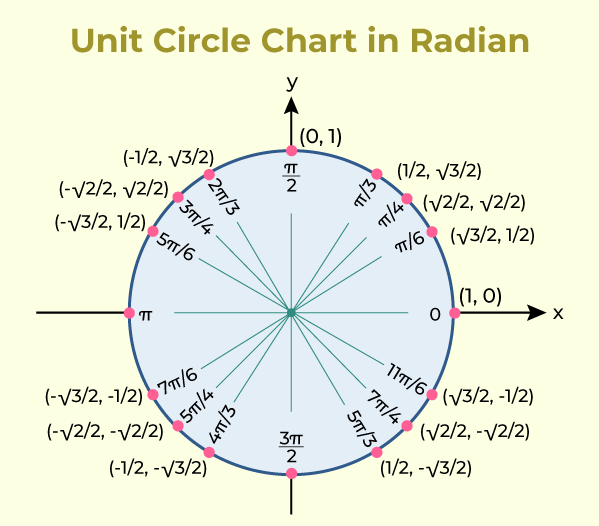
Angles measured in radians are frequently employed with trigonometric functions like sine, cosine, and tangent. For example, the cosine and sine of an angle measured in radians correspond to the coordinates of points in the unit circle.
Example: Find the sine and cosine of π/2.
Solution:
Using trigonometric table,
- Sin( π/2) = 1
- cos( π/2) = 0
Radian measure is particularly useful in various mathematical contexts, such as:
Example 1: Convert 90 degrees to radians.
Solution:
Conversion from Degrees to Radians: Radians = Degrees × π/180
Radians = 90° × π/180
= π/2
Example 2: Calculate the radian measure for a 75-degree angle.
Solution:
Conversion from Degrees to Radians: Radians = Degrees × π/180
Radians = 75° × π/180
= 5π/12
Example 3: Convert -90 degrees to radians.
Solution:
Conversion from Degrees to Radians: Radians = Degrees × π/180
Radians = -90° × π/180
= -π/2
Example 4: What is the cosine of π radians?
Solution:
On the unit circle, cos(π) corresponds to the x-coordinate, which is −1
So, the value of cos(π) is equal to -1
cos(π) = −1
Example 5: What is the angle in degrees if the radian measure is 2π?
Solution:
Conversion from radians to degrees: Degrees = Radians × 180/π
Degrees = 2π × 180/π
= 360 degrees
Example 6: Find the radian measure of an angle subtended by an arc length of 10 units in a circle of radius 5 units.
Solution:
By using formula: θ = s / r
Radians = Arc Length/Radius
= 10/5 = 2
Q1. Convert 135 degrees to radians.
Q2. What is the sine of π/2?
Q3. Find the radian measure of a 300-degree angle.
Q4. Determine the radian measure of a 15-degree angle.
Q5. Convert 720 degrees to radians.
Q6. Determine the radian measure of a 30-degree angle.
Q7. Find the radian measure of an angle subtended by an arc length of 20 units in a circle of radius 4 units.