|
VOOZH | about |
|
VOOZH | about |
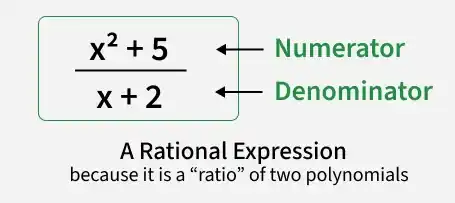
A rational expression is essentially a fraction where both the numerator and the denominator are polynomials. This means it is an algebraic expression that can be written in the form
where P(x) and Q(x) are polynomials, and Q(x) ≠ 0 (since division by zero is undefined). The polynomials P(x) and Q(x) can have any degree, meaning the expression can include terms like x2, x3, constants, etc.
Examples of Rational Expressions:
1)
2)
3)
4)
5)
To simplify the rational expression, we can use the following steps:
Example: Simplify.
Factor the numerator: x2 - 4 = (x - 2)(x + 2)
Cancel the common factor (x + 2).
Rewrite the simplified expression:
Result: x - 2 (with the restriction x ≠ -2)
The domain of a rational expression is the set of all values of xxx for which the expression is defined.
Example :
Step 1: Identify the denominator, which is x − 5.
Step 2: Set the denominator equal to zero to find the restriction:x − 5 = 0 ⇒ x = 5
Step 3: Exclude x = 5 from the domain, because it makes the denominator zero.
So, the domain of the expression is all real numbers except x = 5.
The roots of a rational expression are the values of x that make the expression equal to zero.
Given a rational expression of the form: P(x)/Q(x):
where P(x) is the numerator polynomial and Q(x) is the denominator polynomial:
Example: Consider the rational expression:
Set the numerator equal to zero: x2 - 4 = 0
Solving for x:
x2 = 4
x = ±2Thus, the roots of the numerator are x = 2 and x = -2
Check the denominator: x2 − 9 = 0
Substitute x = 2:
22 − 9 = −5 ≠ 0Substitute x = −2x:
(−2)2 − 9 = −5 ≠ 0Since x = 2 and x = −2 do not make the denominator zero, they are valid roots of the rational expression.
Similar to any other expression, we can perform all the operations on rational expressions i.e.,
To add and subtract rational expression, we can use following steps:
Step 1: Identify the least common denominator (LCD) of the rational expressions.
Step 2: Rewrite each expression with the LCD by multiplying the numerator and denominator with the necessary factors for each.
Step 3: Add or subtract the numerators while keeping the common denominator.
Step 4: Simplify the Result.
Example: Simplify .
Given:
LCD: x(x+1)
Rewrite:
To multiply rational expressions, we can use following steps:
Step 1: Factor both the numerator and the denominator of each rational expression completely.
Step 2: Multiply the numerators to form the new numerator.
Step 3: Multiply the denominators to form the new denominator.
Step 4: Factor the resulting numerator and denominator if possible and cancel any common factors.
Example: Simplify .
Multiply:
Simplify:
To divide rational expressions, we take the reciprocal of the second rational expression (the divisor). After that follow the steps for multiplication.
Example: Simplify .
Given: .
Reciprocal:
Multiply:
Simplify:
Rational expressions can be classified into two types based on the degrees of the polynomials in the numerator and the denominator: proper rational expressions and improper rational expressions.
Proper Rational Expressions: A rational expression is considered proper if the degree of the polynomial in the numerator is less than the degree of the polynomial in the denominator.
Example:
Here, the degree of the numerator is 2, and the degree of the denominator is 3. Since 2 < 3, this is a proper rational expression.
Improper Rational Expressions: A rational expression is considered improper if the degree of the polynomial in the numerator is greater than or equal to the degree of the polynomial in the denominator.
Examples:
Here, the degree of the numerator is 3, and the degree of the denominator is 2. Since 3 > 2, this is an improper rational expression.
Problem 1: Simplify .
Problem 2: Add .
Problem 3: Subtract .
Problem 4: Multiply .
Problem 5: Divide .
Problem 6: Simplify .
Problem 7: Simplify .
Problem 8: Simplify .
Problem 9: Add .
Problem 10: Multiply .