|
VOOZH | about |
|
VOOZH | about |
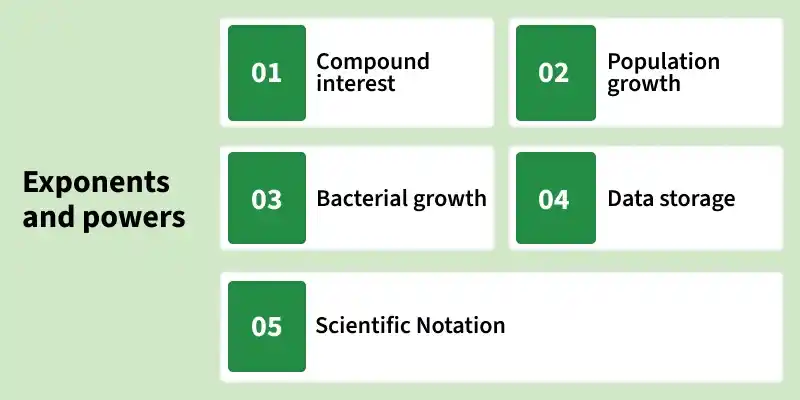
Various applications of exponents and powers are given below:
When money grows in a bank account, it follows an exponential pattern.
A = P(1 + r)t
Exponents and powers are used in biology to recreate population fluctuations.
For example: Imagine a bacteria colony doubling every hour. Exponents show this explosive growth, allowing scientists to predict future population sizes and manage resources effectively. Conversely, radioactive decay (particles breaking down) also follows exponential principles, helping us understand how materials lose potency over time.
Exponents and powers are important concepts for understanding the evolution of technology and computing power.
For Example: Moore's Law describes how computing power increases exponentially over time and roughly doubles every two years. Therefore, this idea can be expressed as an exponential function, that helps in the forecasting of scientific discoveries and the development of ever-more-powerful devices.
Exponents and powers are frequently used in scientific notation in the fields of science and engineering. Extremely big or extremely small numbers can be expressed in a clear and practical fashion using scientific notation. Numbers are written as a product of a coefficient and a power of 10, making calculations easier and more efficient.
For Example: The number 4500000 can be written in scientific notation as: 4.5×10⁶
Exponents and powers are used by scales like the Richter and pH scales to quantify factors that are hard to measure, such as pH and earthquakes. While the pH scale evaluates a substance's acidity or basicity, the Richter scale measures the strength of earthquakes.
For Example: An earthquake of magnitude six is ten times greater than one of magnitude five, and a substance with a pH of two is ten times more acidic than one with a pH of three.