|
VOOZH | about |
|
VOOZH | about |
The word "geometry" itself comes from two Greek words meaning "earth" and "measurement." 3D geometry, also known as three-dimensional geometry, is the branch of mathematics that deals with shapes and figures in three-dimensional space.
In contrast to two-dimensional geometry, which deals with figures in a plane, 3D geometry involves objects that have length, width, and height. Some key concepts in 3D geometry are:
Given below are the real-life applications of Three-Dimensional Geometry:
Imagine you're rearranging your bedroom, and you want to make sure your new bookshelf will fit next to your desk. You use 3D geometry to measure the height, width, and depth of the space to find the perfect size for your bookshelf without it sticking out awkwardly or blocking something else.
When you're trying to fit everything into a suitcase, you're actually doing 3D geometry! You look at all your clothes, shoes, and toiletries, and figure out how to arrange them so they all fit into your suitcase's space, making sure you utilize every inch.
Every time you play a video game or step into a virtual reality world, you're experiencing 3D geometry in action. Game developers use it to create realistic environments and characters that move and interact in a space that feels real, with depth, height, and width.
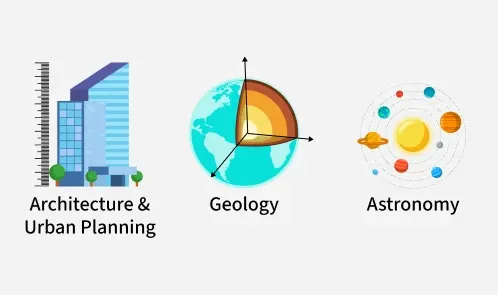
Architects use 3D geometry to design buildings and structures, ensuring they're safe, functional, and aesthetically pleasing. For instance, when designing a skyscraper, they need to calculate how much weight it can support, how wind and weather will affect it, and how people will move through its spaces.
When you use a map or a navigation app to get from point A to point B, 3D geometry is working behind the scenes. It helps in calculating the shortest or fastest route, taking into account the earth's curvature, elevation changes on the route, and any obstacles in your path, like rivers or mountains.