|
VOOZH | about |
|
VOOZH | about |
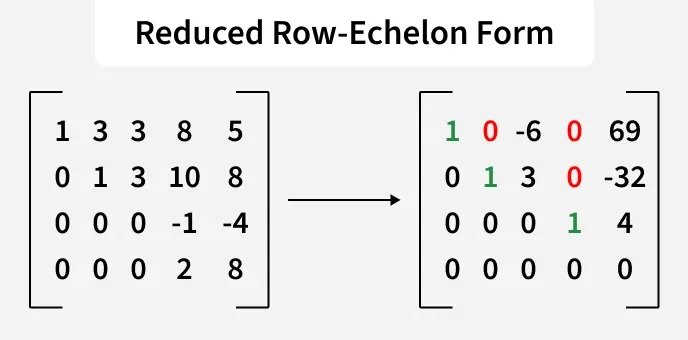
Reduced Row-Echelon Form (RREF) is a special form of a matrix in which each leading entry is 1 and is the only non-zero entry in its column. It is commonly used to solve systems of linear equations and simplify matrix calculations.
In linear algebra, a matrix is in row echelon form if it is obtained as the result of Gaussian Elimination on the rows of that matrix. This form of the matrix must satisfy some conditions which are discussed below:
Example:
Here, matrix C is in row-echelon form. The first and second rows are non-zero rows. The third row is a zero row.
In reduced row echelon form, a matrix must satisfy the following properties:
Example 1:
The above matrix is in reduced row-echelon form. The third row is the zero row which is at the bottom of the non-zero rows. The first and second row are non-zero rows. A11 & A23 are non-zero entries and equal to 1.
Example 2:
The above matrix is in reduced row-echelon form. All rows are non-zero rows.
Solved Example
Solve the following system of equations
Solution:
The given linear equations are
x + y + z = 2
x + 2y + 3z = 7
2x + 3y + 4z = 13
The augmented matrix of these linear equations is
1 1 1 : 2
1 2 3 : 7
2 3 4 : 13
Now subtracting R1 from R2, i.e., (R2=R2-R1)
1 1 1 : 2
0 1 2 : 5
2 3 4 : 13
Now subtracting 2R1 from R3, i.e., (R3=R3-2R1), we get,
1 1 1 : 2
0 1 2 : 5
0 1 2 : 9
Now we will subtract R2 from R1, after that we will get new elements of R1
1 0 -1 : -3
0 1 2 : 5
0 1 2 : 9
Lastly we will subtract R2 from R3 to get new elements of R3
1 0 -1 : -3
0 1 2 : 5
0 0 0 : 4
Now putting the values of x, y and z in the equations, we get,
x - y = -3
y + 2z = 5
0 = 4 , which is impossible.
∴The above system of equations have no solutions.
The step-by-step process to convert a matrix to reduced row echelon form is discussed below:
Let us consider a matrix
Now, we will discuss the steps one by one,
If there is a 1 in the leading entry of the first row then, no change is required in this step. We have 1 in the leading entry in the given matrix A.
1 2 -1 -4
A = 0 -1 1 -3
0 4 -5 14
After the first row and column, we have to make the leading entry of the second row = 1: R2 = - R2
1 2 -1 -4
A = 0 1 -1 3
0 4 -5 14
1 0 1 -10
A = 0 1 -1 3
0 0 -1 2
Now we have to make the leading entry of the third row = 1.
Therefore, R3 = -R3
1 0 1 -10
A = 0 1 -1 3
0 0 1 -2
1 0 0 -8
A = 0 1 0 1
0 0 1 -2
Finally, we get the reduced row echelon form of the matrix A
1 0 0 -8
A = 0 1 0 1
0 0 1 -2
Solved Problems
Find the reduced row echelon form of the given matrix.
3 −2 −3 3
2 3 3 2
Solution:
The given matrix is
3 −2 −3 3
2 3 3 2
Now, R1 - R2 → R1
1 −5 −6 1
2 3 3 2
Now, R2 - 2R1 → R2
1 −5 −6 1
0 13 15 0
Now, 1/13 R2 → R2
1 −5 −6 1
0 1 15/13 0
At the end, R1 + 5R2→ R1
1 0 -3/13 1
0 1 15/13 0
∴ The row reduced echelon form of the given matrix is
1 0 -3/13 1
0 1 15/13 0
Q1. Solve the following system of equations using Gaussian Elimination.
Q2. Solve this system of equations using Gaussian Elimination.
Q3. Solve this system of equations using Gaussian Elimination.
Q4. Is the following matrix in reduced row echelon form?
5 0 0 7
0 1 0 5
0 0 1 4
Q5. Solve the following system of equations.
x + y = 2
3x + 4y = 5
4x + 5y = 9