|
VOOZH | about |
|
VOOZH | about |
When we use statistics to make predictions, we often face differences between what we expect and what happens. These differences are called errors. Two common types are:
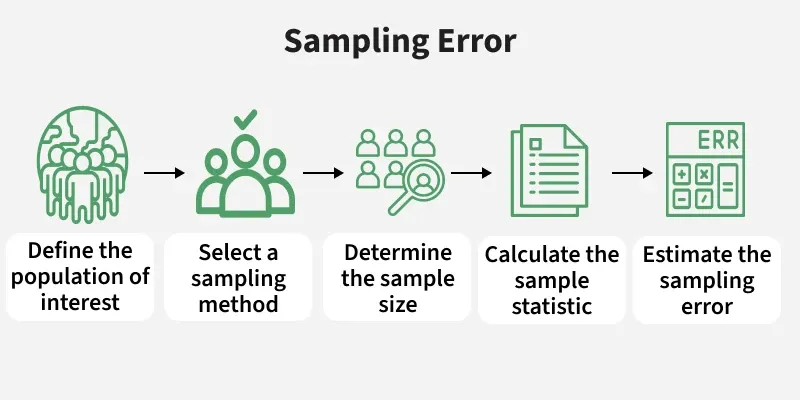
Sampling error arises naturally because we typically use a sample (a subset) to make inferences about a larger population, rather than measuring the entire population. Even with statistically sound sampling methods, the specific sample drawn may not perfectly mirror all characteristics of the entire population. This inherent discrepancy is the sampling error.
The size and shape of the sample are used to calculate the sampling error rate, which reflects the accuracy of the selection process. An important factor in identifying such an error is the selection basis, which is a type of systematic error caused by non-random sampling methods.
The formula to find the sampling error is given as follows:
Sampling Error (SE) = (1/√ N) 100
Where: N is the Sample Size
To reduce sampling error, two methods are:
Sample Size Too Small: When the sample size is too small, it may lead to errors.
Sampling Bias: It occurs when the members of the sample are unrepresentative of the population.
Sample Coverage Error: This could happen for a variety of reasons, including the sample being too small, the sample being unrepresentative of the population, or the sample being contaminated.
Sample Contamination: There may bea chance that where Sample may be diluted. This leads to less accuracy.
Sample Unrepresentativeness: This could happen for a variety of reasons, including the person being too busy to take the survey, the person refusing to take the survey, or the person being unable to take the survey for some reason.
Example 1: A manufacturing company produces light bulbs. It is estimated that 2% of the light bulbs produced are defective. If a box contains 100 light bulbs, what is the probability that exactly 3 light bulbs in the box are defective?
Solution:
To find the probability of getting exactly 3 defective light bulbs out of 100, we can use the binomial probability formula:
P(X = 3) = (100C3) × (0.02)3 × (0.98)97
≈ 0.1168 or 11.68%
Example 2: In a particular city, 25% of the residents have a certain disease. If 5 residents are selected at random, what is the probability that exactly 2 of them have the disease?
Solution:
Let X be the number of residents with the disease out of 5 selected.
P(X = 2) = (5C2) × (0.25)2 × (0.75)3
≈ 0.2734 or 27.34%
Example 3: A fair coin is tossed 10 times. What is the probability of getting exactly 6 heads?
Solution:
Tossing a fair coin 10 times is a binomial experiment with n = 10 and p = 0.5 (probability of getting a head).
P(X = 6) = (10C6) × (0.5)6 × (0.5)4
≈ 0.2051 or 20.51%
Question 4: In a city, 40% of people prefer using public transport. If 6 people are selected randomly, reducing is the probability that exactly 4 of them prefer public transport?
Solution:
Let X be the number of defective screws. This is a binomial distribution with
n=8, p=0.10, and q=1−p = 0.90
Question 1: In a factory, 5% of items are defective. A quality inspector checks a random sample of 20 items. What is the probability that exactly 1 item is defective?
Question 2: A basketball player has a 70% chance of making a free throw. If she takes 8 free throws, what is the probability she makes exactly 6 of them?
Question 3: A student guesses on a multiple-choice quiz with 5 questions, each having 4 options (only one correct). What is the probability that the student gets exactly 2 questions correct?
Question 4:In a city, 40% of people prefer using public transport. If 6 people are selected randomly, what is the probability that exactly 4 of them prefer public transport?