|
VOOZH | about |
|
VOOZH | about |
Simple interest is a straightforward method of calculating the interest charged on a loan or paid on an investment, based on the principal amount, interest rate, and time period. This article will share quick and easy tricks to make calculating simple interest even faster. By learning these shortcuts, you can save time and make smarter financial decisions.
Simple interest is a method for calculating the interest charged on a loan or earned on an investment based on the original principal amount, the interest rate, and the time period over which the interest is calculated.
It is called "simple" because it does not consider the effect of compounding, where interest is earned on previously accumulated interest.
The formula for simple interest is given by:
SI = (P × R × T)/100
Where,
Note: If the rate is given in decimal representation, then SI = PRT.
Some concepts that help us understand simple interests are:
Some tricks related to simple interest include:
When dealing with simple interest, quickly calculating percentages is essential. Here are some shortcuts:
| Calculation Type | Method | Example Calculation | Result |
|---|---|---|---|
| 1% Calculation | Move decimal point two places to the left. | 1% of $500.00 | $5.00 |
| 5% Calculation | Calculate 1% and multiply by 5. | 5 × 1 % 500 | $25 |
| 10% Calculation | Move decimal point one place to the left. | 10% of $500.00 | $50.00 |
| 15% Calculation | Combine the results of 10% and 5%. | 10% of $500 + 5% of $500 | $75 |
| 25% Calculation | Multiply principal by 1/4. | 500 × 1/4 | $125 |
| 50% Calculation | Multiply principal by 1/2. | 500 × 1/2 | $250 |
Using these shortcuts, you can quickly determine interest rates for various principal amounts without the need for complex calculations.
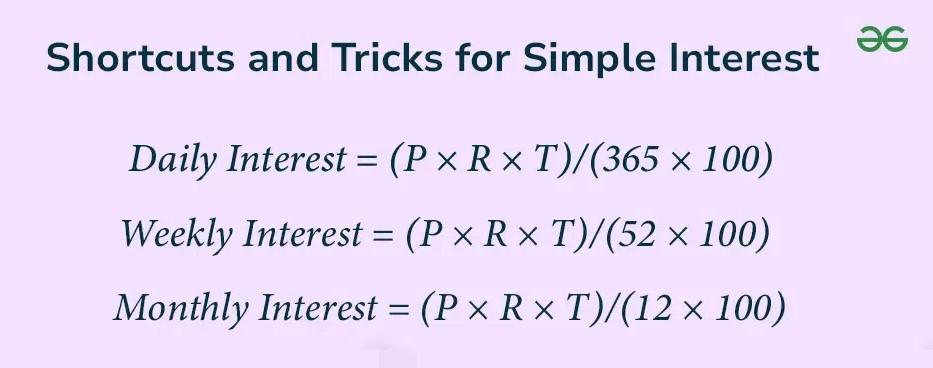
Daily interest calculation is helpful for short-term loans or investments. Here's a simple trick to calculate it:
Convert Annual Rate to Daily Rate using following relation:
Daily Rate = Annual Rate/365
For example, if the annual rate is 5%, the daily rate is 5/365 ≈ 0.0137 %.
Daily Interest = (P × R × T)/(365 × 100)
Where P is the principal and R is the annual interest rate.
Monthly interest calculations are common for loans and investments with monthly compounding. Here's an efficient way to do it:
Convert Annual Rate to Monthly Rate:
Monthly Rate = Annual Rate/12
For example, if the annual rate is 5%, the monthly rate is 5/12 ≈ 0.4167 %.
Monthly Interest = (P × R × T)/(12 × 100)
Some other miscellaneous tricks related to simple interest are given below:
R = (P1R1 + P2R2)/(P1 + P2)
Question 1 : What would be the annual interest accrued on a deposit of Rs. 10,000 in a bank that pays 4 % per annum rate of simple interest ?
Solution :
Here, P = 10000, R = 4, T = 1
=> SI = P x R x T / 100
=> SI = 10000 x 4 x 1 / 100
=> SI = 400
Thus, the annual interest would be Rs. 400
Question 2 : A sum of money amounts to Rs. 28,000 in 2 years at 20 % simple interest per annum. Find the sum.
Solution :
Here, A = 18000, T = 2, R = 20
=> A = P + SI
=> A = P + (P x R x T / 100)
=> A = P [1 + (R x T / 100)]
=> 28000 = P [1 + 0.4]
=> P = 28000 / 1.4
=> P = 20000
Thus, the required sum is Rs. 20,000
Question 3 : A man borrowed a certain sum of money at the rate of 6 % per annum for the first two years , 9% per annum for the next three years, and 14% per annum for the period beyond 5 years. If he pays a total interest of Rs. 22,800 at the end of 9 years, find the amount he borrowed.
Solution :
Let the borrowed sum be P.
=> SI for first 2 years + SI for next 3 years + SI for next 4 years = 22800
=> (P x 6 x 2 / 100) + (P x 9 x 3 / 100) + (P x 14 x 4 / 100) = 22800
=> 95 P / 100 = 22800
=> P = 24000
Therefore, Borrowed sum = Rs. 24,000
Question 4 : At what annual rate of interest will a sum of money be thrice in 10 years?
Solution :
Amount = Principal + SI
If the sum of money would be thrice the principal after 10 years, the SI would be twice the principal.
=> SI = 2 x P
=> (P x R x T / 100) = 2 X P
=> R x T / 100 = 2
=> R x T = 200
=> R x 10 = 200
=> R = 20 %
Thus, the required rate of interest is 20 %
Question 5 : The simple interest on a sum of money in 5 years at 12 % per annum is Rs. 400 less than the simple interest accrued on the same sum in 7 years at 10 % per annum. Find the sum.
Solution :
Let the sum be P.
=> SI in 5 years at 12 % per annum = P x 12 x 5 / 100 = 0.6 P
=> SI in 7 years at 10 % per annum = P x 10 x 7 / 100 = 0.7 P
Now, according to the question,
0.7 P - 0.6 P = 400
=> 0.1 P = 400
=> P = 4000
Thus, the required sum is Rs. 4000