|
VOOZH | about |
|
VOOZH | about |
Surface area is the total area occupied by the surface of a three-dimensional object. It is the sum of the areas of all the surfaces of the object.
There are two main types of surface area (SA) in solid geometry:
When you have a combination of two solids, such as a cylinder with a cone on top, or a cube with a hemisphere on one of its faces, calculating the total surface area involves finding the surface areas of each individual solid and then summing them up.
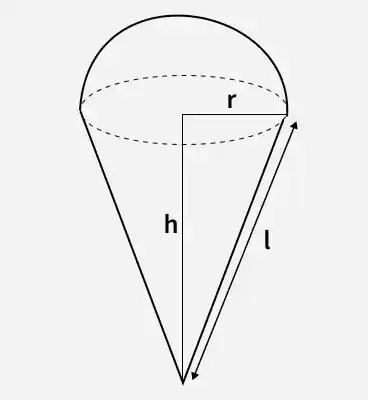
This figure can be simplified into a cone and a hemisphere. But note that while calculating the curved surface area, we do not consider the base of the hemisphere and cone, as it is not exposed outside. Hence, we only add the curved surface area of the solids.
∴ S.A. of figure = C.S.A of cone + C.S.A of hemisphere
S.A. of figure = πrl + 2πr2
S.A. of figure = πr(l+2r)
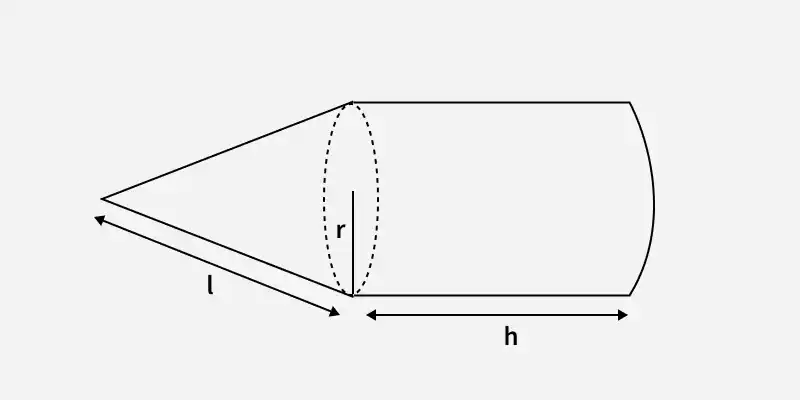
For the total surface area of this solid, we need to take into account the curved surface area of the cylinder, the area of the base of the cylinder and the curved surface area of the cone (not TSA as the base of cone is inside the solid)
∴ S.A. of figure = CSA of cylinder + base area of cylinder + CSA of cone
S.A. of figure = 2πrh + πr2 + πrl
S.A. of figure = πr(2h + r + l)
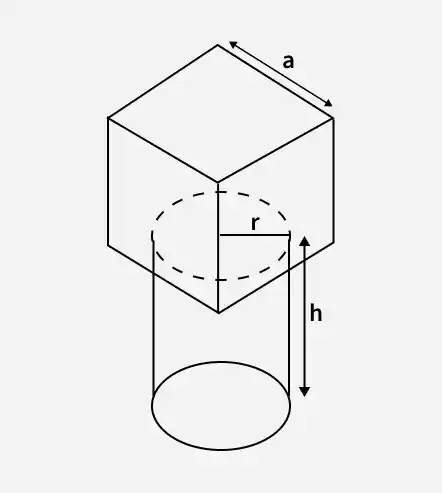
Here, since there is an overlapped area of the top of the cylinder, here is how we calculate the surface area of this solid:
∴ S.A. of figure = (CSA of cylinder + area of base of cylinder + TSA of cube) - area of top of cylinder
S.A. of figure = (2πrh + πr2 + 6a2) - πr2
S.A. of figure = 2πrh + 6a2
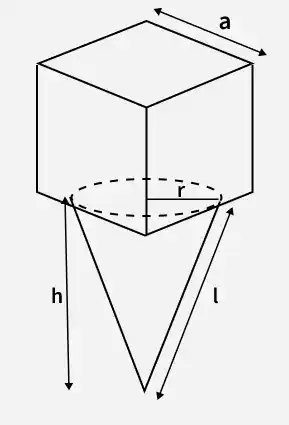
Here, since there is an overlapped area of the top of the cone, here is how we calculate the surface area of this solid:
∴ SA of solid = (CSA of cone + TSA of cube) - area of top of cone
SA of solid = ( πrl + 6a2) - πr2
SA of solid = πr(l + r) + 6a2
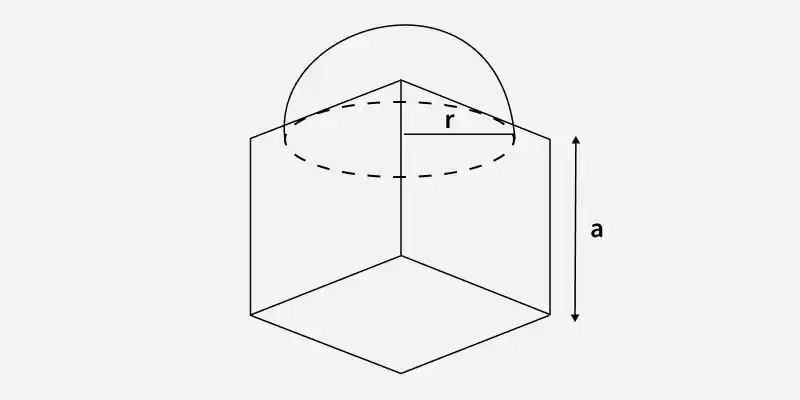
Here, since there is an overlapped area of the hemisphere, here is how we calculate the surface area of this solid:
∴ SA of solid = (SA of cube + SA of hollow hemisphere) - base area of hemisphere
SA of solid = (6a2 + 2πr2) - πr2
SA of solid = 6a2 + πr2
Now that we have seen the combination of two solids, let us look at a more complex topic: combination of three solids.
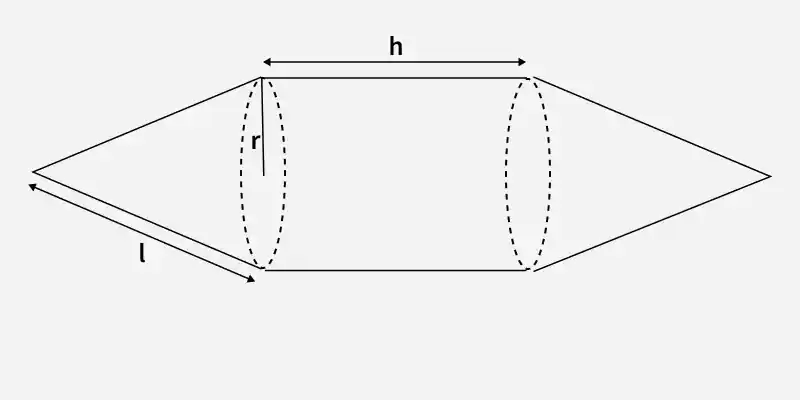
Here, let us consider that the cones are identical and base radius of the cone and the cylinder is the same.
∴ SA of solid = CSA of cylinder + 2 x (CSA of cone)
SA of solid = 2πrh + 2 x (πrl)
SA of solid = 2πr(h + l)
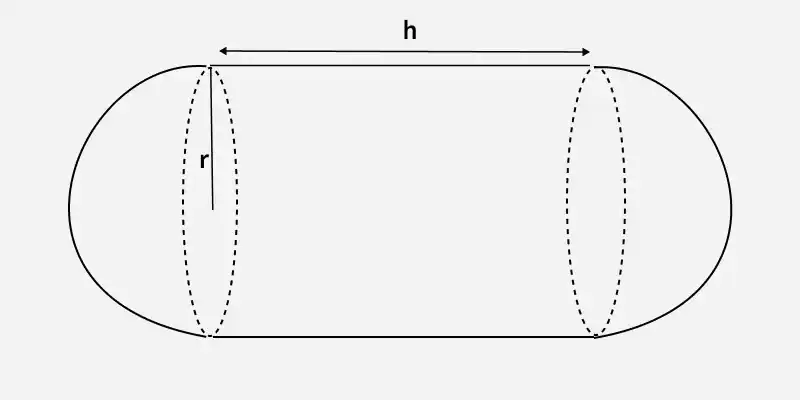
Here, let us consider that the hemispheres are identical and base radius of the hemispheres and the cylinder is the same.
∴ SA of solid = CSA of cylinder + 2 x (CSA of hemisphere)
SA of solid = 2πrh + 2 x (2πr2)
SA of solid = 2πrh + 4πr2
SA of solid = 2πr(h + 2r)
Knowing the surface area of combination of solids can be very helpful in everyday-life as these combinations can be objects we use in real life as well. Some practical applications include:
These are just a few applications that show us the importance of knowing the concept of surface area and how it is deeply related to our everyday life.
Example 1: Find the total surface area of a cylindrical tin can with a hemispherical lid. The radius of the cylindrical part is 5 cm and the height is 12 cm.
Solution:
Surface area of the cylindrical part = 2πrℎ = 2 × π × 5 × 12 = 120π sq. cm
Surface area of the hemispherical lid = 2πr2 = 2 × π × 52 = 50π sq. cm
Total surface area = Surface area of cylindrical part + Surface area of hemispherical lid
Total surface area = 120π + 50π= 170π sq. cm
Example 2: A cone is placed over a hemisphere such that their bases coincide. If the radius of the hemisphere is 6 cm and the height of the cone is 8 cm, find the total surface area of the combination.
Solution:
Surface area of the hemisphere = 2πr2 = 2 × π × 62 = 72π sq. cm
Slant height (l) of the cone = √r2+ ℎ2 = √62+ 82 = √100 = 10 cm
Curved surface area of the cone = πrl = π × 6 × 10 = 60π sq. cm
Total surface area = Surface area of hemisphere + Curved surface area of cone
Total surface area = 72π + 60π = 132π sq. cm
Example 3: A solid iron pole consists of a cylinder of height 220 cm and base radius 9 cm, surmounted by another cylinder of height 60 cm and radius 7 cm. Find the total surface area of the pole.
Solution:
Surface area of the first cylinder = 2πrh = 2 × π × 9 × 220 = 3960π sq. cm
Surface area of the second cylinder = 2πrℎ = 2 × π × 7 × 60 = 840π sq. cm
Area of the circular end of the first cylinder = πr2= π × 92= 81π sq. cm
Area of the circular end of the second cylinder = ??2=?×72=49? sq. cm
Total surface area = Surface area of first cylinder + Surface area of second cylinder + Area of circular ends
Total surface area = 3960π + 840π + 81π + 49π = 4930π sq. cm