|
VOOZH | about |
|
VOOZH | about |
Systematic Random Sampling is a method of selecting a sample from a population in a structured and organized manner. It is a valuable technique in research and statistical analysis providing a systematic yet random approach to sample selection ensuring reliable and accurate results.
In this article, we will discuss systematic random sampling in detail along with some solved examples and others in detail.
Table of Content
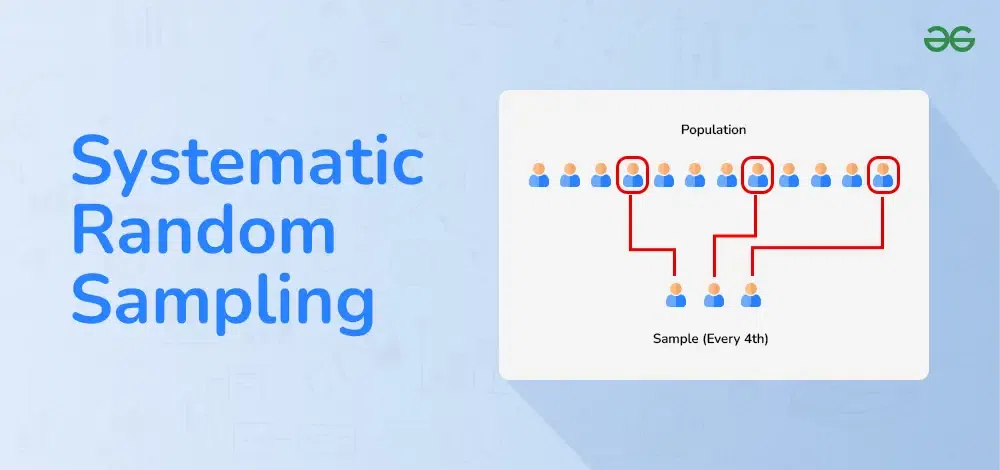
Systematic Sampling is a statistical technique where every nth member of a population is chosen for a sample after an initial random starting point.
Here's how systematic sampling operates:
Some of the types of Systematic Sampling are:
Systematic random sampling is a method that involves selecting elements from a population at regular intervals using a predetermined pattern. It's a hybrid approach that combines randomness with a systematic method to ensure a representative sample.
Here's a detailed breakdown of systematic random sampling:
Systematic random sampling helps avoid bias by ensuring randomness in the selection process while maintaining a systematic structure.
This method is particularly useful when the population is large and ordered, providing a balanced representation of the entire population in the sample.
Systematic Random Sampling is a statistical technique used to select elements from a population at regular intervals through a systematic and structured approach.
Systematic Sampling involves choosing a starting point at random within the population and then selecting every nth element thereafter according to a predetermined pattern until the desired sample size is achieved.
This method combines systematicity with randomness to ensure that each member of the population has an equal probability of being included in the sample, making it a representative subset of the entire population
Check, Random Sampling
Example 1: Consider a university with 2000 students. To conduct a survey, a systematic random sample of 100 students is needed.
Solution:
Random Start: A random number between 1 and 10 is chosen as the starting point.
Sampling Interval: Every 20th student from the randomly selected starting point is chosen for the survey.
If the random start is student number 5, the selected students for the sample will be 5, 25, 45, 65, ..., until 100 students are sampled.
Example 2: Suppose a company has a workforce of 500 employees and needs to gather feedback. They aim to survey 50 employees using systematic random sampling.
Solution:
Random Start: A random number between 1 and 10 is generated to select the starting point.
Sampling Interval: Every 10th employee from the randomly chosen starting point is included in the survey sample.
If the random start is employee number 3, the sample will include employees 3, 13, 23, 33, ..., until 50 employees are surveyed.
Example 3: In a town with 1000 households, a government agency wants to survey 80 households for a census.
Solution:
Random Start: A random number between 1 and 10 is used as the starting point.
Sampling Interval: Every 12th household from the randomly chosen starting point is selected for the census.
If the random start is household number 8, the selected households will be 8, 20, 32, 44, ..., until 80 households are surveyed.
The advantages and disadvantages of Systematic Random Sampling is tabulated below:
Advantages of Systematic Random Sampling | Disadvantages of Systematic Random Sampling |
|---|---|
Provides a structured and systematic approach to sampling, ensuring representative results. | Prone to periodic patterns in the population that may align with the sampling interval, leading to bias. |
Simpler and more practical to execute compared to simple random sampling in large populations. | Requires an accurately ordered or randomly ordered list of the population elements. |
Helps avoid human bias in selection due to its predetermined selection process. | Susceptible to errors if there are any flaws or inaccuracies in the ordering of the population list. |
Offers a balance between random selection and systematic organization, providing efficiency. | If a periodic pattern exists, it can lead to a skewed or unrepresentative sample. |
Provides ease in understanding and implementing the sampling process. | Can be time-consuming if the population list is extensive or complex. |
Systematic random sampling is employed for several reasons due to its unique advantages in statistical analysis. Here are the key points explaining why this technique is used:
The comparison between Systematic Random Sampling and Simple Random Sampling is tabulated below:
Difference Between Systematic Random Sampling and Simple Random Sampling | |
|---|---|
Systematic Random Sampling | Simple Random Sampling |
Selects samples at regular intervals using a systematic pattern. | Selects samples purely at random without any pattern or structure. |
Requires an ordered list of the population, and the sampling interval is predetermined. | Doesn’t require an ordered list; samples are chosen entirely by chance. |
Combines systematic structure with randomness, offering efficiency and representative results. | Provides equal chances of selection for each element, ensuring unbiased representation. |
Can be more practical and time-efficient for larger populations. | Equally applicable to any population size but might be more labor-intensive for large populations. |
More susceptible to periodic patterns in the population, leading to bias if present. | Less prone to systematic bias, but variations in random selection might result in occasional bias. |
To conduct systematic random sampling, determine the sampling interval (k), randomly select a starting point, and then choose every kth element thereafter until the desired sample size is achieved.
The sampling interval (k) is determined by dividing the population size (N) by the desired sample size (n). Mathematically,
k = N/n
To calculate systematic random sampling, follow these steps:
This method ensures that each element in the population has an equal chance of being included in the sample, promoting statistical validity.
Systematic Random Sampling is a statistical technique used to select elements from a population at regular intervals through a systematic and structured approach.
The advantages of Systematic Random Sampling are mentioned below:
Systematic Random Sampling is commonly used in following situations
Also, Check
Example 1: Given Population size (N): 100, Desired sample size (n): 10. Calculate Systematic Random Sampling.
Solution:
Sampling interval (k) = N/n
= 100/10 = 10
Randomly select a starting point: 7
Selected Sample:
7, 17, 27, 37, 47, 57, 67, 77, 87, 97
Example 2: Given Population size (N): 150, Desired sample size (n): 15. Calculate Systematic Random Sampling.
Solution:
Sampling interval (k) = N/n
= 150/15
= 10
Randomly select a starting point: 4
Selected Sample:
4, 14, 24, 34, 44, 54, 64, 74, 84, 94, 104, 114, 124, 134, 144
Example 3: Given Population size (N): 90, Desired sample size (n): 9. Calculate Systematic Random Sampling.
Solution:
Sampling interval (k) = N/n
= 90/9
= 10
Randomly select a starting point: 6
Selected Sample:
6, 16, 26, 36, 46, 56, 66, 76, 86
Example 4: Given Population size (N): 160, Desired sample size (n): 16. Calculate Systematic Random Sampling.
Solution:
Sampling interval (k) = N/n
= 160/16
= 10
Randomly select a starting point: 3
Selected Sample:
3, 13, 23, 33, 43, 53, 63, 73, 83, 93, 103, 113, 123, 133, 143, 153
Example 5: Given Population size (N): 80, Desired sample size (n): 8. Calculate Systematic Random Sampling.
Solution:
Sampling interval (k) = N/n
= 80/8
= 10
Randomly select a starting point: 2
Selected Sample:
2, 12, 22, 32, 42, 52, 62, 72
Problem 1: Given Population size (N): 120, Desired sample size (n): 10. Calculate Systematic Random Sampling.
Problem 2: Given Population size (N): 80, Desired sample size (n): 4. Calculate Systematic Random Sampling.
Problem 3: Given Population size (N): 60, Desired sample size (n): 8. Calculate Systematic Random Sampling.
Problem 4: Given Population size (N): 40, Desired sample size (n): 6. Calculate Systematic Random Sampling.
Problem 5: Given Population size (N): 20, Desired sample size (n): 4. Calculate Systematic Random Sampling.