|
VOOZH | about |
|
VOOZH | about |
The logarithm is the inverse operation of exponentiation. It is defined as the power to which the base number must be raised to get the given number.
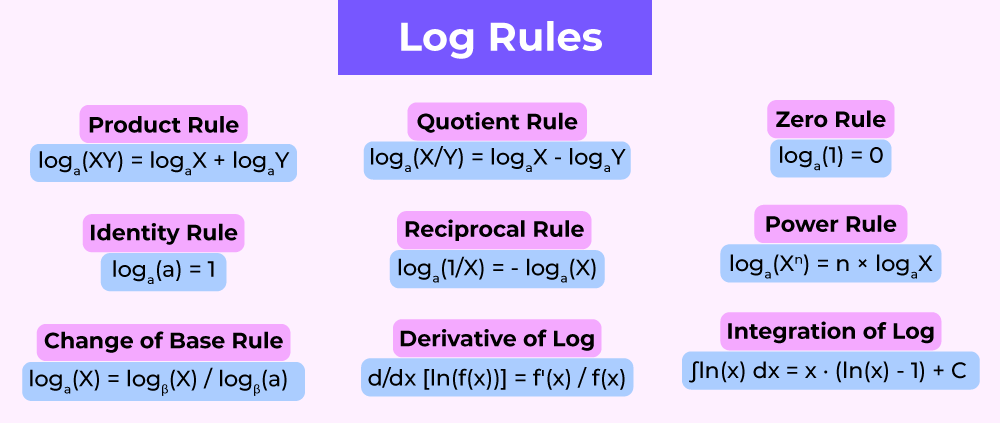
Out of all these log rules, three of the most common are the product rule, the quotient rule, and the power rule.
This article provides essential tips and tricks for tackling logarithm questions effectively, covering key concepts, formulas, and rules that every learner should grasp before diving into practice.
There are two main types of logarithms you’ll encounter:
1) Common Logarithm: Written as log(x), this log has a base of 10.
2) Natural Logarithm: Written as ln(x), this log has a base of e (approximately 2.718).
Below is a detailed table with rules, equations, samples, and quick tricks to solve logarithm questions. Remember the table below to quickly solve the questions.
Rule | Equation | Example | Quick Trick |
|---|---|---|---|
Product Rule | logb(x ⋅ y) = logb(x) + logb(y) | log₂(8⋅4) = log₂(8) + log2(4) = 3 + 2 = 5 | Think "product" means "plus" |
Quotient Rule | logb(x/y) = logb(x) − logb(y) | log₃(27/3) = log₃(27) − log3(3) = 3 − 1 = 2 | Think "quotient" means "minus" |
Power Rule | logb(xk) = k⋅logb(x) | log2(43) = 3⋅log2(4) = 3⋅2 = 6 | Exponent becomes a "coefficient" |
Change of Base Formula | logb(x) = logk(x)/logk(b) | log2(8) = log10(8)/log10(2) ≈ 3 | Use when the base needs to be changed |
Zero Rule | logb(1) = 0 | log5(1) = 0 | A log of 1 is always 0 |
Identity Rule | logb(b) = 1 | log7(7) = 1 | Base and number match = 1 |
Inverse Rule | logb(bx) = x | log2(25) = 5 | Base matches inside power, use exponent |
Negative Log Rule | logb(1/x) = −logb(x) | log2(1/4) = −2 | Flip fraction for a negative result |
Common Logarithmic Values for Base 10 (log10) Table
Value | Approximate Logarithm log10 |
|---|---|
log10(0) | Undefined |
log10(1) | 0 |
log10(2) | 0.301 |
log10(3) | 0.477 |
log10(4) | 0.602 |
log10(5) | 0.699 |
log10(6) | 0.778 |
log10(7) | 0.845 |
log10(8) | 0.903 |
log10(9) | 0.954 |
log₁₀(10) | 1 |
When you have a simple equation of the form logb(x) = y, you can rewrite it in its exponential form to solve for x: x = by
Example: Solve for x in log3(x) = 4.
Solution:
- Rewrite the equation in exponential form: x = 34
- Calculate 34: x = 81
So, x = 81
When you have an equation with logarithms on both sides and the same base, you can set the insides equal to each other.
Example: Solve for x in log₄(x + 3) = log₄(7).
Solution:
Set the insides equal to each other, since both sides have the same base (4), we can set the expressions inside the logarithms equal to each other:
- x + 3 = 7
- x = 4
so the value of x = 4.
Sometimes, you’ll need to use logarithmic properties (product, quotient, or power rule) to simplify an equation before solving it.
Example: Solve for x in log2(4x) = 5
Solution:
Use the product rule to separate the terms:
log2(4) + log2(x) = 5Simplify log2(4) (since 22 = 4, so log2(4) = 2):
2 + log2(x) = 5Subtract 2 from both sides:
log2(x) = 3Rewrite in exponential form: x = 23 = 8
So, x = 8.
If you encounter logarithmic equations with different bases, use the change of base formula to convert one or both sides to a common base.
Example: Solve log2(x) = log3(9)
Solution:
Convert log3(9), using change of base, the change of base formula states:
- log3(9) = log2(9)/log2(3)
Substitute into the Equation:
- log2(x) = log2(9)/log2(3)
Simplify the Right Side:
- Calculate log2(9) and log2(3) in terms of powers of 2:
- Since 9=32, we can use the power rule: log2(9) = log2(32) = 2⋅log2(3).
Thus the equation becomes: log2(x) = 2⋅log2(3)/log2(3)
- Cancel log2(3) on the Right Side: log2(x) = 2
- Rewrite in Exponential Form
- Convert log2(x) = 2 to exponential form: x = 22 = 4
So, x = 4
Question 1: Solve an Exponential Equation Find the value of 'x' in the equation 3x = 27.
Solution:
We can rewrite the equation using logarithms: x = log3 (27).
Using the base-3 logarithm, we find x = 3, as 33 = 27.
Question 2: Use logarithmic properties to evaluate log₂ (8) + log2 (16).
Solution:
Using the property of the sum of logarithms, we have log2 (8) + log2 (16) = log2 (8 * 16).
Simplifying further, we get log2 (128).
Using the base-2 logarithm, log2 (128) = 7, as 27 = 128.
Question 3: Change of Base Calculation. Calculate log₅ (125) using the change of base formula.
Solution:
Using the change of base formula, we have log5 (125) = log10 (125) / log10 (5).
Evaluating the logarithms, we get log5 (125) ≈ 2.0969 and log₁₀(5) ≈ 0.69897
so, log5 (125) = 2.0969 / 0.69897 ≈ 3
also, log5 (125) = 3 , since 5³ = 125
Question 4: Solving Logarithmic Equations Solve the equation 2log₂(x) = 8.
Solution:
We can rewrite the equation as log2(x) = 4.
Converting it to exponential form, we have x = 24.
Simplifying, we get x = 16.