|
VOOZH | about |
|
VOOZH | about |
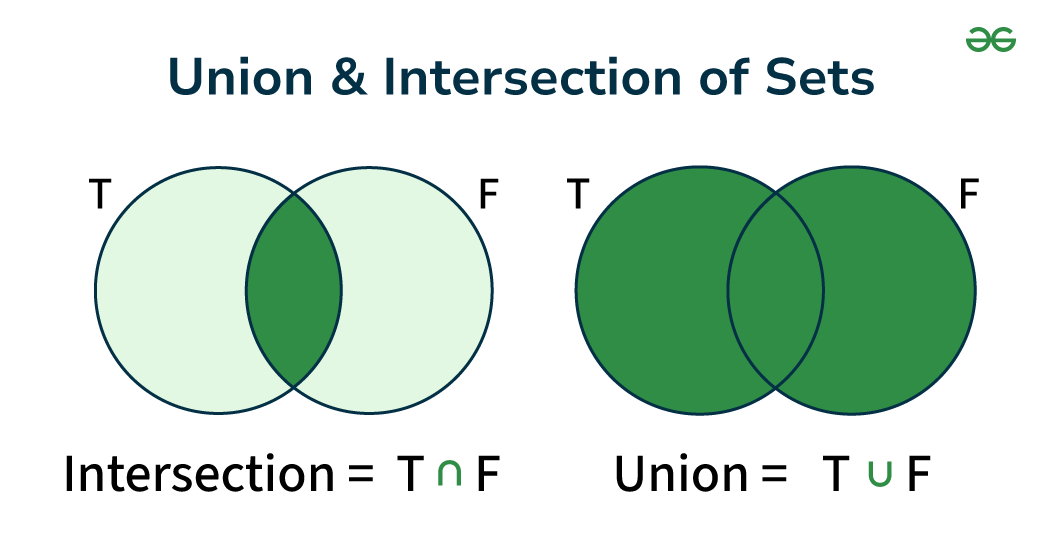
Union and the intersection of sets questions are fundamental in understanding set theory, a crucial concept in mathematics. Mastering these operations allows you to solve problems related to various mathematical disciplines, including probability, statistics, and algebra.
In this article, we will learn about some of the fundamental operations of sets with the help of Union and the intersection of sets questions. These unions and the intersection of sets of questions will help you to understand the concepts and apply them to solve problems in various fields such as computer science, statistics, and logic.
| Operation | Symbol | Formula |
|---|---|---|
| Union of Sets | A ∪ B | A ∪ B = {x: x ∈ A or x ∈ B} |
| Intersection of Sets | A ∩ B | A ∩ B = {x: x ∈ A and x ∈ B} |
Some of the common formulas and properties related to Union and Intersection of Sets are:
| Property | Union | Intersection |
|---|---|---|
| Commutative | A ∪ B = B ∪ A | A ∩ B = B ∩ A |
| Associative | A ∪ (B ∪ C) = (A ∪ B) ∪ C | A ∩ (B ∩ C) = (A ∩ B) ∩ C |
| Distributive over Union | A ∩ (B ∪ C) = (A ∩ B) ∪ (A ∩ C) | A ∪ (B ∩ C) = (A ∪ B) ∩ (A ∪ C) |
| Distributive over Intersection | A ∪ (B ∩ C) = (A ∪ B) ∩ (A ∪ C) | A ∩ (B ∪ C) = (A ∩ B) ∪ (A ∩ C) |
| Identity | A ∪ ∅ = A | A ∩ U = A |
| Annihilator | A ∩ ∅ = ∅ | A ∪ U = U |
| Idempotent | A ∪ A = A | A ∩ A = A |
| Absorption | A ∪ (A ∩ B) = A | A ∩ (A ∪ B) = A |
| De Morgan's Laws | (A ∪ B)′ = A′ ∩ B′ | (A ∩ B)′ = A′ ∪ B′ |
Set A = {1, 2, 3}
Set B = {3, 4, 5}
A ∪ B = {1, 2, 3, 4, 5}
? ∩ ? = {3}
Total no of students = 30
student playing football = n(f) = 20
student playing basketball = n(b) = 15
To find the students who play both, use this formula
n(f ∪ b) = n(f) + n(b) - n(f ∩ b)
30 = 20 + 15 - n(f ∩ b)
n(f ∩ b) = 35 - 30
n(f ∩ b) = 5
So 5 students can play both football and basketball.
Set A = {x : x is an even number less than 10}
Set A = {2, 4, 6, 8}
Set B = {x : x is a multiple of 3}
Set B = {3, 6, 9}
A ∪ B = {2, 3, 4, 6, 8, 9}
A ∩ B = {6}
Set A = {1, 2, 3}
Set B = {3, 4, 5}
Commutative property of Union of sets
A ∪ B = B ∪ A
Now,
A ∪ B = {1, 2, 3, 4, 5}
B ∪ A = {1, 2, 3, 4, 5}
So, A ∪ B = B ∪ A
Commutative property of Intersection of sets
A ∩ B = B ∩ A
Now,
A ∩ B = {3}
B ∩ A = {3}
So, A ∩ B = B ∩ A.
Given sets,
U = {1, 2, 3, 4, 5, 6}
A = {2, 4, 6}
B = {3, 4, 5}
A ∪ B = {2, 3, 4, 5, 6}
A ∩ B = {4}
Given sets,
U = {1, 2, 3, 4, 5, 6}
A = {1, 2, 3}
B = {4, 5, 6}
B' = {1, 2, 3}
A ∩ B′ = {1, 2, 3}
Total no of students = 40
P(p) = 25/40 = 5/8 (probability of liking pizza)
P(b) = 20/40 = 1/2 (probability of liking burgers)
P(p ∩ b) = 15/40 = 3/8 (probability of liking both pizza and burgers)
P( p ∪ b) = P(p) + P(b) − P(p ∩ b)
⇒ P( p ∪ b) = 5/8 + 1/2 - 3/8
⇒ P( p ∪ b) = 6/8
⇒ P( p ∪ b) = 3/4
So, the probability that a randomly selected student likes either pizza or burgers is 3/4.
Total number of students = 50
Students liking pizza = n(A) = 30
Students liking burgers = n(B) = 25
Students like both pizza and burgers (A ∩ B) = 15
A′(students who do not like pizza): 50−30 = 20 students.
B′(students who do not like burgers): 50−25 = 25 students.
(A ∪ B)′ = A′ ∩ B′ = 20
So, students who do not like either pizza or burgers is 20
Given set of items are
List A = {apples, oranges, bananas}
List B = {carrots, tomatoes, spinach}
Now, list of either fruits or vegetables is list C i.e.,
List C = {apples, oranges, bananas, carrots, tomatoes, spinach}
Now, list of items which are both fruits and vegetables is A ∩ B = List D i.e.,
List D = ∅
Q1: Set A contains A = {2, 4, 6} and set B contains B = {3, 4, 5}. Find A ∪ B and A ∩ B.
Q2: In a class of 35 students, 22 students play football and 18 students play basketball. How many students play either football or basketball? How many students play both?
Q3: Represent the set A = {x : x is a multiple of 4 and less than 10} and B = {x : x is an odd number). Calculate A ∪ B and A ∩ B.
Q4: Draw a Venn diagram representing two sets A and B. Label the regions to represent A ∪ B and A ∩ B.
Q5: Verify the associative property of union and intersection for two sets A and B where A = {1, 3, 5} and B = {2, 3, 4}.
Q6: If U = {1, 2, 3, 4, 5, 6, 7} is the universal set, and A = {2, 4, 6} and B = {3, 5, 7}, find A ∪ B and A ∩ B.
Q7: Let U = {1, 2, 3, 4, 5, 6, 7, 8, 9, 10}, A = {1, 2, 3, 4}, and B = {4, 5, 6, 7}. Calculate A ∩ B', where B′ is the complement of set B in U.
Q8: In a group of 50 students, 30 like pizza, and 25 like burgers. If 20 students like both pizza and burgers, what is the probability that a randomly selected student likes either pizza or burgers?
Q9: We have a group of 60 students, and 35 students like pizza (A), and 28 students like burgers (B). Additionally, 18 students like both pizza and burgers (A ∩ B). Using De Morgan's laws, we can find the complement of A ∪ B.
Q10: Consider two shopping lists: List A contains fruits (apples, oranges, bananas), and List B contains vegetables (carrots, tomatoes, spinach, potatoes). Create a new list representing items that are either fruits or vegetables, and another list representing items that are both fruits and vegetables.
Ans 1: A ∪ B = {2,3,4,5,6} and A ∩ B = {4}
Ans 2: 5 students play both and 30 students play either one
Ans 3: A = {4,8} and B = {1,3,5,7....} , A ∪ B = {1,3,4,5,7,8,9,11.....} and A ∩ B = { } = ∅
Ans 4:
👁 Screenshot-2024-08-18-165049Ans 5: A ∪ (B ∪ C) = (A ∪ B) ∪ C and A ∩ (B ∩ C) = (A ∩ B) ∩ C]
Ans 6: A ∪ B = {2,3,4,5,6,7} and A ∩ B = { } = ∅
Ans 7: A ∩ B' = {1,2,3}
Ans 8: 7/10
Ans 9: (A ∪ B)' = 15
Ans 10: A ∪ B = {Apples, Oranges, Bananas, Carrots, Tomatoes, Spinach, Potatoes} and A ∩ B = { } = ∅
Also Read,
Understanding the union and intersection of sets is crucial for solving problems in various fields such as computer science, statistics, and logic. Through the practice problems and examples provided, you can see how these concepts are applied to real-world scenarios. By mastering the operations of union and intersection, as well as their properties and formulas, you can enhance your problem-solving skills and build a solid foundation in set theory.