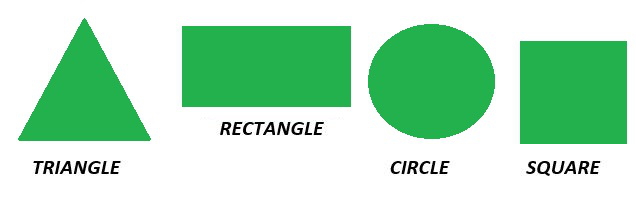
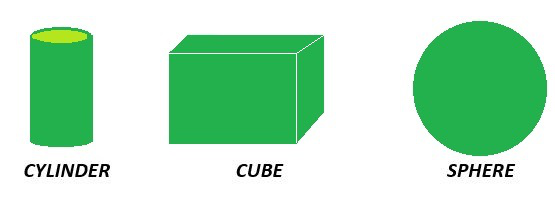
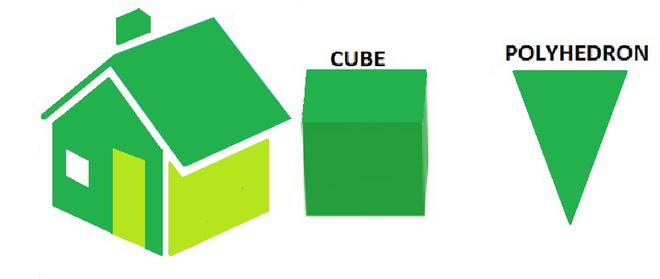
Visualizing Solid Shapes: Any plane or any shape has two measurements length and width, which is why it is called a two-dimensional(2D) object. Circles, squares, triangles, rectangles, trapeziums, etc. are 2-D shapes. If an object has length, width, and breadth then it is a three-dimensional object(3D). cube, pyramids, spheres, cylinders, and cuboids are 3-D shapes.
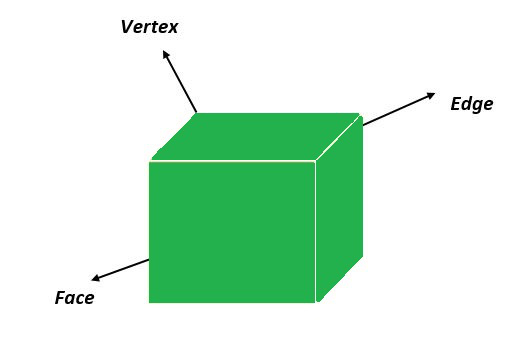
Any kind of solid shape occupies some space. A solid shape or figure is bounded by one or more surfaces. If any two faces of 3-D shapes meet together, we get a line segment which is called an edge when more than two faces of the solid meet at one point then that point is called the vertex of the solid.
In this article, we will study about visualizing solid shapes like cylinders, cubes, spheres, cones, etc, and their properties.
Solid shapes, also known as 3D shapes or three-dimensional shapes, are geometric objects that exist in three dimensions: length, width, and height. Unlike 2D shapes, which are flat and have only length and width, solid shapes have depth, making them occupy space. Examples of Solid Shapes include CUbe, Cuboid, Cone, Cylinder, etc.
Faces, Edges, and Vertices of Solid Shapes
Face
A face refers to any single flat surface of a solid object. Solid shapes can have more than one face. The polygonal regions which a solid is made of are called faces.
Edges
An edge is a line segment on the boundary joining one vertex (corner point) to another. They serve as the junction of two faces. The faces meet at edges which are lines.
Vertices
A point where two or more lines meet is called a vertex. It is a corner. The point of intersection of edges denotes the vertices. These edges meet at vertices which are points
Now, if we talk about three-dimensional shapes then they have different numbers of faces, vertices, and edges. All that flat surface of shape is called a face. This flat shape is two-dimensional. The line segment where the faces of three-dimensional shapes meet each other is called the edge of the figure. The points or the corners where edges meet each other are called vertices.
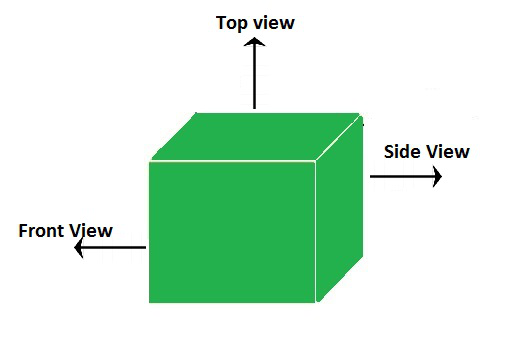
This is the side view (left and right) of the cube which also a square.
Note: A Cube will always look like a square whether its front view, side view or top view.
Cylinder
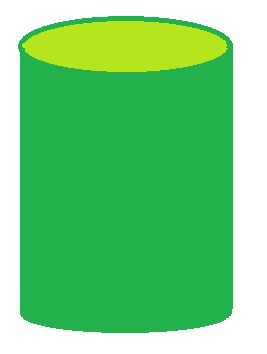
A cylinder is a three-dimensional solid that contains two parallel bases connected by a curved surface. The bases are usually circular in shape. The perpendicular distance between the bases is denoted as the height “h” of the cylinder and “r” is the radius of the cylinder.
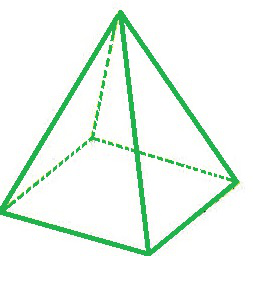
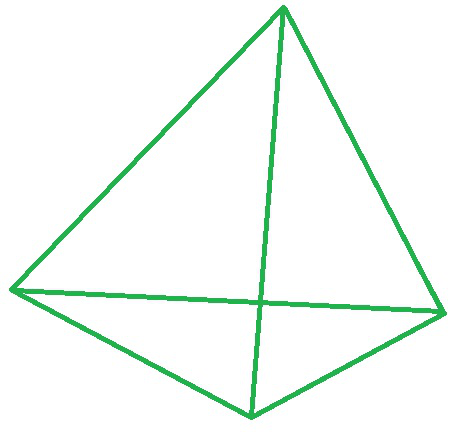
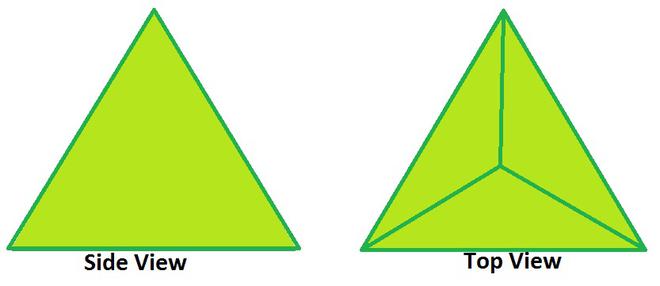
A pyramid is a 3-dimensional geometric shape formed by connecting all the corners of a polygon to a central apex.
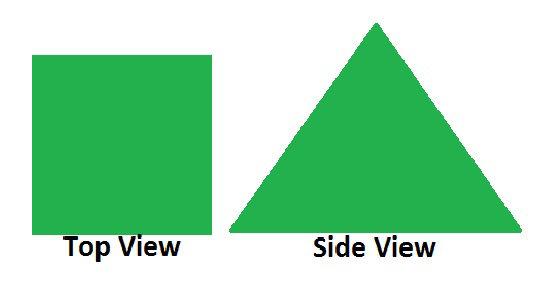
There are many types of pyramids. Most often, they are named after the type of base they have. Following is a square pyramid because of its base as a square.
All faces are congruent squares <br> - All edges are equal in length <br> - All angles are right angles
Cuboid (Rectangular Prism)
Six faces, each a rectangle
Opposite faces are congruent and parallel <br> - All angles are right angles <br> - Length, width, and height may be different
Sphere
Perfectly round shape with all points equidistant from the center
No edges or vertices <br> - Surface area = 4πr^2 <br> - Volume = (4/3)πr^3, where r is the radius
Cylinder
Circular bases connected by a curved surface
Two circular faces <br> - Height perpendicular to the bases <br> - Volume = πr^2h, where r is the radius and h is the height <br> - Surface area = 2πr^2 + 2πrh
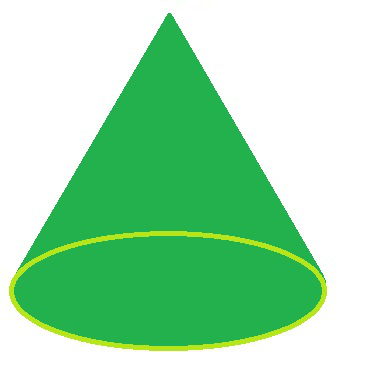
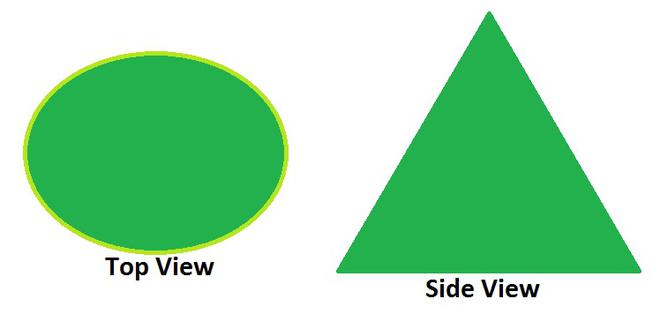
Cone
Circular base tapering to a single point (apex)
One circular base <br> - Curved surface (lateral surface) <br> - Height perpendicular to the base <br> - Volume = (1/3)πr^2h, where r is the radius and h is the height <br> - Slant height (l) can be found using Pythagoras' theorem: l = √(r^2 + h^2)
Pyramid
Polygonal base with triangular faces meeting at a common vertex
Base can be any polygon (square, rectangle, triangle, etc.) <br> - Height perpendicular to the base <br> - Volume = (1/3) × base area × height <br> - Lateral area (surface area excluding the base) depends on the shape of the base
Visualizing Solid Shapes - Sample Problems
Question 1: How many vertices are there in asphere?
Answer:
Sphere has no vertices in there because it has round shape.
Question 2: Is a cone polyhedron? Give explanation.
Answer:
Cone is not a polyhedron because it has round shape. Polyhedron is a 3D shape made by joining many polygons together. Polyhedron comes from Greek, poly means many and hadron means surfaces for example prism, cube, pyramid etc. are polyhedron 3D shapes.
Question 3: What is a triangular pyramid? What is a pyramid called if it has a square base?
Answer:
If a triangle has triangle shape of bottom then it is a triangle pyramid if a triangle has square shape of bottom then it will be called as a square pyramid its depend on bottom of pyramid.