|
VOOZH | about |
|
VOOZH | about |
Subtracting two numbers is a basic operation of arithmetic and finding the difference between any two numbers (positive integers) is very easy, we need to find the difference between the given two numbers and put the sign accordingly.
In this article, we have covered the basics of subtracting positive numbers along with examples and others in detail. before moving to positive numbers we first have to learn the definition of Positive Numbers.
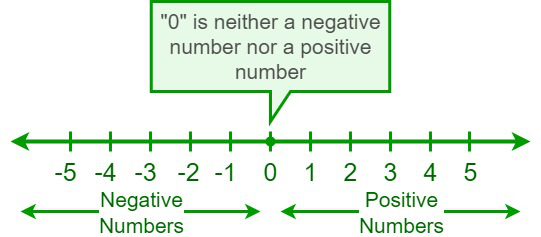
Positive numbers are numbers preceded by the (+) symbol or can be simply a number always greater than zero. Positive numbers are displayed on the right side of the zero on a number line. 2, 15, 23.86, 17/19, etc. are some examples of positive numbers, i.e., positive numbers may be integers, decimals, or fractions.
Specific guidelines must be followed when we perform arithmetic operations like
A positive number is subtracted from another by changing its sign, which is followed by adding the sign-changed number to the first number. However, the final output may be a positive or negative number and the magnitude of the result will be less than both operands if none of the operands is zero.
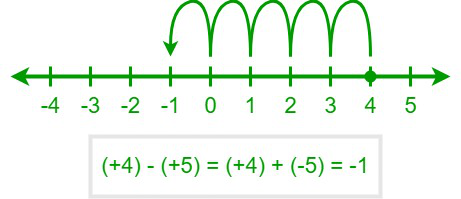
The final output will be a negative number if the magnitude of the second operand is greater than the first operand. For example, (+4) – (+5) will be equal to (+4) + (-5). We know that, on a number line, we shift to the left to add a negative number.
So, as "–5" is added to (+4), we shift 5 units to the left, starting from (+4). Hence, the answer is "–1."
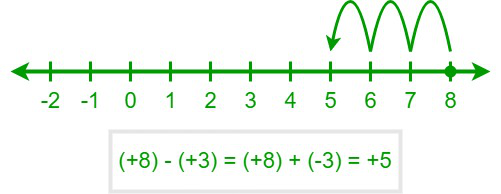
The final output will be a positive number if the magnitude of the second operand is less than the first operand. For example, +8 – (+3) will be equal to (+8) + (–3). We know that, on a number line, we shift to the left to add a negative number. So, as "–3" is added to (+8), we shift 3 units to the left, starting from (+8). Hence, the answer is "+5."
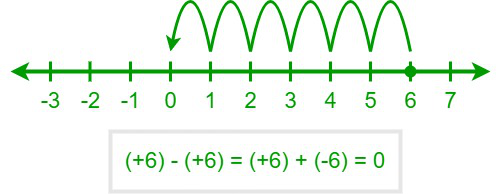
The final output will be zero if the magnitude of the second operand is equal to the first operand. For example, (+6) – (+6) will be equal to (+6) + (–6). We know that, on a number line, we shift to the left to add a negative number. So, as "–6" is added to (+6), we shift 6 units to the left, starting from (+6). Hence, the answer is "0."
Problem 1: Determine the solution for: (3 × 4) – (2 × 5) – (1 × 8).
Solution:
Given,
(3 × 4) – (2 × 5) – (1 × 8)
By solving the bracket at first, we get
= (12) – (10) – (8)
Now, open the brackets.
= 12 – 10 – 8
Now, add the positive and negative integers separately.
= 12 – 18
= -6
Therefore, (3 × 4) – (2 × 5) – (1 × 8) = -6
Problem 2: Subtract 6a2 + 8b2 + 20ab from (3a + 5b)2.
Solution:
Given,
(3a – 5b)2 - (6a2 + 8b2 + 20ab)
= (9a2 + 25b2+ 30ab) - (6a2 + 8b2 + 20ab) {Since, (a + b)2 = a2 + b2 + 2ab}
Now, open the brackets,
= 9a2 + 25b2 + 30ab - 6a2 - 8b2 - 20ab
Now, add or subtract like terms.
= 9a2 - 6a2 + 25b2 - 8b2 + 30ab - 20ab
= 3a2 + 17b2 + 10ab
Hence, (3a + 5b)2 - (6a2 + 8b2 + 20ab) = 3a2 + 17b2 + 10ab
Problem 3: Evaluate: 68 – 35 – 10 – 43 + 14.
Solution:
Given,
68 – 35 – 10 – 43 + 14
Add the positive and negative integers separately
= 68 + 14 - 35 - 10 - 43
= 82 - 88
= (+82) + (-88) = -6
Hence, [68 – 35 – 10 – 43 + 14] = -6
Problem 4: Subtract the given positive integers,
Solution:
- Subtract 10 from 5 = (+5) – (+10)
From the rule of subtracting negative numbers, we know that, when a positive number is subtracted from another by changing its sign, which is followed by adding the sign-changed number to the first number.
Hence, (+5) – (+10) = (+5) + (–10) = –5
- Subtract 17 from 29 = (+29) – (+17)
= (+29) + (–17) = +12
- Subtract 56 from 87 = (+87) – (+56)
= (+87) + (–56) = +31
Problem 5: Subtract (5x + 2y)2 from (7x + 6y)2.
Solution:
Given,
(7x + 6y)2 - (5x + 2y)2
= (49x2 + 36y2 + 84xy) - (25x2 + 4y2 + 20xy) {Since, (a + b)2 = a2 + b2 + 2ab}
Now, open the brackets,
= 49x2 + 36y2 + 84xy- 25x2 - 4y2 - 20xy
Now, add or subtract like terms,
= 49x2 - 25x2 + 36y2 - 4y2 +84xy - 20xy
= 24x2 + 32y2 + 64xy
Hence, (7x + 6y)2 - (5x + 2y)2 = 24x2 + 32y2 + 64xy
Problem 6: Determine the solution for: (48 ÷ 3) – (6 × 7) – (12 × 5).
Solution:
Given,
(48 ÷ 3) – (6 × 7) – (12 × 5)
By solving the bracket at first, we get
= (16) – (42) – (60)
Now, open the brackets.
= 16 - 42 - 60
Now, add the positive and negative integers separately.
= 16 - 102
= -86
Therefore, (48 ÷ 3) – (6 × 7) – (12 × 5) = -86.