|
VOOZH | about |
|
VOOZH | about |
A complex number is defined as the addition of a real number and an imaginary number. It is represented as "z" and is written in its standard form as (a + ib), where a and b are real numbers and i is an imaginary unit whose value is √(-1). The real part of the complex number is represented as Re (z), and its imaginary part is represented as Im(z). Some examples of complex numbers are 1 + √2i, 6–4i, 5 + 7i, etc. The imaginary unit is called "iota," which is either represented as "i" or "j". Complex numbers aid in calculating the square root of negative numbers. In addition to this, complex numbers also play a major role in signal processing, fluid dynamics, AC circuit analysis, electromagnetics, quantum mechanics, etc.
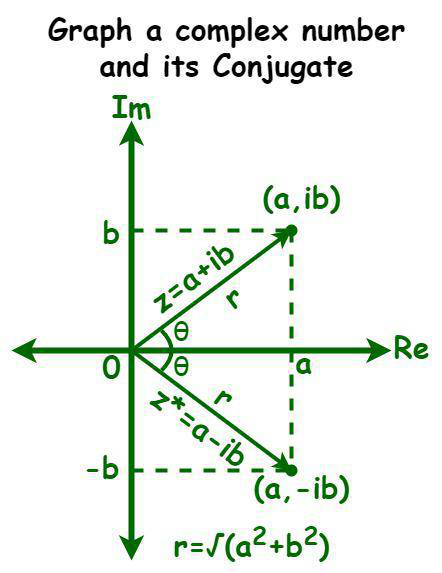
The conjugate of a complex number is also a complex number obtained by changing the sign between the real and imaginary parts of the original complex number. The magnitude of a complex number and its conjugate is the same. The conjugate of a complex number z is denoted by z̅ or z*. If z = a + ib is a complex number, where a is the real part and ib is the imaginary part, then its conjugate is z* or z̅ = a – ib. In an argand plane, the complex conjugate (a – ib) is the mirror image of the complex number (a + ib) about the real axis.
Re(z̅) = Re(z)
Im(z̅) = −Im(z)
z + z̅ = (a + ib) + (a − ib) = 2a = 2Re(z)
z − z̅ = (a + ib) − (a − ib) = 2ib = 2Im(z)
z × z̅ = (a + ib)×(a − ib)= a2+b2
A complex number z = a + ib can be represented as a point on the Euclidean plane coordinates as (Re(z), Im(z)). The Euclidean plane that represents complex numbers as points where X and Y axes represent the real and imaginary parts of a complex number is called an argand plane or a complex plane. From the below graph, we can observe that the conjugate of a complex number is the reflection of a complex number about the real axis (X-axis).
Argz (θ) = tan−1(b/a)
The arithmetic operations like addition, subtraction, multiplication, and division can be performed on complex numbers just as we can do on natural numbers. Make a note that, while performing arithmetic operations on complex numbers, we have to combine the like terms, i.e., the real parts are combined separately and the imaginary parts are combined separately. Let z1 = a + ib and z2 = c + id be two complex numbers. Now, the arithmetic rules of complex numbers are as follows:
If two complex numbers z1 and z2 are added, then the real parts of z1 and z2 are added separately and the imaginary parts of z1 and z2 are added separately.
z1 + z2 = (a + ib) + (c + id) = (a + c) + i(b + d)
If a complex number z1 is subtracted from z2, then the real part of z1 is subtracted from z2, and the imaginary part of z1 is subtracted from z2.
z2 – z1 = (c + id) – (a + ib) = (c – a) + i(d – b)
The process of multiplying two complex numbers is identical to multiplying two binomials. i2 = -1 formula is used while performing the multiplication of two complex numbers.
z1 × z2= (a + ib) × (c + id) = (ac – bd) + i(ad + bc)
If a complex number z1 is divided by z2, then the result is equal to the product of z1 and the reciprocal of z2.
The reciprocal formula of a complex z = a + ib is z−1=1/(a + ib) =(a − ib)/(a2+b2)
z1/z2 = (a + ib) × 1/(c + id) = (a + ib) × (c – id)/(c2 + d2)
Answer:
is the complex conjugate of a complex number z = a + ib. The conjugate of a complex number is also a complex number obtained by changing the sign between the real and imaginary parts of the original complex number.
If z = a + ib is a complex number, where a is the real part and ib is the imaginary part, then its conjugate is
z* or z̅ = a – bi
Here, (a + ib) and (a – ib) are conjugates of each other, i.e., (a + ib) is the complex conjugate of (a – ib) and vice-versa. The magnitude of the conjugate (a + ib) is the same as the (a – ib). The sum and product of a complex number and its conjugate are real.
Example 1: Simplify: (3+4i)/(1–5i).
Solution:
Given: (3+4i)/(1–5i)
To rationalize the denominator, multiply both numerator and denominator with the conjugate of (1–5i), i.e., (1+5i).
(3+4i)/(1–5i) × (1+5i)/(1+5i)
(1–5i(1+5i) = 12 – (5i)2
= 1 –(–25) {Since, i2 = –1}
= 1+25 = 26
(3+4i)/(1–5i) × (1+5i)/(1+5i)= [(3+4i)(1+5i)]/26
= (3+15i+4i+20i2)/26
= (3+19i–20)/26
= (19i–17)/26
Hence, (3+4i)/(1–5i) = (19i–17)/26.
Example 2: If z = 5 – 7i and w = 4 + i, then express the complex number z/w in the form of a + ib, where a and b are real numbers.
Solution:
Given: z = 5 – 7i and w = 4 + i
Now, z/w = (5 – 7i)/(4 + i)
To rationalize the denominator, multiply both numerator and denominator with the conjugate of (4 + i), i.e., (4 – i).
(5 – 7i)/(4 + i) × (4 – i)/(4 – i)
(4 + i) × (4 – i) = 42 – i2
= 16 – (–1) {Since, i2 = –1}
= 16 + 1 = 17
Now, (5 – 7i)/(4 + i) × (4 – i)/(4 – i)
= [(5 – 7i)(4 – i))]/17
= (20 – 5i – 28i + 7i2)/17
= (20 – 33i + 7(–1))/17
z/w = (13 – 33i)/17
Hence, z/w = (13 – 33i)/17.
Example 3: Simplify:
a) (4 – 9i)(6 + 3i)
b) (5 + 11i) – (12 – 13i)
Solution:
a)(4 – 9i)(6 + 3i)
= 4(6 + 3i) – 9i(6 + 3i)
= 24 + 12i – 54i – 27i2
= 24 – 42i – 27(–1) {Since, i2 = –1}
= 24 – 42i + 27 = 51 – 42i
Therefore, (4 – 9i)(6 + 3i) = 51 – 42i.
b) (5 + 11i) – (12 – 13i)
= 5 + 11i – 12 + 13i
= (5 – 12) + (11i + 13i)
= 24i – 7
Therefore, (5 + 11i) – (12 – 13i) = (24i – 7).
Example 4: Find the values of a and b if (7 + 3i)/(2 – 3i) = a + ib, where a and b are real numbers.
Solution:
Given: (7 + 3i)/(2 – 3i) = a + ib, a, b ∈ R
To rationalize the denominator, multiply both numerator and denominator with the conjugate of (2 – 3i), i.e., (2 + 3i).
(7 + 3i)/(2 – 3i) × (2 + 3i)/(2 + 3i)
(2 – 3i) × (2 + 3i) = 22 – (3i)2
= 4 – 9i2 = 4 – 9(–1) {Since, i2 = –1}
= 4 + 9 = 13
Now, (7 + 3i)/(2 – 3i) × (2 + 3i)/(2 + 3i) = [(7 + 3i)(2 + 3i)]/13
= (14 + 21i + 6i + 9i2)/13
= (14 + 27i + 9(–1))/13
= (5 + 27i)/13
(7 + 3i)/(2 – 3i) = (5/13) + (27/13)i
a + ib = (5/13) + (27/13)i
So, a = 5/13 and b = 27/13.
Thus the values of a and b are 5/13 and 27/13.
Example 5: Find the sum, difference, and product of the complex numbers z1 = 8 – 5i and z2 = 1 – 3i as a complex number.
Solution:
Given: z1 = 8 – 5i
z2 = 1 – 3i
Sum:
z1 + z2 = 8 – 5i + 1 – 3i
= (8 + 1) + (–5i – 3i)
z1 + z2 = 9 – 8i
Difference:
z1 – z2 = (8 – 5i) – (1 – 3i)
= 8 – 5i – 1 + 3i
= (8 – 1) + (–5i + 3i)
z1 – z2 = 7 – 2i
Product:
z1 × z2 = (8 – 5i) × (1 – 3i)
= 8(1 – 3i) – 5i(1 – 3i)
= 8 – 24i – 5i + 15i2
= 8 – 29i + 15(–1) {Since, i2 = –1}
= 8 – 15 – 29i = –(7 + 29i)
z1 × z2 = –(7 + 29i).