VOOZH about

URL: https://www.geeksforgeeks.org/maths/why-is-the-absolute-value-function-not-differentiable-at-x-0/

⇱ Why is the absolute value function not differentiable at x=0? - GeeksforGeeks


  • Courses
  • Tutorials
  • Interview Prep

Why is the absolute value function not differentiable at x=0?

Last Updated : 23 Jul, 2025

The absolute value function is not differentiable at x = 0 because the function has a sharp corner at that point, resulting in a discontinuity in the slope of the tangent lines.

Let's discuss this in detail.

What Does Differentiable Mean?

In mathematics, a function is said to be differentiable at a point if it has a defined derivative at that point. The derivative represents the rate at which the function’s value changes as its input changes. Graphically, the derivative at a point is the slope of the tangent line to the function’s graph at that point.

What is Absolute Value Function?

The absolute value function, denoted as ∣x∣|x|∣x∣, returns the non-negative value of a number. It is defined as:

This function represents the distance of a number from zero on the number line, ignoring direction.

Graph of the Absolute Value Function

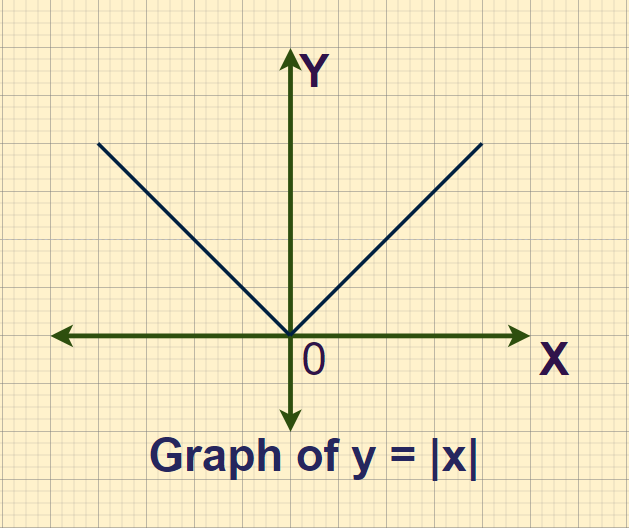
The graph of the absolute value function |x| forms a V-shape, which meets at the point (0,0). To the left of zero, the graph slopes downward, and to the right, it slopes upward. This change in direction is key to understanding the lack of differentiability at zero.

👁 Lightbox

Differentiability of Absolute Value Function at x=0

  • Slope on the Left of Zero: As you approach zero from the left side (negative x-values), the function . The slope of this function, which is the derivative, is consistently -1. This is because the graph is a straight line sloping downwards as it approaches zero from the left.
  • Slope on the Right of Zero: Approaching zero from the right side (positive x-values), the function ( |x| = x ). Here, the slope (derivative) is 1, as the graph is a straight line sloping upwards towards zero.
  • Slope at x=0: At x = 0 , there is a sharp turn in the graph. On the left, the slope is -1, and on the right, it is 1. At the point ( x = 0 ) itself, the slope does not have a single, well-defined value. Instead, what we observe is a sudden jump from -1 to 1, without any smooth transition. This sharp point, or cusp, means there’s no single tangent line that can touch the graph only at ( x = 0 ). Without a well-defined tangent line, we cannot have a derivative.

Conclusion

In simpler terms, the absolute value function is not differentiable at zero because it has a sharp point there. The function’s slope changes abruptly, which means there is no single rate of change at that point. Understanding this helps in grasping more complex concepts in calculus, where the behavior of functions at specific points plays a crucial role in analysis and problem-solving.

Read More,

Comment

Explore