|
VOOZH | about |
|
VOOZH | about |
Nominal data is a type of categorical data used to label or classify items into different groups without any order or ranking. The categories are distinct, mutually exclusive, and represent qualities or names rather than numerical values. Since there is no meaningful order among the categories, arithmetic operations cannot be performed on nominal data.
The following characteristics help in understanding the nature and properties of nominal data.
Nominal data is collected by classifying information into different categories or labels. Some common methods used to collect nominal data are given below:
Some common techniques for visualisation for nominal data are:
Frequency tables list the categories along with their corresponding frequencies or counts. They provide a simple and organised way to summarise nominal data.
For example, suppose a questionnaire asks 100 people about their favourite fruit from the categories “Apple,” “Banana,” “Orange,” “Strawberry,” and “Grapes.” The frequency table for this data is shown below:
| Fruit | Number of People |
|---|---|
| Apple | 25 |
| Banana | 30 |
| Orange | 15 |
| Strawberry | 10 |
| Grapes | 20 |
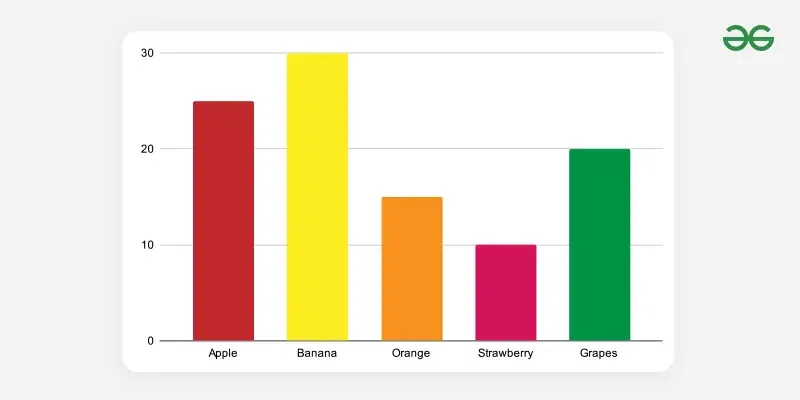
Bar charts are one of the most straightforward ways to visualise nominal data. Each category is represented by a bar, and the length or height of the bar corresponds to the frequency or count of that category. This method allows for easy comparison between categories.
Bar Chart for the above-mentioned data is as follows:
Pie charts display data in a circular format, where each slice represents a category's proportion relative to the whole dataset. This visualisation is useful for showing the parts of a whole.
For the data discussed above,w e can represent the same data as
| Fruit | Number of People | Calculation | Percentage |
|---|---|---|---|
| Apple | 25 | (25/100)×100 | 25% |
| Banana | 30 | (30/100)×100 | 30% |
| Orange | 15 | (15/100)×100 | 15% |
| Strawberry | 10 | (10/100)×100 | 10% |
| Grapes | 20 | (20/100)×100 | 20%The pie |
The chart for this data is:
Related Articles