Render Props is a React pattern that allows components to share logic by passing a function as a prop. The receiving component calls this function to render content dynamically, enabling code reuse while keeping the UI flexible.
MouseTracker maintains the mouse position in its state.
Passing the mouse position as an argument, it calls the render function prop
App component provides the function that renders the mouse position.
Why Use Render Props?
Render Props provides several advantages, including:
Code Reusability: Instead of duplicating logic across components, you can encapsulate it in one place and use a render function to dictate how the UI looks.
Separation of Concerns: It separates business logic from UI components, making the codebase cleaner and more maintainable.
Greater Flexibility: Unlike Higher-Order Components (HOCs), Render Props allow you to customize the way components are rendered dynamically.
Note: While Render Props was a popular pattern in React for sharing reusable logic, it is now less common in modern React development. In many cases, Custom Hooks have replaced Render Props due to their simplicity and improved readability.
Passing Functions as Props
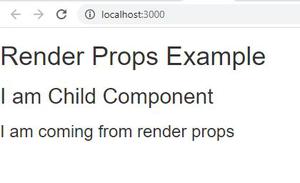
This example demonstrates the render props pattern in React where a function is passed to child component. The child component uses the render prop and display additional content.
Parent controls what gets rendered inside the child dynamically.
It enables flexible and reusable UI rendering.
Use Cases for Render Props
Mouse Tracking: Dynamically manages the mouse cooridnates.
Form Handling: Efficiently manages the form state.
Authentication: Based on Authentication State, they render UI.
Data Fetching : For fetching the API, they reuse the logic.
Animation Control: Dynamically manages the animations.
Render Props vs. Higher-Order Components (HOCs) vs. Custom Hooks
Both Render Props and HOCs aim to share reusable logic among components, but they do so differently. With Hooks, React now offers an even better alternative.
Render Props
Higher-Order Components (HOC)
Custom Hooks
Passes a function as a prop
Wraps a component and injects props
Uses a function that manages state and logic
Can lead to function nesting
Can lead to wrapper hell
Clear and concise
May cause re-renders if function is created inline