|
VOOZH | about |
|
VOOZH | about |
Agile and Waterfall are two widely used approaches in software development. While Agile focuses on flexibility and iterative delivery, Waterfall follows a structured and sequential process.
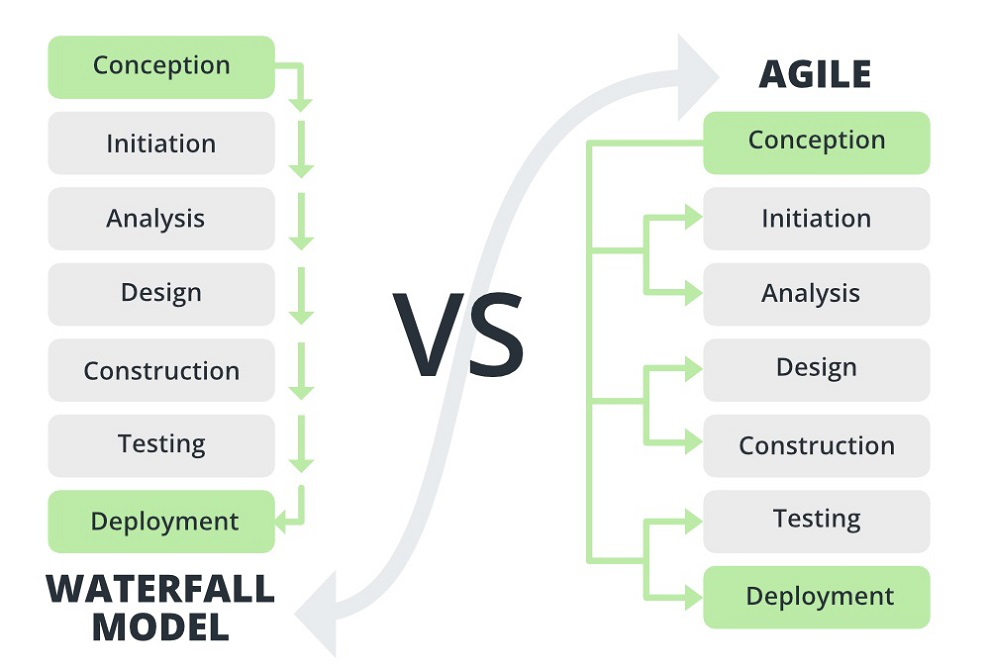
Agile is an iterative and flexible approach where development is done in small increments with continuous feedback and improvement.
Waterfall is a linear and sequential approach where each phase is completed before moving to the next.
This diagram visually represents how Agile and Waterfall differ in their execution flow and development process.
Example: Agile repeats development cycles for each feature, while Waterfall completes all phases once for the entire product.
The following table highlights the key differences between Agile and Waterfall methodologies
| Agile Project Management | Waterfall Project Management |
|---|---|
| Client involvement is continuous throughout the development process | Client involvement is limited, mainly during requirement gathering and final delivery |
| Changes can be easily incorporated at any stage of development | Changes are difficult and costly once a phase is completed |
| Follows an iterative and incremental approach | Follows a sequential and linear approach |
| Suitable for complex and evolving projects | Suitable for simple and well-defined projects |
| Testing is performed continuously along with development | Testing starts after the development phase is completed |
| Delivers software in small, usable increments | Delivers the complete product at the end |
| Planning is flexible and adaptive | Planning is fixed and predefined |
| High collaboration among cross-functional teams | Collaboration exists but is mostly phase-based |
| Risks are identified and resolved early | Risks are often identified at later stages |
| Faster delivery of working features | Slower delivery due to sequential execution |